Christmas Came Early

A joint post by Derek Logan and Andrea Fanjoy

Over the last few nights, both KCS and St. George’s on-the-Hill Nursery School held their Annual General Meetings. Voting on the amalgamation of the two schools was held, and we are excited to announce that the amalgamation has been wholly supported by the parent communities of both schools. As a result, the next few months will be full of new opportunities as we come together and go about the business of aligning our programs.

Those of you who know KCS know that there is something special about this place. To work here is to experience the proverbial 1 + 1 = 3. We all love what we do. We gratefully learn from and collaborate with each other, day in and day out. We’re frank about the challenges we face. And we’re determined to do our absolute best, pushing our boundaries so our best keeps getting better.

With the amalgamation of St. Georges and KCS, we will all have new colleagues. Faculty and staff from both schools are keen to meet, learn from each other and collaborate. Each of us bring experience and perspective that the other may not have, and that will make our best better.

GiftAs we head into the holidays, as adults, we can reflect how Christmas has changed for us since we were children. We now tend to experience the joys of the season through the eyes of little ones while we reflect on the year past and the year to come. However, the excitement of new experiences and the things we appreciate hasn’t changed – the appreciation of a meaningful gift hasn’t changed either. In the staff room the other day, chatting with our new colleagues from St. Georges Nursery School, it became apparent that Christmas had come early for us grown-ups as we received the gift of new opportunity.

We look forward to a big new year. And we look forward to all the time we’ll spend getting better, together.

Derek Logan
Head of School

Andrea Fanjoy,
Assistant Head, Academics
You can follow Andrea on Twitter @afanjoy.
Testing What Matters in Life

How did you do on your last test?

If you’re not a student you probably can’t remember. Tests are for students, right?

Formal education has a long history of testing. Spelling, math, science, history – no other institution tests more than schools. Obviously.

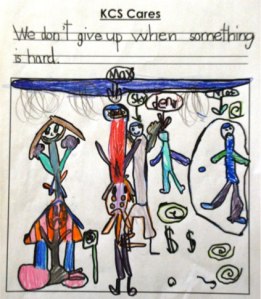
KCS CaresWhat’s not as top of mind, however, are the tests that we face minute-by-minute, wherever we are, whomever we’re with and whatever we’re doing. These are the tests of character that appear in our interactions with others, choices of how to spend our time, how we work, how we play, and how we respond to the challenges thrown our way. And if you’re following what most experts are saying, it is character, and specifically traits such as initiative, curiosity, grit, creativity, and adaptability, that will best determine our success in life.

Educators and parents alike spend a lot of time thinking about tests, whether designing, marking or preparing children to do their best with them. Tests help us monitor growth in students and effectiveness of teaching. They have value. But most of these tests don’t measure what matters most. They aren’t designed to.

So, what would a test of character look like? Simple. Watch what others do, of their own volition, and particularly when out of the gaze and direction of authority figures. Minute-by-minute.

And if you want to help prepare students to do well on these tests? Provide a school experience that not only teaches character but also includes the encouragement, time and support needed so students can practice the skills and traits that matter, and do so for their own purposes. Students of character need freedom to initiate, create, persist at solving real problems, make a difference and more, not for marks and not because they’re told to. They need a school that believes in the infinite potential of children, if we let it take shape, and a school which recognises that this means doing a number of things differently.

Educators, watch what your students do with free time. That’s testing what matters. And give them a school experience that lets them develop the traits and skills that matter most. That’s preparing them to ace the test. You won’t be disappointed.

Andrea Fanjoy,
Assistant Head, Academics
You can follow Andrea on Twitter @afanjoy.

This article was first published in SNAP Etobicoke, December 2012.

Our People + Effort = Successful Change

Last week we announced our proposed amalgamation with St. George’s on-the-Hill Nursery School (SGNS).  The faculty and staff of both schools reacted to the announcement with a positive mixture of excitement and anticipation as we tackle our future together.  Both organizations understand the benefits of amalgamation.  I really didn’t expect anything less.  And here’s why.

I joined KCS back in September 1999 as the grade 8 homeform teacher.  At that time I taught history, Language Arts and geography to our grade 7 and 8 students.  In 1999, KCS had one class in each grade, and we had approximately 150 students in the school.  Our  staff was about 25 people, a number of whom still teach at KCS today.  Halfway through my first year, I was happy with my decision to join the KCS team.  Even then, I knew this was a great school.

Over the past fourteen years, KCS has grown to 317 students and 46 faculty and staff.  The school has faced many opportunities and challenges along the way – some planned for, others unanticipated.  We’ve opened two additions to the school, one in March 2003, and one in December 2009.  Those of you who have lived through a renovation know the inconveniences you have to live with during construction. We have managed our school through an economic recession and a flood in February 2010 that closed six of our classrooms for an extended period of time.  Through each opportunity or challenge, I’ve watched the people at KCS listen, ask questions and propose solutions, and then get to work to make sure KCS comes out the other side a better school.  And importantly because of that can-do, positive attitude, we’ve created many memories and had many laughs along the way.  I know that the people at SGNS have had to face similar opportunities and challenges over that same time period that they have successfully dealt with.

Change either succeeds or fails due to the efforts of the people involved.  Based on past experience at KCS, I am confident that the people at SGNS and KCS will all grow and learn together as we amalgamate the two schools at this exciting time.  We have responded successfully to opportunities in the past, and I feel the future will be no different.  In fact, with such a positive outlook with the faculty and staff of both schools, I am certain we will be better together.   We are excited for the outcome of the vote at both upcoming AGMs, which will put a stamp of approval on this project and enable us to move forward.

Derek Logan
Head of School

Type, Click, …Swipe

typewriterThis past weekend, I took my kids to a museum in St. Jacobs, Ontario. They were fascinated by the antiques called typewriters – especially when the metal bar for each letter lifted to strike the inserted paper. Wow!

It is incredible how far along technology has progressed. Typewriters will always fascinate our children but there still was a learning curve with its use. The arrival of computers grabbed the world’s attention but there still is a learning curve with ‘mouse’ control. In the past few years, the arrival of personal, mobile touchscreen devices (iPads, Playbook, smartphones, etc.) garnered the widest audience.

Just last week, I attended the ECOO Conference (Educational Computing Organization of Ontario) where hundreds of teachers from across Ontario convened to share ideas and experiences. During the many sessions over two days, there was a sea of tablets (iPad, Galaxy Tab2, etc.) being utilized to take notes, participate using the Twitter backchannel or download the presenter’s files. Educators of all ages were actively engaged with these touchscreen computers.

What is the learning curve with these mobile devices? Just ask a toddler. Children as young as 2 or 3 years easily manipulate these touchscreens as there are no longer ‘big keys’ to press down, no ‘mouse’ to control – just a screen where you can tap, swipe and even pinch.

How easy is that?

Stacy Marcynuk
Director of IT, Curriculum
Kingsway College School

How Technology Increases the Personal Touch in School

The notion shared in the title may not be obvious. Because the personal touch matters, it’s worth understanding and, for the benefit of students, acting upon.

Of course, technology isn’t a person. It won’t ever replace the power of a teacher who knows and cares for his or her students. It won’t bring the creativity and professional judgment the teacher applies daily in his or her class. So how could technology possibly increase the personal touch?

First, let’s take a hard look at the familiar. The traditional “sage-on-the-stage” approach to teaching unfolds at the pace decided by the teacher. It covers content decided by the teacher, and is delivered in a manner decided by the teacher. While appropriate at times, this approach is imperfect and, for many students, impersonal. These students require a different pace, be it faster or slower. They respond better to a different level of content, whether more simplified or complex, or would understand concepts better with different choices of content.

Technology personalizes school because it brings flexibility in pace, level and content like a teacher alone cannot. Here are some examples:

  • Instead of completing the same math fact sheet, students can use websites like www.thatquiz.org to practise the math facts they need to practise, at the right pace and level of challenge for them. Similar tools exist for all basic skill development.
  • Instead of learning through the lens of textbooks, students can use technology to roam the world for relevant content. Under teacher supervision, students can create their own multi-media “texts”, in the form of wikis, that they and their classmates can study from with pride.
  • Instead of sitting through a lesson that many students may not need (because they already know it) or not follow (because they’re lost), teachers are leveraging technology to personalise instruction. Technology can deliver introductory instruction at a pace controlled by each student (you can pause, rewind, rewatch at will). Students who need different levels of instruction can get that too. Watching instructional videos the night before class makes the in-class lesson more effective and efficient, and leaves more class time for real teacher-student interaction.

The personal touch matters and having a great teacher matters. Technology can help make the most of both.

Andrea Fanjoy,
Assistant Head, Academics
You can follow Andrea on Twitter @afanjoy.

This article was first published in SNAP Etobicoke, November 2012.


School and Other Things that Scare Us

Some lessons need to come from afar to be noticed.

Maasai Warriors visit KCSTwo special guests visited KCS last Friday. Jackson and Wilson, young Maasai warriors from Kenya, came as ambassadors for Free the Children. Draped in their traditional regalia, they told stories of growing up in their mid-African country, fleeing drought, herding cattle and collecting beaded bracelets from their “mammas” when they did good deeds, bracelets which they still wear with pride today.

Mindful of the young audience, they only shared one scary story. It was the story of how schools came to the Maasai. This was a terrifying development for parents, and their terror was passed down to their children. Moms and Dads told their offspring to never go near “school”, as it was a place that took children away from their parents and stole from them their culture and traditions. If policemen tried to force them to go, children were told to run.

Sure enough, the policemen came and children ran. In Wilson’s case, a police officer caught up and threw the young boy over his shoulder. He offered Wilson a candy and explained that school was just as sweet. The officer carried Wilson back to his parents, and, according to Wilson’s recollection, school was similarly explained to them. Wilson and Jackson not only ended up going to school but also became the first in their community to earn university degrees.

In my experience, the value of what is learned from cross-cultural exchanges is beyond measure.  The novelty in their details makes the universal lesson in the story that much more evident and memorable. One lesson from our Friday visit is that change can be both scary and wise. Though our community of Etobicoke and the entire developed world is long past any fear of schooling, we are not done changing and not beyond being fearful of change, even if it is right and positive. A daily read of the newspaper is full of such stories.

Jackson and Wilson are testaments to what can happen when positive change is embraced. Their experience with schooling, despite the rocky start, is a story of thinking flexibly, questioning, being curious, embracing learning (including that which challenged their assumptions) and ultimately, taking responsible risks.

Great lesson. Thanks, Wilson and Jackson, for coming from Kenya to our little corner of Etobicoke so we can learn from it.

Andrea Fanjoy,
Assistant Head, Academics
You can follow Andrea on Twitter @afanjoy.

Thinking, Doing and Checking Assumptions at the Door

By the time this is published, the four months of construction on our house should be nearly done. The experience has left me with more than just an addition.

Shop Class as SoulcraftBrowsing for a good summer read, I stumbled upon Shop Class as Soul Craft by Matthew Crawford. Crawford was a 14-year-old electrician, who moved on to tinkering with car and motorcycle engines, then went to university to earn a PhD in philosophy. Hired to work in a think tank, he assumed he had reached the pinnacle of achievement. He was highly educated, well paid, well dressed and looking forward to the intellectual challenges that would surely ensue.

Assuming the prevailing attitudes of the day, he grew up with the notion that university and the jobs it led to were a higher calling than the trades. University was for people who were good at thinking, while college was for those better at doing. Reverence was reserved for the former.

Not many people have so fully walked down both paths as Crawford. His voice of unique experience reveals that our thinking had more than a fair share of nonsense. First, the notion that all work following university requires supreme thinking he found to be supremely hollow. The many people he met working in the trades spent their days pondering and solving complex problems the likes of which he never found at the think tank.

Equally revealing, Crawford outlines the evolution of both work and attitudes surrounding it. Prior to the onset of the Ford Motor Company and other more efficient models of machine-making, the trades were recognized for what they are – pursuits that offer endless thinking as well as doing, that bring evident value at the end of a day’s labour. The rewards inherent in self-reliance have vanished for many of us today. Of course, university is a training ground for significant work. It simply isn’t the only such training ground.

Smart thinking includes scrutiny of assumptions. Thanks to the scrutiny in Shop Class as Soul Craft, and made real by our home renovation, my summer has included this unexpected bonus of appreciation and humility. Encourage youth to find their calling, and check assumptions at the door.

Andrea Fanjoy,
Assistant Head, Academics
You can follow Andrea on Twitter @afanjoy.

This article was first published in SNAP Etobicoke, October 2012.

Star Habits, Wish Habits

I couldn’t wish for more than what’s happening with our Habits.

We’re starting our third year since the official launch of our Habits of Mind, Body and Action. Anything new needs time to settle, time for all to adjust (or in KCS terms, time to exercise one’s flexible thinking), plus time for glitches to surface and tweaks to be made to make what’s new into a perfect fit.

Lots of such activity took place over the past two years while the Habits were still relatively new. This August, when teachers were asked about how they plan to integrate the Habits in their program for the upcoming year, it was eye-poppingly evident that the adjustment is behind us and we’re now going full speed ahead with our efforts to directly teach the habits that matter most for success in life. Collectively, faculty shared over one hundred ideas they have to teach and leverage the Habits in their classes. Here is a sample:

  • Leader of the Day with a special role to help the class
  • Class mission statements to support growth of the Habits
  • Student-made posters of the Habits
  • Student goal-setting on the Habits
  • Reference to the Habits in school assignments
  • Discussion of the Habits in class meetings and novel studies
  • Students teaching the Habits to other students
  • Students teaching the Habits to their parents and grandparents
  • Connecting the Habits with the study of heroes and leaders

One idea that is particularly out of this world came from grade 4. The students are identifying ‘Star Habits’ and ‘Wish Habits’. A ‘Star Habit’ is a habit they feel they have already established and of which they are proud. A ‘Wish Habit’ is a habit they want to focus on developing in first term. The students looked over all 26 Habits, reflected deeply, made their choices, and explained them in the context of home and school. Star Habit, Wish Habit as their ‘Star’ and ‘Wish’ Habits.

Like the spirit behind our Habits initiative, the students have wishes with a plan. And in the same way that our wishes to teach the Habits are coming true, I’ve no doubt our students’ ‘Wish Habits’ will also come true. What are your ‘Star’ and ‘Wish’ Habits? And what’s your plan to make your wishes come true? If you need some help, feel free to ask one of our grade fours.

Andrea Fanjoy,
Assistant Head, Academics

You can follow Andrea on Twitter @afanjoy.

A recommended read: The Globe and Mail’s ‘Why kids need to fail to succeed in school’

The following article was in The Globe and Mail on August 31.  I have written about this topic on a couple of occasions in the past few years.  I thought the article would be of interest as we begin the 2012/13 school year.

http://www.theglobeandmail.com/life/parenting/back-to-school/why-kids-need-to-fail-to-succeed-in-school/article4513436/

Often in this space I will write about things students say to me that make me smile and remind me why teaching is such a rewarding, memorable and humourous profession.  Yesterday during the grade 1 drop in I met one of the new grade 2 boys who was accompanying his sister and his parents.  He said hi, and then looked up and said, “You have the same sandals as my Dad.”  An interesting first day observation between a student and a principal.

This morning, I came in from recess, and walked into the grade 1B classroom to deliver a couple of birthday cards.  The students were getting ready for their first KCS French lesson.  One of the grade 1 girls looks up at me and says, “You’re cute.”  I’m fairly certain that I have never had that said about me in my twenty years in education.  However, if you know my wife Heather’s email address, please feel free to pass this information on to her.  See you around the school.

Derek Logan
Head of School

Why Do We Have To Go To School?

Do your kids ask this?

Long ago I used to think therein lay the foe that I would slay as an educator. It was asked simply because schools hadn’t yet found a way to make learning enticing enough. While I continue my quest to make it as inviting as possible (you get more bees with honey after all), I have surrendered to the fact that it’s really hard to beat the happiness of holidays. I burst with joy when I hear children say that they miss school when away, but have stopped torturing myself when not all relish it as much.

So, while neither I nor anyone else has made school the quintessential “place to be” for all children, my career-long efforts have at least given me a response to the question of why children have to go to school. At least, this is what I think the response should be.

  • To acquire knowledge needed to understand the world and as fodder for our thinking.
  • To develop skills that allow us to share our understanding and thinking.
  • To learn how to learn (for it must never end).
  • To learn how to get along and work with many others, including people not of our choosing.
  • To learn how to struggle, even fail, and get back up again.
  • To learn that our actions matter in the world, and to proceed with care.
  • To learn who we are by facing challenge and temptation.
  • To acquire abilities and dispositions that matter in life – curiosity, empathy, persistence, adaptability, leadership and more – so we can wisely navigate our own path to happiness.

It may be hard to beat summer holiday, and I’m glad children have it. Without a doubt, children also learn a lot of value over the summer, not to mention all other occasions outside of school. But more learning must be done while young, much more, and that is what schools are for. Or should be.

I have a clear answer for my sons’ question. I’m left, however, asking my own.

Andrea Fanjoy,
Assistant Head, Academics
You can follow Andrea on Twitter @afanjoy.

This article was first published in SNAP Etobicoke, August 2012.