Unknown's avatar

About Derek Logan

Kingsway College School Head of School

90 Days and Counting

It’s been almost three months since my first Blog post went up.  Writing comes with the territory of being a Head of School:   Blog posts, speeches, Open House presentations, misplaced Christmas concert concluding thoughts, etc.  And although over the years it has gotten easier with practice, like all things, it is never simple.  I took a few minutes today to review the eighteen blogs I’ve written since September 22:

  • Becoming a Blogger
  • Things You Can’t Control
  • Summer Reading
  • Auditions and Tryouts
  • Are You Kidding Me?
  • It Has to Start Somewhere
  • Tradition and Memories
  • Being Stuck
  • Survey Says…
  • Report Cards Used to Say What?
  • The Power of the Jelly Bean
  • Remember
  • When Winning Doesn’t Matter
  • Thanking Others
  • Being an Educator is Much More Than A Job
  • Establishing Positive Habits
  • World War II on Twitter
  • Give Your Kids a Chance to Explain

The topics have been wide-ranging, hopefully thought-provoking and/or interesting, while some may just bring a smile.  It’s pleasing to see that we now have approximately 40 people following our Blog.  Thanks for signing up.  My next Blog post won’t be until January.  Until then, I wish you a very Merry Christmas and a safe holiday with your families.

Derek Logan
Head of School
Give Your Kids a Chance to Explain…

This past Wednesday night, I attended my son’s Holiday Concert.  He’s in grade 8, and in September he let Heather and I know that he’d decided to play his bass clarinet in the concert band.  This was a pleasant surprise for us, although I secretly thought, “there goes another two evenings in my calendar.”  Prior to the concert he told me the concert band would open the evening with a couple of pieces, and then all of the grade 8s would conclude the concert singing a song – thus providing no chance to sneak out halfway through!  I’ve heard people do this…

Surprisingly, halfway through the concert, he comes out on stage with his grade 8 class to play The Hanukkah Song.  In the band, he sits at the back beside his friend who is playing percussion.  I’m watching them file in and then I watch Brandon have a conversation with his friend on the drums.  Next thing I know, Brandon is making his way out to the exit.  Since I’ve sat through 18 years of concerts at the schools I’ve worked at, and attended the many concerts my own children have played in, I knew Brandon had forgotten his music.  The band teacher didn’t wait for Brandon to return and he missed playing the piece.

When we got in the car to go home, I looked at him and I asked him if he could play me The Hanukkah Song when we got home.  Without missing a beat he turns to me and says, “It’s a funny thing, Dad.  My friend forgot his music, so I went to get his music for him.  By the time I got back they had already started and I couldn’t get back to my seat in the band.”

Derek Logan
Head of School

World War II on Twitter

On Monday night, when I read The Globe my eye was drawn to an article entitled, “On Twitter, Hitler’s blitzkrieg rages once more.”  Before moving into school administration, I began my teaching career as a history/English teacher and had completed my Masters of Arts degree in War Studies at the University of London.  I’ve always had an interest in military history, so the title of the article definitely got my attention.  The article noted that a recent graduate of Oxford University had started a Twitter feed “RealTimeWWII” this past August.  He now has 150 000+ followers, including me, as of Tuesday morning when I figured out – with some help – how to follow his feed.  Each day he posts approximately 40 tweets, timed as much as possible to the precise hour they happened on this day in 1939.  Amazing.  Insightful.  A couple of tweets that caught my attention:

  • Labour Ministry: saxophone makers are henceforth exempt from conscription; military bands in France report “serious shortage of saxophones” (November 29)
  • Playing football now banned in German schools, due to wear & tear on boys’ shoes & leather shortage (US magazine photo) (November 28)
  • “God bless you Mr. Chamberlain” on UK radio again. Written last year after Munich peace treaty. Seems rather hollow now (November 26)
  • UK: Ponies roaming free in the New Forest are now being painted with stripes of fluorescent paint so motorists can see them in the blackout (November 25)
  • UK: Ministry of Supply now announcing that bacon & butter will be rationed in the new year. Smoked mutton being sold as “replacement bacon” (November 23)

If you’re interested in the Second World War or you know someone who is, let them know about this site.  Social media 2011 meets the World War II.  I wonder how the war might have been different if social media had been around at the time…alternative history.  A great genre of books.

Derek Logan
Head of School

Establishing Positive Habits Before Bad Habits Start

The other day, I was sitting at my son’s soccer training reading his Sports Illustrated magazine (November 14th edition). This was the college basketball preview edition. I’ve never been a big fan of basketball even though I tried to become one when the Raptors came to town a number of years ago. NBA players who go on strike is amusing news to me.

However, while I was thumbing through the magazine, an article caught my eye: “Dewayne Dedmon’s Leap of Faith”. Dewayne was 18 years old when he first picked up a basketball. He wasn’t allowed to play the game for various reasons, but one day in April 2008 he was sitting in the gym at Antelope Valley College in California and he said to the coach, Dieter Horton, that he wanted to play basketball. He was 6’8” so the coach invited him back the following week for a tryout. These requests from young teenage boys had happened often to the coach over the years, but only 1 in 10 kids ever came back for the tryout. Dewayne, however, did show up.

In short, he didn’t know how to do anything on the basketball court. In the words of the author of the piece, Chris Ballard: “In one sense Dedmon was a coach’s nightmare; in another he was a coach’s dream. He had no bad habits to correct, because he had no habits. He was a blank slate.” Is it easier to establish a habit when a person is young or is it easier to break a bad habit and establish a new one in its place? A fundamental question we have asked at KCS over the years. In most cases, the early years of a child’s life is the best possible time to begin to establish and reinforce positive habits. We do it daily here.

Dedmon’s story is certainly unique in many ways. You might want to look for the article and get the whole story. He is now playing at USC and is projected to be a top NBA pick in an upcoming draft – whenever that might be. Dewayne is preparing for that next challenge in his life equipped with a foundation of good habits; just as our soon-to-be grade 8 graduates are preparing for high school.

Derek Logan
Head of School

Being an Educator is Much More than a Job

This week our 7/8 team competed in the annual PSAA touch football tournament in Oakville. Unfortunately for the students, this wasn’t one of those years in which we took home the championship banner. And while I admit, winning is much more enjoyable than losing, as I have written before in this space there is so much more to sports than winning for both the participants and the coaches.

Our team played four games, tying one game, losing a couple of close games, and I won’t try to write about the fourth game. However, at the last game, I’m standing beside one of our players. It’s about five minutes into the game, and he turns to me and says to me, “I don’t know if you’ve had a great time today, but I sure did.” These are the things that happen to me in education that make what I do much more than a job.

Derek Logan
Head of School

Thanking Others

For the past couple of weeks, I have watched my wife, Heather, prepare for a raffle for my son’s soccer team. One day she came home from a parents’ meeting and let me know that she had volunteered to do this. Heather sent various emails, wrapped baskets, answered phone calls, made a couple of visits to the mall, etc. She has received thanks from various families, the coach and team manager, and disappointingly dealt with some ungrateful families along the way. Heather would talk to me about these responses, but as she said to me, it wasn’t about her, it was for the boys.

Heather’s ex-military. She gets the idea of service to others. All she wants is a thank you when she does something like this raffle. In our “discussions” about the raffle, I mentioned how tremendous our volunteers are at KCS. How they are involved in a wide variety of activities, both in the classroom, in our school store, on the Board/committees, on school trips or organizing school wide events (such as the Welcome Back BBQ, the Christmas Cracker, the Gala, etc.). Heather knows that by volunteering without the expectation of getting something in return besides a thank you, she was setting a terrific example for Alyssa and Brandon.

The commitment of time by our volunteers for the benefit of the students of KCS allows us to do so much. I know Heather’s time preparing for the soccer raffle will benefit the boys on the team. When our families choose to give their time to KCS, the staff, faculty and students appreciate it. We remind our students to say thank you to our volunteers, and I do my best to say thank you to our volunteers in person, via a phone call or an email. Each of you, by volunteering, act as examples to your kids and reinforce our curriculum about the importance of doing things for others. If you’ve been involved in volunteering at KCS this term, thank you. Without your commitment, we would not be the school that we are today.

Derek Logan
Head of School

When Winning Doesn’t Matter

Last week in chapel, I shared a story with our students about two rowers from a school just outside of Philadelphia. James Konopka and Nick Mead abandoned their Under-17 doubles race they were competing in to help rescue two fellow competitors who had capsized in the unseasonably cold water. Once they had ensured that the other two rowers were safe, they finished the race.

It’s a terrific story of doing what is right and realizing that winning isn’t everything in sports (or in life). I often find myself reading stories such as this one, and asking myself one simple question: what would I have done?

Derek Logan
Head of School

Remember

Remember. Buy a poppy. Thank a veteran.

Derek Logan,
Head of School

The Power of the Jelly Bean

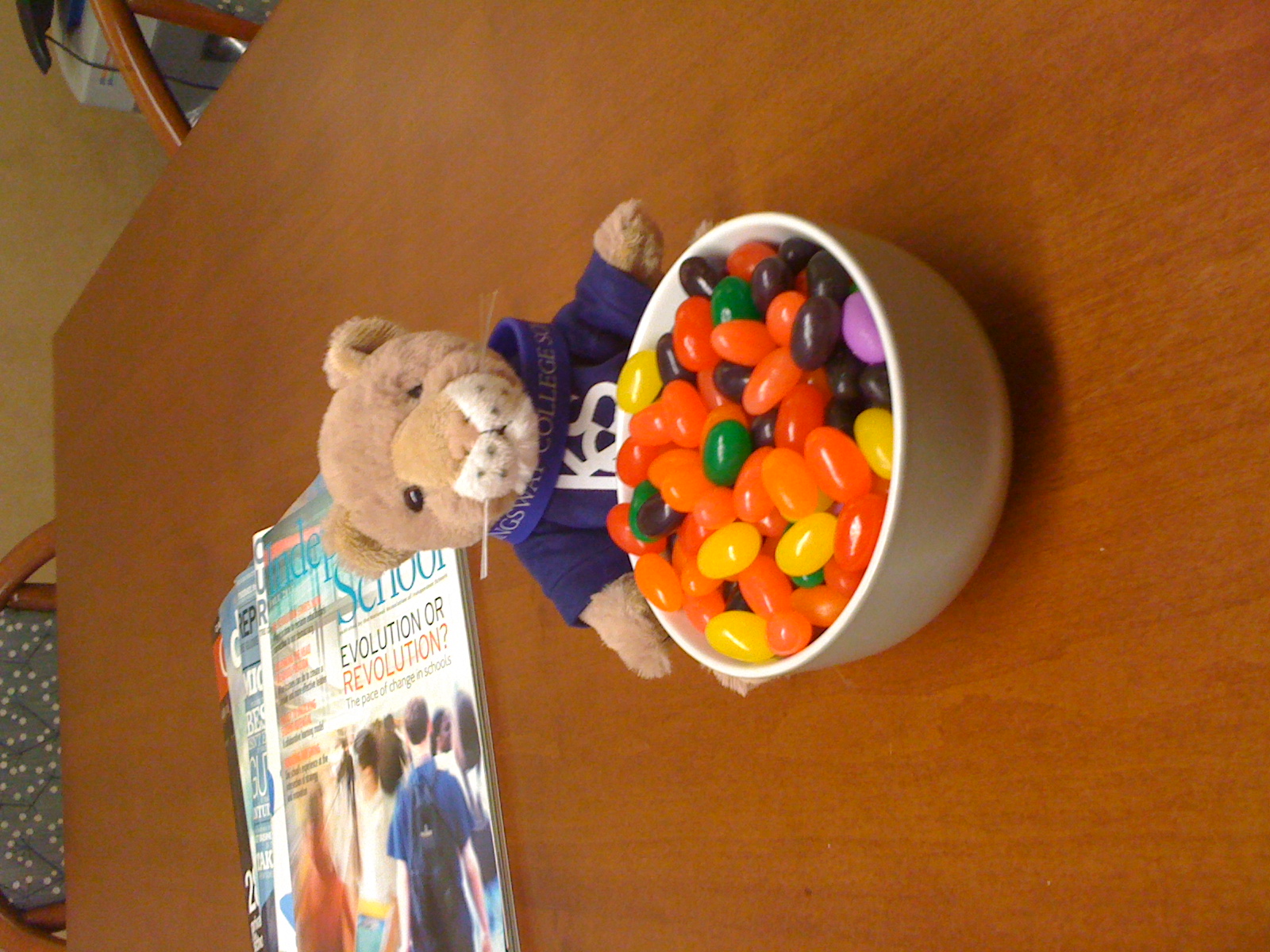
KCS JellybeansAbout a year ago I put a bowl of jelly beans on the table in my office. There was a simple reason to do so: I like jelly beans. Subsequently, I’ve discovered many others do as well: teachers, parents, committee members, and students. Since that day, my bowl of jelly beans has taught me some things.

Some observations:

  1. Jelly beans are a great conversation starter. People like to tell me their favourite flavours and their not-so-favourite flavours. Others aren’t so discerning. Those who frequent my office a lot enjoy discussing the various brands of jelly brands that can be found in the bowl. I purchase the ones that are on sale and in the store that I’m in…usually the Shopper’s Drug Mart around the corner from my house. This suggests I’m cheap and don’t like shopping…both correct.
  2. Jelly beans can lead to feeling guilty. I see this all the time in a number of ways. It might be by the people who eat so many of them and, as a result, stop by my office with a fresh bag to replenish the bowl. This is a common occurrence since the bowl needs to be filled up on a weekly basis. Some people will eat them only in the afternoon. “It’s too early to eat candy” is a common refrain heard. Like eating a jelly bean in the afternoon instead of the morning really makes a difference. I would suggest that these same folks are the ones who would consistently eat ½ a donut in the staffroom (at least when it was a regular occurrence to find donuts in the staffroom).
  3. Jelly beans can tell you a little about a person’s manners. It’s always interesting to watch a new person in my office. Some will ask if they can have one, others will just take them. People who already know me are interesting as well. For most of them, they will only eat jelly beans when I’m in my office. However, others sneak in my office when I’m not there and eat them (I know who you are…students tell me).
  4. Jelly beans uncover personal rules people set for themselves. Some people have told me they won’t eat them at all because they don’t “eat unwrapped candy in bowls”. For some reason, primary teachers often share this rule with me.
  5. People play favourites with jelly beans and choose some flavours and colours over others. Sometimes a person will pick through the bowl and are very selective about the ones they choose to eat. Hmmm…

Stop by and have a jelly bean or two; but remember, I’m watching you even when I’m not there.

Derek Logan
Head of School

Report Cards Used to Say What?

On Thursday, October 27, we were fortunate as part of The Memory Project to have a Canadian Air Force veteran, Captain Mort Lightstone, visit our school and talk to our grades 7/8 students about his experience in the RCAF in Korea, Europe and Vietnam.  Mort was accompanied by a journalist and a photographer from Maclean’s magazine.  We have so much going on at our school for Remembrance Day, it was an added bonus to have a veteran speak to us.  Mort brought along a number of his personal items, including pieces of his uniform, photographs and maps (he was a navigator).

In addition, he brought along his report card from Ottawa Technical High School from the late 1940s.  On the inside cover, it read:

Report to Parents or Guardians

Every pupil has Homework to do especially when his report is unsatisfactory.

We would request the parents or the guardians or our pupils to cooperate with us:

First:  By securing the regular and punctual attendance of the pupil.

Second:  By insisting on the careful preparation of homework.  A student should average nightly:
Grade Nine, 1 hour.

Grade Ten, 1 ½ hours.
Grade Eleven, 1 ½ hours.
Grade Twelve, 2 hours.

Third:  By studying this report and commending the successful pupil, or encouraging the weaker pupil with constructive criticism.  Parents are invited to consult with the Form Master or Principal on any matter concerning the progress of the students.

E.D. Hendry, B.A., Principal

On the back of the report card, it read:

WORKING HABITS
The student should develop good working habits.  The following are important:  Neatness of work; promptness in preparation of work; care of personal and school equipment and property; attitude towards the teachers and fellow students; attitude towards his work.

ATTENDANCE
Irregular attendance is one of the greatest hindrances to progress.  No pupil should be absent for less reason than would be accepted by the business man if the student were in his employ.

With our school’s report cards going home later this month, it’s interesting to look at the differences (and similarities) between the two reporting systems.

Derek Logan
Head of School