A Notion Worth Knocking

Working the brainI remember the indignation. I was a grade 8 student studying for a science test. I announced with all the wisdom and conviction of a 13-year-old that it was ridiculous studying all this science. “It’s not like I’m going to be a scientist!”

No doubt I would have joined the chorus today that also argues against learning and memorizing facts. Hardly a day goes by that I don’t read or hear the argument that students don’t need to know things like they used to. Anything one needs to know can be found on the internet.

A number of reasons why this notion is incorrect quickly come to mind: students need information as fodder for critical and creative thinking; people don’t always have the internet when they need it; you can’t simultaneously Google everything you need to know to think about a complex issue; much information we learn contributes to our sense of community and identity.

Reading Kathie Nunley’s book A Student’s Brain: The Parent/Teacher Manual, I can now add another definitive reason for why this notion needs knocking. Pure and simple, having to learn anything, anything, makes your brain stronger. The more the brain takes in, the more neural pathways become established. The more those pathways are repeatedly used, the more permanent those pathways become. The more numerous, varied and permanent those pathways are, the more ways in which the brain is ready to learn everything else it’s subsequently exposed to. Much like a muscle that grows whether you’re lifting barbells or babies, the brain is a use-it-or-lose-it organ. If you want to be good at anything in life, learn everything you can.

Along the way, you might even learn what I learned when applying to university. My undergraduate, as it turned out, was in science.

Andrea Fanjoy,
Assistant Head, Academics
You can follow Andrea on Twitter @afanjoy.

This article was first published in SNAP Etobicoke, June 2013.

Habits Worth Having

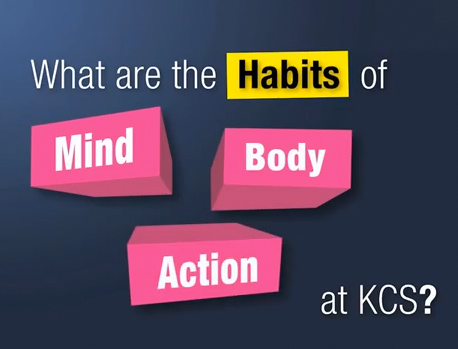
What Are The Habits of Mind, Body and Action?Our students have lots of habits. Rather than trying to break them, we’re shamelessly celebrating them in our just-released school videos on how we develop lifelong learners at KCS.

If your habits need a little tweaking, you might be inspired by some of our students and the habits they’ve already embraced in their lives:

  • A student in grade 4 whose favourite habit is to take responsible risks, because it reminds her to try something new
  • A student in grade 7 whose favourite is to persist, because it’s what he knows he most needs to do
  • A student in grade 6 whose favourite is to share what you know, because if everyone did so we would all be smarter. Besides, collaborating is fun.

Check out our KCS Habits of Mind, Body and Action and think about which is your favorite? Why? Then share it with others, and do a little inspiring of your own.

Learning for the Love of It

Paddle Tennis KCS Elective 2013

Paddle Tennis Elective
photo credit: Mary Gaudet/Etobicoke Guardian

I can remember the day I found my passion. To the extent that we can help spark it, we want our students to find theirs.

Third term clubs and teams have started – twenty-nine opportunities in the areas of academics, arts, athletics and citizenship. Scheduled so students can do as much as their hearts desire, our keenest students pursue up to ten offerings each term in each of our Four Doors to Learning.

Many dozens of ‘Brainiacs’ (independent student-initiated projects) plus leadership and service projects are in full swing. Feel like creating a whole new language, or creating a comic that spoofs James Bond? That’s what a group of boys in grade 4 have shown they’re inclined to do. How about organizing a food drive, like a group of girls in grade 2? A boy in grade 5 is creating a video game that the class can use in its upcoming unit on the human body. And compelled by the desire to make a difference, a group of grade 7 students is organising KCS’ participation in a global Vow of Silence, an awareness-raising effort that allows children to ‘speak’ on behalf of those silenced by unacceptable circumstance. Giving time, encouragement and guidance so students can pursue what moves them has created a virtual deluge of learning

Third term also marks the start of our much-anticipated electives program for students in grades 6 to 8. Every Wednesday these students break out of the routine, learning just for the love of it. Joining an elective of their choosing, here is what these disparate delighted groups are up to:

  1. Receiving instruction in and cooking meals for a local youth shelter
  2. Creating a dramatic presentation from beginning to end
  3. Learning, playing and spreading the word about paddle tennis
  4. Geocaching (www.geocaching.com) and putting KCS on the international geocaching map
  5. Composing a school song
  6. Composing songs to promote social justice
  7. Receiving expert coaching in baseball, then providing that instruction to young KCS students
  8. Creating Renaissance art
  9. Building and programming robots to face challenges

And because we’re pretty tireless, a brand new opportunity for students in grades 4 to 8 with a special kind of passion is being revealed this Friday…

The day I found my passion was the day my life became defined by commitment to lifelong learning. This is our wish for our students. Let the sparks fly.

Andrea Fanjoy,
Assistant Head, Academics
You can follow Andrea on Twitter @afanjoy.

Some Old School is Good School

Learning & Teaching MethodsI confess. At my school, we do some things that are very old school.

I follow what’s happening in the profession very closely. I read with interest what educators around the world are doing. I note that old-school approaches are often assumed wrong, not by research but by opinion.

These are exciting times in education, and there is a lot of room for new tools and strategies. Technology has made much that was impossible possible. Project-based learning, flat classroom projects that connect students around the world, and emphasis on 21st century stills like collaboration and inquiry are welcome progress. I love reading about how educators around the world are using these new approaches, and love bringing much of what is new to our school.

I’m also compelled to be a voice that says there is value in some of what schools used to do. The evidence is in the students, and the fact that a restricted array of approaches will never be sufficient for all. Schools must include all that has recently shown promise, plus remember all that used to have value, and then apply them all according to the needs of each student. So, in addition to all the current practices at our school, what old-school ones have we found also meet student needs?   We teach reading in many ways, but one way is through what’s called Direct Instruction, which is teacher-directed, and is the highly specific teaching of phonics, decoding and comprehension. We teach printing and cursive using a resource that is also specific to the skill, and we use it for six years in a row so that writing has a chance to develop alongside keyboarding skills. We teach math facts until students are fully fluent, allow minimal use of a calculator, and teach math concepts with clear step-by-step instruction. We have exams starting in grade 6, and put a significant effort in teaching students how to prepare for this significant challenge.

Teaching all students well requires open-mindedness to an unbounded array of tools and practices. It requires deep knowledge of each student, reflective practice, knowledge of quality research and the evidence of experience. That needs to be read more often. Whether old-school or new-school, if it helps students, it belongs.

Andrea Fanjoy,
Assistant Head, Academics
You can follow Andrea on Twitter @afanjoy.

Learning What We Don’t Want to Learn

Habits of Mind, Body and ActionThe first Habit on our poster is ‘Embrace Learning’. Don’t let the soothing tone of the word ‘embrace’ deceive you. We could have just as easily described it as ‘Learn whether you like it or not’.

Learning can be like that. Thankfully, most of the time, and certainly at KCS, learning does feel like a warm embrace. It’s delivered by teachers who evidently care about their students and about making learning as positive as possible. And so it should be.

I’ve been reminded recently, however, about the underbelly of ‘embrace learning’, a side that was always intentionally part of that Habit, but that may have gone unnoticed, hidden in the shadows of the ever-more pleasant type of learning that is more the norm here. I’m talking about those important lessons in life that we resist, the lessons we’d prefer not to learn, but learn we should. They may challenge our character, or reveal a sandy foundation upon which we had built mighty assumptions. These lessons may arise when exams yield lower marks than expected; sometimes they arise when we’ve done something we’re later ashamed of; sometimes they will trip up students who otherwise find learning very easy, but then are faced with a topic that is annoyingly difficult to understand. Though these examples focus on the young, we’re never too old for these lessons. And while these examples focus on others, I don’t pretend to be immune.

Humans are generally a comfort-seeking lot. Daniel Willingham, cognitive scientist and author of Why Students Don’t Like School, argues that the brain strives to be as efficient as possible, lazy even, preferring to do as it wishes and not as it is forced to do. Add a dash of limited understanding, bias, immaturity, emotion, or over-confidence, and you have someone ready for one of these most humbling lessons. If they embrace it.

Most learning should feel like a warm embrace. But growing up and being our best self will include these more challenging lessons too. While decidedly uncomfortable, the reward for their steep price is broader understanding, growing maturity, more rational thought and healthy humility. Resilience, thinking flexibly and the ability to persist, three other noteworthy habits, also grow as a result.

That’s learning worth embracing.

Andrea Fanjoy,
Assistant Head, Academics
You can follow Andrea on Twitter @afanjoy.

Exams Got You Down? Just PAUSS

The following blog first appeared one year ago. It’s as relevant now as it was then. We all face challenges from time to time, and how we face them makes all the difference. That’s where the KCS Habits come in.

At KCS, it’s our mission to develop lifelong learners with the habits to face and embrace life’s challenges. Many of our students and parents have an extra one of those challenges on their plate right now.

Exams.

Students in grades 6-8 write exams starting January 28th. Love them or dislike them (yes, we’ve had students say they love them!), learning to prepare for and take exams is a challenge we all have to face at some point. Starting them in grade six, with ample guidance and time learning how to prepare, is the best way to start. Though a big deal, exams at KCS are also a safe opportunity to face this challenge, ‘try your best’, and learn from mistakes.

Looking at our Habits poster in my office Friday morning, I wondered which of the habits students should focus on to be successful preparing for exams. Five stood out. When written down, it became clear they made for a nice little acronym – a beacon for calm in the storm of stress that often surrounds the ‘e’ word. The acronym is PAUSS. The habits are:

Persist – this is a marathon, not a sprint

Adapt – old patterns of studying and time management likely need to change

Use past learning – use notes and old tests; use strategies that you already know to work, and avoid those that you know don’t

Show self-control – stick to the study plan; focus on the task; remember to also rest, eat well and get exercise

Strive for accuracy – follow the study keys, test yourself, aim to understand any errors

Exams inherently stir up anxiety. PAUSS, happily, does not.

If your child is writing exams, encourage them to PAUSS. And watch with pride as your child develops habits that matter. Take heart. Dread will soon be replaced with delight, and doubt will be replaced by well-earned confidence. And the unknown challenges to come will face a tougher foe.

Thinking, Doing and Checking Assumptions at the Door

By the time this is published, the four months of construction on our house should be nearly done. The experience has left me with more than just an addition.

Shop Class as SoulcraftBrowsing for a good summer read, I stumbled upon Shop Class as Soul Craft by Matthew Crawford. Crawford was a 14-year-old electrician, who moved on to tinkering with car and motorcycle engines, then went to university to earn a PhD in philosophy. Hired to work in a think tank, he assumed he had reached the pinnacle of achievement. He was highly educated, well paid, well dressed and looking forward to the intellectual challenges that would surely ensue.

Assuming the prevailing attitudes of the day, he grew up with the notion that university and the jobs it led to were a higher calling than the trades. University was for people who were good at thinking, while college was for those better at doing. Reverence was reserved for the former.

Not many people have so fully walked down both paths as Crawford. His voice of unique experience reveals that our thinking had more than a fair share of nonsense. First, the notion that all work following university requires supreme thinking he found to be supremely hollow. The many people he met working in the trades spent their days pondering and solving complex problems the likes of which he never found at the think tank.

Equally revealing, Crawford outlines the evolution of both work and attitudes surrounding it. Prior to the onset of the Ford Motor Company and other more efficient models of machine-making, the trades were recognized for what they are – pursuits that offer endless thinking as well as doing, that bring evident value at the end of a day’s labour. The rewards inherent in self-reliance have vanished for many of us today. Of course, university is a training ground for significant work. It simply isn’t the only such training ground.

Smart thinking includes scrutiny of assumptions. Thanks to the scrutiny in Shop Class as Soul Craft, and made real by our home renovation, my summer has included this unexpected bonus of appreciation and humility. Encourage youth to find their calling, and check assumptions at the door.

Andrea Fanjoy,
Assistant Head, Academics
You can follow Andrea on Twitter @afanjoy.

This article was first published in SNAP Etobicoke, October 2012.

From Humble Beginnings: KCS European Battlefield Trip

Today we held our first European Battlefield club for our students who will be attending our school’s trip to the Canadian battlefields in France, Belgium and England next March.  In preparation for the trip, student participants in both grades 7 and 8 attend a battlefield club bi-weekly to help them to understand some of what they will see when they arrive in Europe for their 10 day trip.  My son, who attends grade 9 at a high school in Oakville, will be going on this trip with me in March (my daughter attended the last trip and my Dad the very first one).  Like many of us do before we visit a place for the first time, I am having my son watch movies, read and look through photos from previous trips in preparation for March.

I can still remember as if it was yesterday, coming back from a history conference in 2001 that was held in Montreal, where I met over 100 history teachers from across the country.  At the conference was a former history teacher (Don Bogle) from the Durham region, who was working for a school travel company in his “retirement”.  He asked if there were any teachers who were interested in organizing a battlefield trip for their school.  I joined a group of 20 teachers expressing interest.  As in most groups, the level of interest and a willingness to do the work don’t often match:  four of us ultimately organized trips for our schools for 2003. I guess it’s always easier to decide not to bring change to an organization than it is to do so.  We were the only elementary school willing to organize a trip.

I can remember coming back, sitting down with Dr. Z at the time (my predecessor as KCS Head), explaining what I wanted to do, and then after a few discussions, he agreed to let me go ahead and organize our first trip.  I assume at the time, he may have had some reservations, but the work that I had done with him in the past certainly gave him the confidence I could pull this off.  I knew the impact of travel on my own understanding of history, and although there would be a tremendous amount of learning and understanding in order to make this happen, I was confident the benefits to the participants would be proven over time.

As usual, there were many naysayers who questioned my sanity in taking grades 7 and 8 students (and their parents!) overseas.  “To Quebec is okay…to France?  You must be losing your mind!”  Others would look at me when I told them parents would also be invited to attend as we needed a certain number of people to make the trip happen.  These folks, many times teachers, would often shake their heads and back away slowly.  Planning a trip overseas just after 9/11 only added fuel to the doubters fire.  I still remember, about two weeks before we left in March 2003, we held a meeting in the library for all participants.  A father stood up and asked me in front of the group, “What do you plan to do if terrorists storm the plane?”  That moment will be forever etched in my mind.
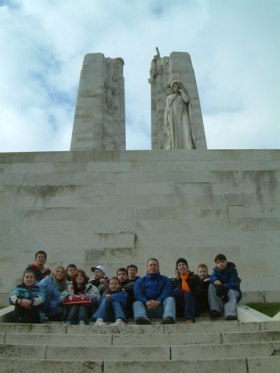
A photo from 2003 of our first group of students, Ms. Gaudet and I at Vimy Ridge.

Needless to say, that first trip was a success that we continue to build upon.  We have taken over 250 KCS students, parents and teachers on these bi-annual trips so far.  And from those first four schools, dozens of schools across the country have followed the path our four schools began; we often run into boys from St. Andrew’s College in Europe during our trips.  The naysayers back in 2002 could not see out into the future or what was possible in student travel and the positive impact it would have on the participants.  Parents who attended the trip with their child(ren) often return to me years later to talk about the lasting impression the trip made.  My favourite story is the Dad who called me the day after Remembrance Day in 2005 – he and his daughter had been on the trip in March of that year.  He left me a simple voicemail:  “Hi Derek, this is Dave.  I now understand Remembrance Day.”

Dawn Biljetina and Jenn Macdonald have continued to build on the success of those first few trips.  An important part of their effort was the formation of a battlefield club that participants would attend prior to the trip.  Ms. B quickly realized that the participant’s experience on the trip would be so much better if they had read something, researched, watched documentaries, movies and YouTube clips on the wars, before they arrived at the ultimate classrooms:  the battlefields in Normandy, Passchendaele and Vimy.  Certainly not a novel or revolutionary idea from a teaching perspective, but one that helped enrich the trip for the participants.  It was great to sit in the battlefield club today and see the learning the students are undertaking themselves and with Ms. B in preparation for March.

Star Habits, Wish Habits

I couldn’t wish for more than what’s happening with our Habits.

We’re starting our third year since the official launch of our Habits of Mind, Body and Action. Anything new needs time to settle, time for all to adjust (or in KCS terms, time to exercise one’s flexible thinking), plus time for glitches to surface and tweaks to be made to make what’s new into a perfect fit.

Lots of such activity took place over the past two years while the Habits were still relatively new. This August, when teachers were asked about how they plan to integrate the Habits in their program for the upcoming year, it was eye-poppingly evident that the adjustment is behind us and we’re now going full speed ahead with our efforts to directly teach the habits that matter most for success in life. Collectively, faculty shared over one hundred ideas they have to teach and leverage the Habits in their classes. Here is a sample:

  • Leader of the Day with a special role to help the class
  • Class mission statements to support growth of the Habits
  • Student-made posters of the Habits
  • Student goal-setting on the Habits
  • Reference to the Habits in school assignments
  • Discussion of the Habits in class meetings and novel studies
  • Students teaching the Habits to other students
  • Students teaching the Habits to their parents and grandparents
  • Connecting the Habits with the study of heroes and leaders

One idea that is particularly out of this world came from grade 4. The students are identifying ‘Star Habits’ and ‘Wish Habits’. A ‘Star Habit’ is a habit they feel they have already established and of which they are proud. A ‘Wish Habit’ is a habit they want to focus on developing in first term. The students looked over all 26 Habits, reflected deeply, made their choices, and explained them in the context of home and school. Star Habit, Wish Habit as their ‘Star’ and ‘Wish’ Habits.

Like the spirit behind our Habits initiative, the students have wishes with a plan. And in the same way that our wishes to teach the Habits are coming true, I’ve no doubt our students’ ‘Wish Habits’ will also come true. What are your ‘Star’ and ‘Wish’ Habits? And what’s your plan to make your wishes come true? If you need some help, feel free to ask one of our grade fours.

Andrea Fanjoy,
Assistant Head, Academics

You can follow Andrea on Twitter @afanjoy.

A recommended read: The Globe and Mail’s ‘Why kids need to fail to succeed in school’

The following article was in The Globe and Mail on August 31.  I have written about this topic on a couple of occasions in the past few years.  I thought the article would be of interest as we begin the 2012/13 school year.

http://www.theglobeandmail.com/life/parenting/back-to-school/why-kids-need-to-fail-to-succeed-in-school/article4513436/

Often in this space I will write about things students say to me that make me smile and remind me why teaching is such a rewarding, memorable and humourous profession.  Yesterday during the grade 1 drop in I met one of the new grade 2 boys who was accompanying his sister and his parents.  He said hi, and then looked up and said, “You have the same sandals as my Dad.”  An interesting first day observation between a student and a principal.

This morning, I came in from recess, and walked into the grade 1B classroom to deliver a couple of birthday cards.  The students were getting ready for their first KCS French lesson.  One of the grade 1 girls looks up at me and says, “You’re cute.”  I’m fairly certain that I have never had that said about me in my twenty years in education.  However, if you know my wife Heather’s email address, please feel free to pass this information on to her.  See you around the school.

Derek Logan
Head of School