Remember

Remember. Buy a poppy. Thank a veteran.

Derek Logan,
Head of School

The Joy of Dance

It was 2:30 last Friday afternoon. Lady Gaga’s The Edge of Glory traversed the walls and halls of the school. One hundred students were participating in a Fit2Dance workshop, dancing in Canada Hall and singing with all the spirit they could muster. Lise, our other Assistant Head, and I, working upstairs on much more mundane affairs, looked out our window to see a solitary grade 6 student walking in the hall, laptop cradled in his arms, grooving with each step, then suddenly spin and moon walk the rest of his way to class.

What a beautiful sight.

May our students always find ways to have song and dance in their lives.

Andrea Fanjoy,
Assistant Head, Academics

The Power of the Jelly Bean

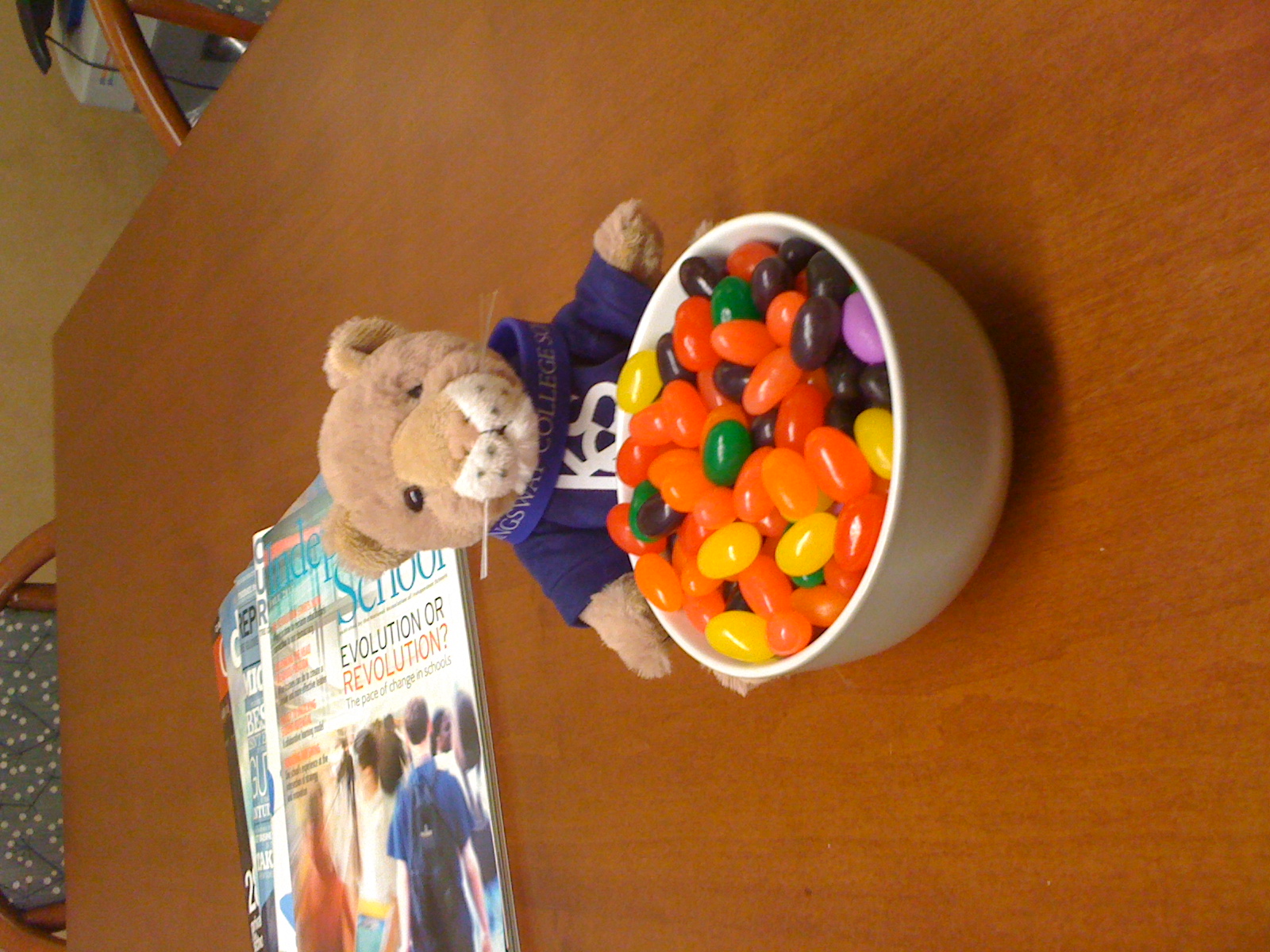
KCS JellybeansAbout a year ago I put a bowl of jelly beans on the table in my office. There was a simple reason to do so: I like jelly beans. Subsequently, I’ve discovered many others do as well: teachers, parents, committee members, and students. Since that day, my bowl of jelly beans has taught me some things.

Some observations:

  1. Jelly beans are a great conversation starter. People like to tell me their favourite flavours and their not-so-favourite flavours. Others aren’t so discerning. Those who frequent my office a lot enjoy discussing the various brands of jelly brands that can be found in the bowl. I purchase the ones that are on sale and in the store that I’m in…usually the Shopper’s Drug Mart around the corner from my house. This suggests I’m cheap and don’t like shopping…both correct.
  2. Jelly beans can lead to feeling guilty. I see this all the time in a number of ways. It might be by the people who eat so many of them and, as a result, stop by my office with a fresh bag to replenish the bowl. This is a common occurrence since the bowl needs to be filled up on a weekly basis. Some people will eat them only in the afternoon. “It’s too early to eat candy” is a common refrain heard. Like eating a jelly bean in the afternoon instead of the morning really makes a difference. I would suggest that these same folks are the ones who would consistently eat ½ a donut in the staffroom (at least when it was a regular occurrence to find donuts in the staffroom).
  3. Jelly beans can tell you a little about a person’s manners. It’s always interesting to watch a new person in my office. Some will ask if they can have one, others will just take them. People who already know me are interesting as well. For most of them, they will only eat jelly beans when I’m in my office. However, others sneak in my office when I’m not there and eat them (I know who you are…students tell me).
  4. Jelly beans uncover personal rules people set for themselves. Some people have told me they won’t eat them at all because they don’t “eat unwrapped candy in bowls”. For some reason, primary teachers often share this rule with me.
  5. People play favourites with jelly beans and choose some flavours and colours over others. Sometimes a person will pick through the bowl and are very selective about the ones they choose to eat. Hmmm…

Stop by and have a jelly bean or two; but remember, I’m watching you even when I’m not there.

Derek Logan
Head of School

Lead to Make a Difference

Lead To Make A DifferenceA student entered my office this morning. “I have the chocolate”, she said, then promptly opened her pink flower-covered backpack, pulled out a bag and showed me multiple packages of fair-trade chocolate, each tied up with ribbon. We’re approaching the big moment when she and her friend present their powerpoint at a school-wide assembly and initiate the leadership project they have been working on since last year: Fair Food Friday.

They are in grade three. How we got here is an interesting story.

They knew about leadership projects, because they happen here frequently and visibly. They approached me about doing a project on chocolate, “because everyone loves chocolate.” One thought it would be great to collect recipes, and maybe students could win something by contributing recipes.

During one of these early meetings, her friend remarked, “I don’t know. Most of the projects here do something. They matter. This one doesn’t seem to.”

“But just doing something you like matters!”, she replied.

“Yeah, but…” Back and forth they went.

At this point, I told them about a leadership project from a previous year when students spoke at assembly about the connection between the chocolate we all love, and child labour in Africa. Upon hearing this, raising awareness of this underside of the chocolate industry, and awareness of fair trade foods, became the compelling purpose of the project. The plan is as follows: They will start the project with a presentation at assembly that tells the story of chocolate, child labour and fair trade. Also during this presentation, they will invite students and teachers to contribute their favourite recipes. Every week, they will randomly draw one recipe from their box, and give fair-trade chocolate to the person who shared it. At the end of the year, the recipes will go into a e-cookbook, and a hard copy cookbook for the KCS library.

With the plan in place, the girls wrote their speech, decorated their recipe collection box, bought the chocolate prizes, and are almost finished their power point. The official launch of Fair Food Friday is imminent.

Last year, the article “Student Leadership, Gone Viral”, first published by OurKids, explained the bigger picture of student leadership at KCS. But it’s the details that go into each project that excite me most. And it’s the details that convince me our students are really learning to be leaders, because the students are behind the details every step of the way. As for making a difference, without these two students, 310 people would likely not hear about the connection between chocolate and child labour. Most wouldn’t learn how fair trade practices have been established so that consumers can make things better by their purchasing choices, not worse. They would not be reminded of these things week after week, making the memory of this lesson stick. Many would not have the opportunity to savour fair trade chocolate under the envious eyes of their school community over the course of the upcoming year.

This is leadership that makes a difference. As icing on the (chocolate) cake, it inspires me to follow their lead. And it is just one of the dozens of student-led projects I’ll witness over the year.

This is not what schools were designed to do. But they could be. Imagine what a difference that would make.

Andrea Fanjoy,
Assistant Head, Academics
Follow Andrea @afanjoy

Report Cards Used to Say What?

On Thursday, October 27, we were fortunate as part of The Memory Project to have a Canadian Air Force veteran, Captain Mort Lightstone, visit our school and talk to our grades 7/8 students about his experience in the RCAF in Korea, Europe and Vietnam.  Mort was accompanied by a journalist and a photographer from Maclean’s magazine.  We have so much going on at our school for Remembrance Day, it was an added bonus to have a veteran speak to us.  Mort brought along a number of his personal items, including pieces of his uniform, photographs and maps (he was a navigator).

In addition, he brought along his report card from Ottawa Technical High School from the late 1940s.  On the inside cover, it read:

Report to Parents or Guardians

Every pupil has Homework to do especially when his report is unsatisfactory.

We would request the parents or the guardians or our pupils to cooperate with us:

First:  By securing the regular and punctual attendance of the pupil.

Second:  By insisting on the careful preparation of homework.  A student should average nightly:
Grade Nine, 1 hour.

Grade Ten, 1 ½ hours.
Grade Eleven, 1 ½ hours.
Grade Twelve, 2 hours.

Third:  By studying this report and commending the successful pupil, or encouraging the weaker pupil with constructive criticism.  Parents are invited to consult with the Form Master or Principal on any matter concerning the progress of the students.

E.D. Hendry, B.A., Principal

On the back of the report card, it read:

WORKING HABITS
The student should develop good working habits.  The following are important:  Neatness of work; promptness in preparation of work; care of personal and school equipment and property; attitude towards the teachers and fellow students; attitude towards his work.

ATTENDANCE
Irregular attendance is one of the greatest hindrances to progress.  No pupil should be absent for less reason than would be accepted by the business man if the student were in his employ.

With our school’s report cards going home later this month, it’s interesting to look at the differences (and similarities) between the two reporting systems.

Derek Logan
Head of School

Zombies and Other Leaders

As I turned the corner, there he was. Dressed in black, blood dripping down his face, one eyeball hanging from its socket and, most curiously, a flicking tongue protruding from his forehead.

Surprised and a little uncomfortable, maybe I just need to get out of Etobicoke more often.

My husband and I had just left Private Lives, the Noel Coward play at The Princess of Wales. Our boys were spending the day and night with their grandmother, and we were ambling our way to Little Italy for dinner. We were also, we later learned, in the midst of the annual Zombie Walk. Our moment of middle-aged pleasure was turned inside out by dozens of moaning, groaning, staggering, decomposing creatures from the earth.

Zombies as leaders you ask? I admit, my first instinct was to be put out by such disturbing images in my path. However, the Habits that seem to lie in wait in my mind, pouncing whenever I lazily try to avoid them, set me straight. What are the Zombies doing wrong? There wasn’t a single Habit they were breaking that I could fault them for. And when I thought about it, they were doing some things perfectly right. They were thinking and acting creatively, they were taking a responsible risk, and despite the dreary façade, there’s no doubt good-hearted humour was underneath it all. They were setting a positive example on worthy fronts.

While the Zombies weren’t trying to be leaders, they did make a difference with me. They reminded me not to jump to judgment. It was an ‘embrace learning’ moment that I deserved.

Happy Halloween to all. May it be full of zombies and other leaders.

Survey Says…

I enjoy listening to kids. They tell you what they think, often without the diplomacy and subtleness that adults use in conversation. You very rarely walk away from a conversation with a student wondering, “what is he/she really trying to tell me?” This week we were reviewing the results of our annual alumni survey that we send to our graduates who are in grade 9 at another school. This quote came back from one of them: “The teachers are there [at this student’s new high school] because it is their job to teach, whereas at KCS the teachers are there for you.” It made me proud.

Derek Logan
Head of School

Habits that Matter

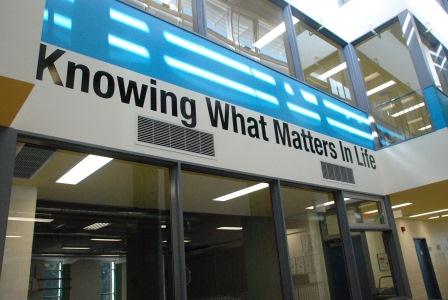
Knowing What Matters in LifeEveryone who has stepped in our doors since September will have noticed that habits loom large at KCS. They are everywhere – on our walls, in our halls, and even on a third story window… somehow, a snail made his (her?) way up there. Derek called a number of us over to see it. “Come see this example of persistence and resilience, for which I’m responding with awe and appreciation.” Chuckling aside, we were all genuinely impressed by this example of the snail. If you know ‘what matters’, you may be surprised by where you find it. And if anyone can explain why a snail would be clinging to a third story window, I’m ready to embrace learning. Please share what you know.

Learn about the KCS Habits of Mind, Habits of Body and Habits of Action.

Being Stuck

I knew this day would come.  I was hoping it wouldn’t come so early.  This is about my eighth entry for our school’s blog.  For the past few days, I’ve been speaking to various individuals about what I would write.  I’ve been in and out of classes trying to come across a funny story or two.  Nothing was resonating with me.  For example, I entered a grade 6 class early on Friday morning.  They were just getting ready for recess and their homeform teacher was talking to them about our upcoming Halloween school dance for our grades 6-8 students.  Most of the students were committed to attend.  One of the boys was holding out.  Following the discussion, his comment was, “Alright, I’ll come for the snacks.”  It made me smile.  Hopefully it did the same for you.

Was this story worthy of writing about in my blog?  Did it have a message that people want to hear?  Is it significant enough?  What will people think about me if I write this down?  I guess it’s too late to worry about those questions now.

Derek Logan
Head of School

Gambatte (Persist)

It is not that I’m so smart. But I stay with the questions much longer.
–        Albert Einstein

A lifetime ago (or so it seems), I lived in Japan. There began my fondness for the word persist.

Every day, in every context, every Japanese person I came across told others “Gambatte!”, “Persist!”. From toddlers at the doctor’s office, to students at school, to adults in their daily to and fro, it was almost as common as hello. It stood out particularly because of its relative absence in dialogue back home in Canada.

How often do you hear the word persist?

As evident in the quote up top, persisting worked for Einstein. Steve Jobs also has a compelling story in persistence, as told in his 2005 speech at Stanford’s graduation ceremony (if you haven’t seen it, visit the KCS YouTube channel and find it in Favorites). Also, though not yet famous, persisting works for KCS students when they face challenges, be they reading, writing, math, exams, or opportunities sought and lost. We see it all the time.

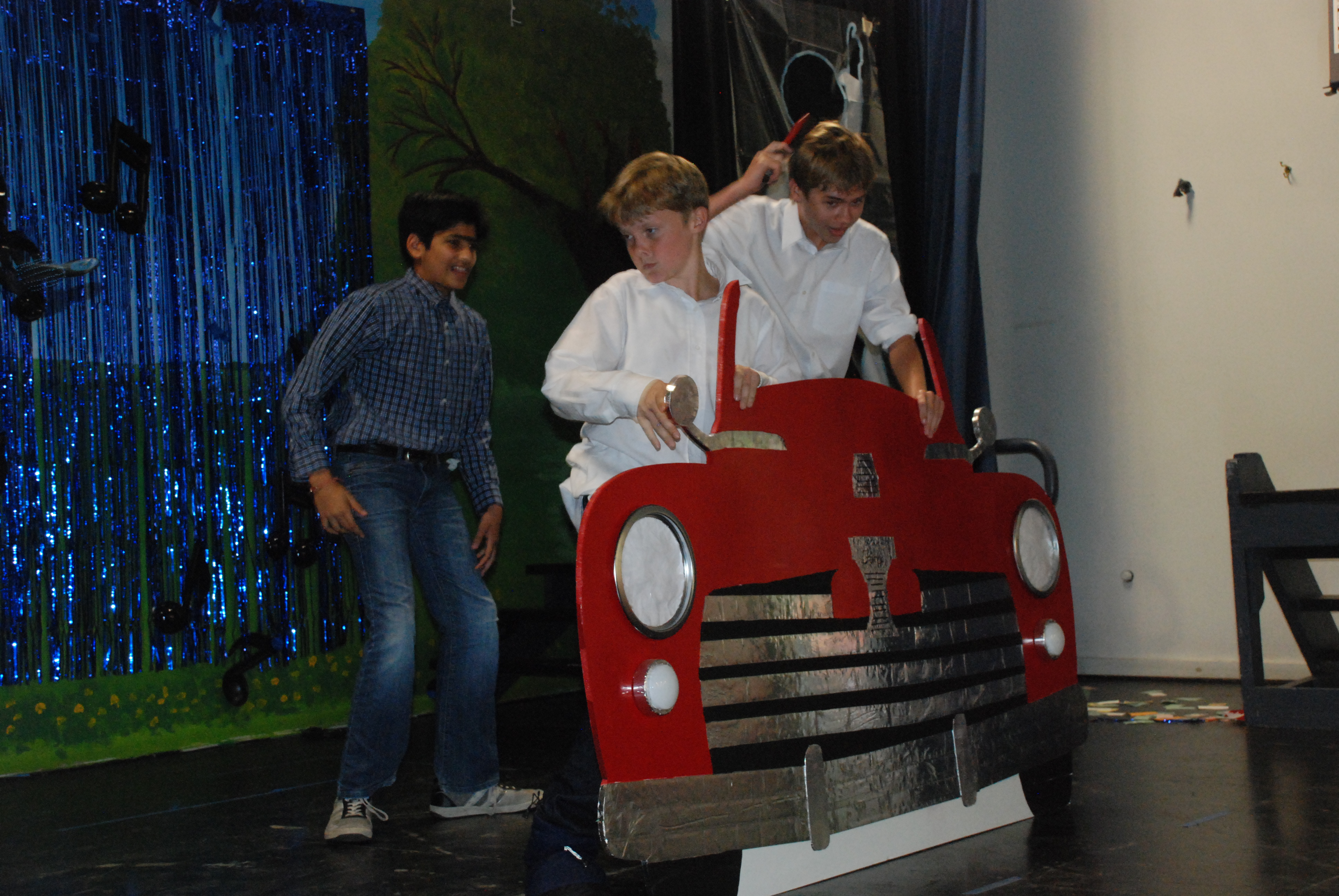
Grade 8 Lip SyncAs I write, the 2011 Lip Sync just ended. A new story of persisting emerged from this event. One of our grade 8 students sent me an email asking if he and his large group could use the Multipurpose Room to practice. That rehearsal went poorly, and he sent me a subsequent email saying they wouldn’t perform. The next morning, however, he sent yet another email. Here is what he wrote: “I thought about the lip sync again and I am willing to make one more shot at this. Sorry for causing you a lot of mayhem. I am going to regroup with certain people and see if I can reconfigure the lip sync from a large size crowd to a smaller one to make it work.”

Well, they regrouped and put on a most entertaining performance! Of everyone in the audience (maybe apart from his ecstatic parents), I took the most pleasure. I knew about the extra layers of leadership, persistence, flexible thinking and resilience that went into the final production.

Now, I could also add that seeing this young man grooving with peers on stage was hugely out of his comfort zone. But that would get me talking about taking responsible risks…

If persisting helped you accomplish things that mattered in your life, please help us spread the word. It’s a secret to success worth sharing.

Andrea Fanjoy,
Assistant Head, Academics