A Beautiful Thing

It’s not easy being a teen. It’s not always easy being a young child either. Bring the two together to play, however, and life doesn’t get much better.

Grade 8, being our graduating year, brings a number of special responsibilities. Among these is the grade 8 – primary buddy program. In early October, each grade 8 student is assigned to be a buddy for a new student in grade 1 or 2. Their challenge? Get to know their young buddy, find out what they enjoy doing, and then do it with them over the course of the year.

Collectively they’ve had tea parties, picnics, dodge ball games, and Wii Dance recesses. They’ve played soccer outside, built Lego in my office and read together in the library. One group of buddies made a picture book together. Another particularly hard-working group organized a school-wide scavenger hunt. High fives and hugs are the signature greeting when they pass each other in the hall.

The joy and reverence on the youngest faces is tonic for troubled teens. The attention of the oldest, biggest and most respected students of the school immediately overrides any frustrations of being five, six or seven. Any students and teachers walking by can’t help but stop, smile and watch them play.

Life isn’t always easy or beautiful. Grade 8s making these occasions happen for their young buddies is undeniably beautiful. Make the world better is one of our KCS Habits. Thank you, grade 8s, for making our little piece of the world much better.

Andrea Fanjoy,
Assistant Head, Academics
You can follow Andrea on Twitter @afanjoy.

Sing a Song of KCS

SongwritingThis year has been the grade 6s first year with electives and we weren’t sure what to expect. Every Wednesday, for two hours, our group of three girls go down to the music room and try to write a KCS school song. Most people might think that songwriting isn’t very interesting (that’s what the three of us in the elective thought before) but it is the most amazing and fun grade 6 experience that we have ever had. All week we look forward to sitting down with all the instruments and playing whatever we want because there’s no wrong answer. Our goal is to write the KCS school song within 10 weeks and our progress has been incredible. The first three weeks, we brainstormed ideas of what KCS felt like, looked like, smelled like and meant to us and we came up with many sheets expressing our feelings. The fourth week, a singer/songwriter named Jennifer Foster came in and helped us a lot with how to write a song and which notes to use to give the overall warm feeling that we wanted for the song. Some of the words that the four of us kept coming up with were: warm, family, community, friendship and laughter because these words all describe KCS. We also wanted to include that you don’t have to be someone specific and you don’t have to change yourself to go to KCS. This experience has been one of the most educational, interesting, and fun experiences that we have ever had. None of us can believe how much work you can get done even while laughing and having so much fun.

Hope for Habits for Today and for the Future

Love the EarthThis past week was National Volunteer Week and Earth Week. The thing about celebrating weeks like this is that we hope that we raise awareness of important ideas. What we really hope will happen is that those ideas spread!

We have Earth Week activities at KCS:

  • Meatless Monday
  • Trashless Tuesday
  • Walk to School Wednesday
  • Turn off the Lights Thursday
  • Fill your Water Bottle Friday
  • Grade 7 service learning students reminded classes about energy conservation, water conservation, recycling, rain forest preservation, and more.
  • Grade 1 students participated in workshops presented by older students about water conservation and recycling.
  • Grade 2 students read books, wrote poems, and made posters about helping the planet.
  • Grade 3 students planted seeds and prepared soil experiments.
  • Grade 4 and 6 students cleaned up the school grounds and surrounding areas.
  • Grade 5 students will be calculating their eco-footprint using a carbon footprint calculator online.
  • Grade 7 students did a creative assignment about sustainable happiness. Sustainable happiness is ‘happiness that contributes to individual, community and/or global wellbeing and does not exploit other people, the environment, or future generations.’ (C. O’Brien)
  • Grade 8 students viewed Sharkwater, a film about sharks, their habitat, and the effects of humans on their ecosystem.

What we hope will happen is that our community learns about being friendly to the environment. We hope that they incorporate green habits that they will have for their whole lives, not just during Earth Week. We show this by having green habits integrated into our daily lives at KCS.

Similarly, we love and appreciate our volunteers at KCS! We don’t wait until volunteer week to thank them! Increasingly, our students are volunteering in our school and in the surrounding community. Once one person tells others how they volunteered to help, many of their peers are willing to join in the joy that comes from helping others. We are grateful to them and proud that they are making a difference.

Here are some of the many ways that students are volunteering:

  • Mentoring younger students
  • Providing lunch leadership to younger students
  • Leading chapels and assemblies
  • Conducting tours of our school to guests
  • Making gift baskets for local women’s shelters
  • Helping at a local church fundraiser
  • Refereeing basketball games for Special Olympics Ontario
  • Teaching younger students at figure skating
  • Caring for neighbours when they are sick
  • Sorting food at a food bank
  • Helping seniors at a retirement home

We hope that students see volunteering as one of the habits that they continue to do well after they have left KCS. We don’t have green habits only during Earth Week. And we don’t just volunteer or thank our volunteers during National Volunteer Week. But here’s to the happy future that comes from the habits learned at KCS!

Ms. Gaudet
Citizenship Coordinator

Habits Worth Having

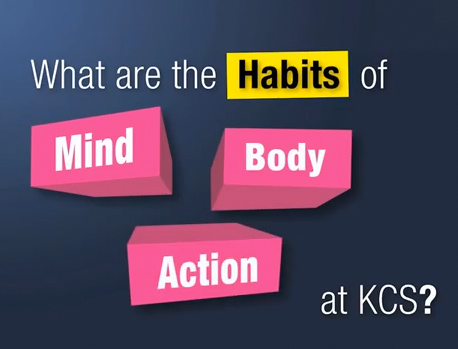
What Are The Habits of Mind, Body and Action?Our students have lots of habits. Rather than trying to break them, we’re shamelessly celebrating them in our just-released school videos on how we develop lifelong learners at KCS.

If your habits need a little tweaking, you might be inspired by some of our students and the habits they’ve already embraced in their lives:

  • A student in grade 4 whose favourite habit is to take responsible risks, because it reminds her to try something new
  • A student in grade 7 whose favourite is to persist, because it’s what he knows he most needs to do
  • A student in grade 6 whose favourite is to share what you know, because if everyone did so we would all be smarter. Besides, collaborating is fun.

Check out our KCS Habits of Mind, Body and Action and think about which is your favorite? Why? Then share it with others, and do a little inspiring of your own.

Testing What Matters in Life

How did you do on your last test?

If you’re not a student you probably can’t remember. Tests are for students, right?

Formal education has a long history of testing. Spelling, math, science, history – no other institution tests more than schools. Obviously.

KCS CaresWhat’s not as top of mind, however, are the tests that we face minute-by-minute, wherever we are, whomever we’re with and whatever we’re doing. These are the tests of character that appear in our interactions with others, choices of how to spend our time, how we work, how we play, and how we respond to the challenges thrown our way. And if you’re following what most experts are saying, it is character, and specifically traits such as initiative, curiosity, grit, creativity, and adaptability, that will best determine our success in life.

Educators and parents alike spend a lot of time thinking about tests, whether designing, marking or preparing children to do their best with them. Tests help us monitor growth in students and effectiveness of teaching. They have value. But most of these tests don’t measure what matters most. They aren’t designed to.

So, what would a test of character look like? Simple. Watch what others do, of their own volition, and particularly when out of the gaze and direction of authority figures. Minute-by-minute.

And if you want to help prepare students to do well on these tests? Provide a school experience that not only teaches character but also includes the encouragement, time and support needed so students can practice the skills and traits that matter, and do so for their own purposes. Students of character need freedom to initiate, create, persist at solving real problems, make a difference and more, not for marks and not because they’re told to. They need a school that believes in the infinite potential of children, if we let it take shape, and a school which recognises that this means doing a number of things differently.

Educators, watch what your students do with free time. That’s testing what matters. And give them a school experience that lets them develop the traits and skills that matter most. That’s preparing them to ace the test. You won’t be disappointed.

Andrea Fanjoy,
Assistant Head, Academics
You can follow Andrea on Twitter @afanjoy.

This article was first published in SNAP Etobicoke, December 2012.

Can we stay in for recess?

Growing up in Nova Scotia, I distinctly remember asking that question. In winter, I would volunteer to clean the boards (blackboards, that is) or laminate, just to avoid the cold nor’ easters. In the warmer weather, we had to be cajoled back in at the end of recess.

Our students ask this question too. But, it happens year round.

This past school year one of my most recess-loving boys asked to stay in to work on his Lego robotics project for science class. He knew that the extra time testing his robot would help his team in the next competition. And, to him, it was worth it.

After visiting an outdoor education centre, a group of grade 7 girls decided to construct Save That Species, a skit, in game show format, which was regularly performed at assembly to inform their peers about endangered species in a fun and informative way. They asked to stay in to practice, arrange costumes, and construct background slides on the computer.

Others worked on presentations for younger students, creating games for their class, or tracking our Lights Out Lunch where classes are reminded to turn off the lights. Clearly, student leadership is pervasive.

During our student voice sessions in 2011/12, we asked students about leadership. We asked: What does it mean to be a leader? How do you feel that you get to be a leader at KCS? What would you add or change about student leadership at KCS?

Here’s what some of our students had to say:

‘To be a leader means that you encourage others to make positive choices, to act with empathy, to do what is right.’ Interestingly, few students thought that being a leader means the one who wins the trophy, or the one who gets to be in charge of others. They’re empowered as leaders to help others, not to overpower others. I think that is an amazing indicator of our school’s culture.

The list of ways that students were involved was extensive! Among the ways that they showed leadership: teaching younger students, peer tutoring, house captain projects, helping teachers lead clubs, coming up with new ideas for the school, picking up garbage in the park, creating new projects, and helping others with their problems.

One of my favourite quotes was from a grade one student: “I feel good whenever you (the teacher) say ‘journal time is over’ and I pick up all the pencil crayons.” It’s the little things that make a difference.

Students voiced their opinion that there should be more time dedicated to leadership. At present, there is a leadership class for grades 6, 7, and 8 students. We’ll be using every opportunity to make sure that students who want to be leaders, can be leaders. We believe that everyone can be a leader.

The teachers at KCS read about leadership this past summer. The Leader in Me, by Stephen R. Covey, talks about how students are empowered and engaged when they can be leaders. Luckily, this is not be a revolutionary idea for our school. It’s already there.

Ms. Gaudet
Citizenship Coordinator, Grade 7 History & Geography