Why Do We Have To Go To School?

Do your kids ask this?

Long ago I used to think therein lay the foe that I would slay as an educator. It was asked simply because schools hadn’t yet found a way to make learning enticing enough. While I continue my quest to make it as inviting as possible (you get more bees with honey after all), I have surrendered to the fact that it’s really hard to beat the happiness of holidays. I burst with joy when I hear children say that they miss school when away, but have stopped torturing myself when not all relish it as much.

So, while neither I nor anyone else has made school the quintessential “place to be” for all children, my career-long efforts have at least given me a response to the question of why children have to go to school. At least, this is what I think the response should be.

  • To acquire knowledge needed to understand the world and as fodder for our thinking.
  • To develop skills that allow us to share our understanding and thinking.
  • To learn how to learn (for it must never end).
  • To learn how to get along and work with many others, including people not of our choosing.
  • To learn how to struggle, even fail, and get back up again.
  • To learn that our actions matter in the world, and to proceed with care.
  • To learn who we are by facing challenge and temptation.
  • To acquire abilities and dispositions that matter in life – curiosity, empathy, persistence, adaptability, leadership and more – so we can wisely navigate our own path to happiness.

It may be hard to beat summer holiday, and I’m glad children have it. Without a doubt, children also learn a lot of value over the summer, not to mention all other occasions outside of school. But more learning must be done while young, much more, and that is what schools are for. Or should be.

I have a clear answer for my sons’ question. I’m left, however, asking my own.

Andrea Fanjoy,
Assistant Head, Academics
You can follow Andrea on Twitter @afanjoy.

This article was first published in SNAP Etobicoke, August 2012.
Sportsmanship Matters

This has been an exciting summer for my son’s soccer team. Brandon plays for North Mississauga Panthers U14 boys’ team in the Ontario Youth Soccer League.  This weekend they are playing for the Provincial Championship, and they have qualified for the National Championships that will be held in Toronto in early October.  As many of you know who have children who compete in various activities, standing on the sidelines can be an emotional rollercoaster for a parent.

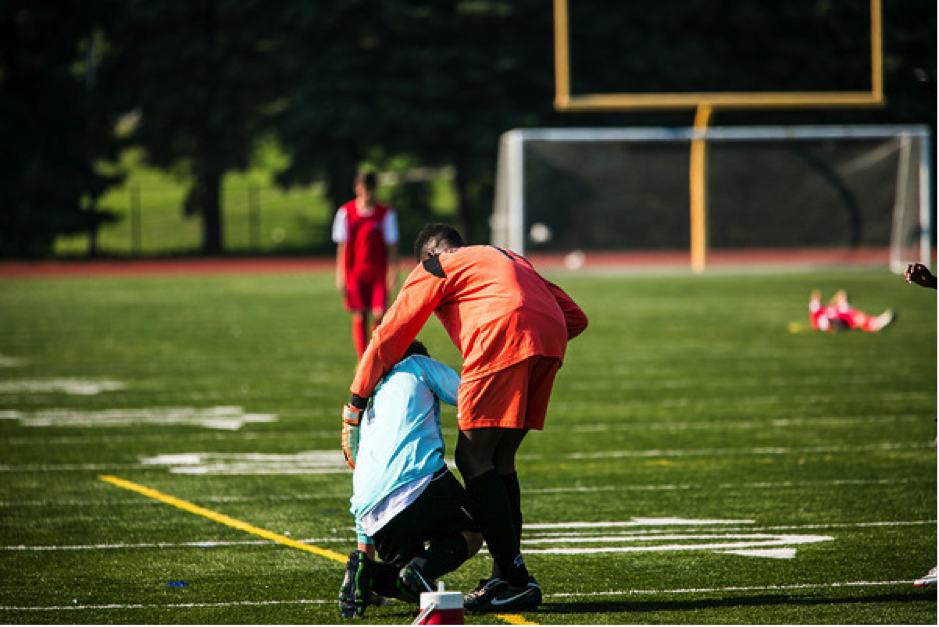
A couple of weekends ago, the Panthers faced their rivals, Brampton East Scorpions, in the semifinals.  They won on penalty kicks.  After the game was over this photo was taken of the two goalies:

John Wooden, UCLAs famous basketball coach noted that sports reveals character.  How many times I’ve witnessed the truth of that saying over my years standing on the sidelines: both in the boys’ behaviour on the field and the parents’ behaviour on the sidelines.  After viewing this photo last week, it certainly made me proud to know that Brandon is associated with teammates like this.

Derek Logan
Head of School

The Leader in All of Us

Read any good books over the summer?

I hope you all had time to enjoy the ‘dog days’ of summer. I know you didn’t have homework to supervise and uniforms to wash. While you may have continued working, I hope summer offered you time to slow down and curl up to a good book.

Our teachers did. All of our teachers read the book The Leader in Me, by the late Stephen Covey, renowned author of “7 Habits of Highly Effective People”. Every summer, KCS faculty read a common book that relates to an area of focus for the upcoming year. I stumbled upon The Leader in Me while browsing through the shelves at Chapters last Christmas. It told the stories of schools around the world, not too many, that had embraced what we also embrace at KCS: Habits that matter and ubiquitous student leadership. These are exceptional schools that have had exceptional impact. We’re on the same path.

Everyone has the power to be a leader. In fact, we exert our influence all the time, often without even knowing it. Last week all faculty watched Drew Dudley’s TEDxToronto talk “Leading with Lollipops” (http://www.youtube.com/watch?v=hVCBrkrFrBE ). A few words and an impromptu gesture on his part served to keep a peer in university and catalyzed a relationship that led to marriage. And he doesn’t even remember it. We’re all leaders, whether or not we know it. By recognizing and encouraging leadership in everyone, children included, there’s no limit to the positive impact on the world.

This may not have been the theme of the books you read over the summer. But I thought you’d like to know that this was the theme of what we read. Leadership is ubiquitous at KCS. And little by little, our students help make the world a better place. There’s always room for more. We hope you’ll embrace our Habits and join us.

Andrea Fanjoy,
Assistant Head, Academics

You can follow Andrea on Twitter @afanjoy.

The Yin and Yang of Learning

There’s nothing like our grade two International Celebration to remind me of the Yin and Yang of learning.

Last Friday, our grade twos showed up in costumes from around the world. In their grade-two way, they did a brilliant job at assembly and then back in their classrooms sharing what they knew about their adopted countries.

What I love about this is the way these projects immerse students in how different life can be elsewhere. Some people argue we should focus on our similarities with others, and of course there are many. However, I’m most grateful for our differences, because it’s our differences which make us reflect anew on ourselves.

When I lived in Japan, not a single day went by when I didn’t learn something new, something that made me pause and adjust my understanding of the world and what was possible in it. Among all those lessons was that of Yin and Yang, and the notion that life is full of complementary opposites – it always was, is, shall be and should be – just like night and day.

This flies in the face of the primal Western mindset – the conviction that all can and should be great, that happiness should be a singular goal, and that frustration, setbacks, and grief are bad and to be avoided.

Heavy stuff from a grade two showcase.

Taking place one week before the end of school, I can’t help but reflect on the year. We wholeheartedly strive to maximize the Yang (light) part of the duality. Learning should have many successes. It should have moments of unbridled joy. There are so many such moments at KCS that a book couldn’t capture them all, let alone a blog.

It’s also important to remember the presence and the role of the Yin (dark).The year has also had frustrations, tears, injuries, and conflicts. There have been disagreements, hurt feelings, difficult discussions, and problems that lingered longer than anyone wanted. We work hard to minimize them, yet they happen anyway.

Life happens in complementary opposites, and life happens at KCS. Learning to be resilient is one of our KCS Habits because being resilient is necessary to get through the bumps inherent in a life fully lived.

We’ll keep working to make as much happiness as possible at KCS. And we’ll keep working to help our students face any setbacks. Knowing what matters in life includes both.

Thanks for the reminder, grade twos. And thanks to everyone, teachers, parents and students, who live through the Yin and Yang with us. It has been a great year of learning.

Andrea Fanjoy,
Assistant Head, Academics

You can follow Andrea on Twitter @afanjoy.

Drinking From the Stanley Cup

Three or four of you might have watched the conclusion to the NHL season last night.  If you are really interested, you may have watched the postgame celebration on the ice and in the dressing room with the Cup.  You may have asked yourselves, I wonder what the liquid is they are drinking when they pass the Stanley Cup around.  A KCS grade one boy has the answer.

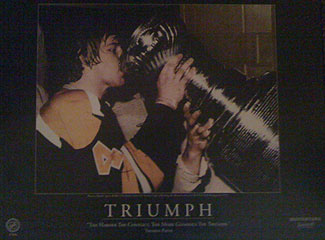
Last week, I was sitting at my desk at the end of lunchtime, when two grade 1 boys asked if they could come in and speak to me.  The first boy asked me if I could do anything I want in my job.  Before I was able to respond, his sidekick looked over at a poster I have in my office with Bobby Orr drinking out of the Stanley Cup after winning it in 1972.  At the bottom of the poster it states:  TRIUMPH:  “The harder the conflict, the more glorious the triumph.”—Thomas Paine.  He asked me who was in the photo and why is he drinking out of the Cup?

I told him the photo was of Bobby Orr and it was taken in the dressing room right after the Bruins won the Cup.  This caused him to pause, look at the poster and then back at me and ask, “So he was really thirsty so he poured some water into the Stanley Cup and had a big drink?”  “Exactly,” was my response.

Derek Logan
Head of School

How a Regular Dose of Fiction Can Make You a Better Person

“We have discovered that fiction at its best isn’t just enjoyable. It measurably enhances our abilities to empathize with other people and connect with something larger than ourselves.”

–     Dr. Keith Oatley, University of Toronto

My son had the benefit of being mugged the other day. Thankfully, it happened through fiction, in this case, Eric Walters’ book Shattered. He also had the experience of working in a soup kitchen, meeting people who are homeless, and hearing their stories.

My son is a reluctant reader who will only independently gravitate to baseball magazines. Like many other parents of reluctant readers, I do back flips trying to entice him to read books. On a recent occasion, with six baseball-based novels in hand, my son said the following: I hate fiction. It’s not real.

Too bad for him, I had just read about the work of numerous psychologists, as explained in Oatley’s blog post “Changing Our Minds by Reading Fiction” at www.sharpbrains.com. He pointed out that fiction is a simulation for our social and emotional worlds. Though not true stories, they are real in their ability to act as experience that shapes who we are. And in fact, these researchers do find evidence that readers of fiction change as a result. Knowing of their work, I gave my son a bigger response than he expected.

Life is social. Experience is valuable. Reading fiction offers an infinite array of social experiences, equipping readers to better understand and navigate the complex and sometimes precarious social world in which we live.

Being mugged is something I hope never really happens to my son. Working in a soup kitchen and hearing the stories of those who seek warmth and a meal there is something I do hope happens to him, though as yet he’s not open to the idea. So be it. Thanks to fiction, he’s already started checking it out.

And while he’s still pinning his hopes on a future in baseball, I know he’s being prepared for much more.

Andrea Fanjoy,
Assistant Head, Academics

You can follow Andrea on Twitter @afanjoy.

KCS: Known In Ottawa

Last night, my wife and I attend a fundraiser for CAMH (Centre for Addiction and Mental Health).  I had the opportunity to speak to Dr. David Goldbloom, the newly appointed Chair of the Mental Health Commission of Canada.  You may recall our school was very fortunate back in January to have Dr. Goldbloom lead our Encouraging Dialogue panel on Mental Health and Our Children.

On Tuesday, he was attending a conference on Anti-Stigma and Mental Health in Ottawa.  As he came out of the conference, our grade 6 students were getting off their bus.  Our students are in Ottawa for four days as part of their end of the year trip.  He asked them where they were from.  One of our students said, “KCS”.  His response was, “You mean that great school in Etobicoke, Kingsway College School?”  The student was incredulous that he knew about KCS, but in his words, the “group were obviously very proud of their school.”  As Head of School, I love to hear these stories about our students and school.

Derek Logan
Head of School

Heroes Pop Up When Least Expected

Last Friday we held our fourth annual Grandparents Day at KCS.  Grandparents were invited to KCS to listen to the music from our bands and choirs, view the amazing Heroes art displays throughout the school, and visit their grandchildren in their classes.  With the exception of the torrential rains that hit the Etobicoke area, it was shaping up to be a great morning on Friday.

About 8:10 that morning, as I was downstairs reviewing the remarks I would give following the music presentations in Canada Hall, someone came down to see me to let me know there was a police officer in the main lobby.  As Head of School, there are few words that bring a knot to my stomach more than, “Derek, there’s a police officer at the front desk.”  I get the same feeling when being stopped by a R.I.D.E. program when I’m not drinking:  I know I haven’t done anything wrong, and yet…

As I arrived at the front desk, I realized that it was Officer Rick, our area’s Community Relations Officer.  He explained to me that there were PD days in both the public and Catholic schools so he felt that this would be a great day to stop by and visit KCS; my initial reaction to hearing this is not printable.  Needless to say, as the parents and grandparents were coming into the school, they saw not only his cruiser, but Officer Rick standing with me greeting the students.  I can only imagine what was going through their minds.  If I had been sharp, I could have explained he was here as part of our Heroes display, but that thought didn’t cross my mind until one of our parents planted the idea in my mind after the musical performances.  At KCS, as in life, you always need to be ready to deal with the unexpected.

This slideshow requires JavaScript.

Derek Logan
Head of School

Sandbox Learning

Imagine our Habits of Mind, Body and Action were grains of sand in a sandbox.

Mixed in the sand are heaps of creative and flexible thinking, collaboration, clear communication, and persisting. There’s sharing what you know, listening to understand, finding humour and making the world better. There’s even some showing self-control in the sandbox, but those grains may be a little less numerous somehow…

Now imagine playing in that sandbox.

Thanks to our electives pilot, I don’t need to imagine it. I get to play in that sandbox. Every Wednesday five grade 6 students and I meet for the Modern Languages Mash-Up elective. With the full support of Rosetta Stone language learning software, each student is learning the third language of their choice. Mandarin, Japanese, Spanish, Italian and Filipino are now languages being learned at KCS.

The sandbox part of the elective is the video we made for the showcase. The students had learned they were required to make a multi-lingual video where they each speak their respective languages. The rest was up to them. Thanks to all the various Habits, we were well on our way to making a tale of global conflict at high sea. Though we all brought various skills to the task, none of us had ever done all we attempted for this project. One jumped at the chance to write the script. Another set to work on Garageband, composing the musical track that would capture the mood of our saga. A third suggested we use Lego to enact the story, an idea that was met with a resounding “YES!” (and resulted in the precipitate drop in showing self-control – Lego is a powerful temptation apparently). Two others worked on the visuals, from building the Lego ships to putting together the iMovie. Most of us, at one point or another, didn’t know how to do what we were trying to do. That’s when we most felt we were in a sandbox. And that’s when I knew my little group of students and I were honing our lifelong learning skills. Our Habits were getting a healthy workout.

Much has been said about the unprecedented challenges and opportunities inherent in the decades to come. If ever the world was straightforward, it is decreasingly so. Tomorrow’s workers will likely face pretty bleak sandboxes sometimes, where they don’t know what to do but they must act anyway.

Our students will bring the Habits to their sandbox, plus some special experience playing in it.

I’m not yet sure how our movie will be received. Our plan, is for it to go viral once it’s posted on our KCS YouTube channel. You see, dreaming big is also part of playing in sandboxes.

But if it doesn’t reach blockbuster status, the educator in me knows it was all still worthwhile. The Habits have value beyond the making of this video.  And playing in sandboxes has value beyond the playground.

Andrea Fanjoy,
Assistant Head, Academics

With Awe and Appreciation

One popped in to help my Mandarin student with his pronunciation.

Two co-chaired a gala that will live on as the most fun gathering of pirates, Willy Wonkas, Godfathers, Flappers and other assorted book characters Etobicoke has ever seen.

Two others worked steadfastly, as always, in our Parent Network Store.

I sat with six at our strategic planning meeting on Tuesday. Another six joined the grade ones on their outdoor education trip.

About a dozen worked in the hallways putting up 309 pieces of “Hero” art.

Thirty hosted dinner parties for hundreds of grateful KCS Moms, Dads, Friends and Staff.

Dozens more gave generously in time, expertise and goods to our Feast of Fiction extravaganza.

… and that doesn’t even cover the whole week.

One of our KCS Habits is Respond with Awe and Appreciation.  Between all of the above, and the countless other ways parents help make KCS what it is – New Family mentors, Welcome Back BBQ, special lunches, library helpers, various fundraisers, Open House volunteers, the Board of Governors and committees, class parents, and many more  – I am filled with the awe and appreciation we aim to establish in our students.

With effort, the world can be pretty awesome. With appreciation for the huge contributions of our parents, our little corner of the world is.

Andrea Fanjoy,
Assistant Head, Academics