A Notion Worth Knocking

Working the brainI remember the indignation. I was a grade 8 student studying for a science test. I announced with all the wisdom and conviction of a 13-year-old that it was ridiculous studying all this science. “It’s not like I’m going to be a scientist!”

No doubt I would have joined the chorus today that also argues against learning and memorizing facts. Hardly a day goes by that I don’t read or hear the argument that students don’t need to know things like they used to. Anything one needs to know can be found on the internet.

A number of reasons why this notion is incorrect quickly come to mind: students need information as fodder for critical and creative thinking; people don’t always have the internet when they need it; you can’t simultaneously Google everything you need to know to think about a complex issue; much information we learn contributes to our sense of community and identity.

Reading Kathie Nunley’s book A Student’s Brain: The Parent/Teacher Manual, I can now add another definitive reason for why this notion needs knocking. Pure and simple, having to learn anything, anything, makes your brain stronger. The more the brain takes in, the more neural pathways become established. The more those pathways are repeatedly used, the more permanent those pathways become. The more numerous, varied and permanent those pathways are, the more ways in which the brain is ready to learn everything else it’s subsequently exposed to. Much like a muscle that grows whether you’re lifting barbells or babies, the brain is a use-it-or-lose-it organ. If you want to be good at anything in life, learn everything you can.

Along the way, you might even learn what I learned when applying to university. My undergraduate, as it turned out, was in science.

Andrea Fanjoy,
Assistant Head, Academics
You can follow Andrea on Twitter @afanjoy.

This article was first published in SNAP Etobicoke, June 2013.

Tough Stuff

“At first we argued consistently about what had to be done. Now we don’t argue and we compromise.”
–        A student in the Lego Robotics elective

TeamworkBeing Active is how some people relax. Acting with empathy is second nature for others. We universally enjoy those adept at finding humour. And we all know people for whom share what you know is a lopsided strength…

The KCS Habits are everywhere. Even a cursory read of the daily paper is an immersion in the Habits, whether by their presence or oh-so-unfortunate absence in world events. The challenge we’ve undertaken at KCS is for every person to have all of the Habits. Every one. At once. While it may be asking too much to say that all of our young graduates will have every Habit firmly and forever established, we do believe they’re old enough to be aware of the Habits that matter in life, and to reflect on where they’re strong and where growth is needed.

A recent assignment asked our electives students to reflect on their growth in some key Habits. Our songwriting, Renaissance Art and theatre students are clearly growing in their ability to create. Our Lego robotics students are doing an impressive job persisting in building and programming their robots. And the baseball students will all be sharing what they know when they instruct and coach the grade three students in the upcoming Baseball Classic.

What Habit do the students find toughest? According to the reflections, the one most students seem to struggle with is seeking collaboration.

What’s one of the most important attributes for success in one’s career? The ability to collaborate.

Good thing our students are working on it, and realizing the need to do so.

Andrea Fanjoy,
Assistant Head, Academics
You can follow Andrea on Twitter @afanjoy.

Students Speak Through Music

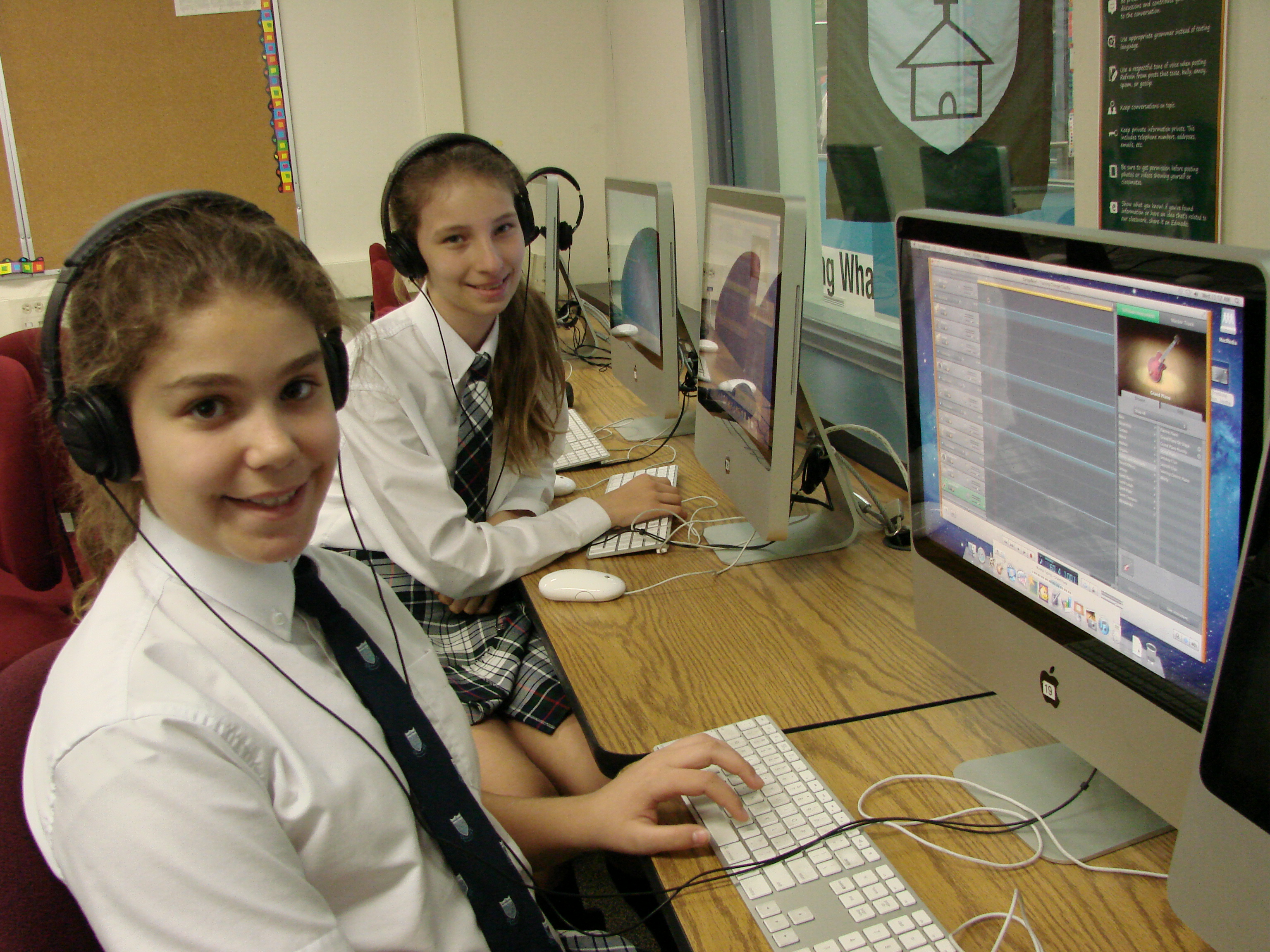
Tracking Change Tracking ChangeIn the elective, Tracking Change, students are in the midst of composing a music track that connects to a social justice movement for change. Students have composed music tracks that connect to issues of education, equality, anti-bullying, and animal rights. The complexity of these issues is further highlighted by the multiple layers and texture of the compositions themselves.

Seeing these tracks on the computer screen and seeing the students working collaboratively and creatively is inspiring. The issues, while different, are linked. Students somehow find ways to connect to one another throughout the process. Using Apple’s GarageBand, it’s amazing to see and hear how students have managed to create a track that speaks to us through music.

A visit to Humber College Studios introduced students to the exciting world of sound engineering. It was interesting to learn that our work with loops, controlling dynamics, balance, and instrument recording were similar to what was being done in a professional studio.

Since our visit to Humber, students have begun editing their final tracks. Instrument levels are being adjusted, voices are being recorded, loops are being softened. The tracks are growing and changing just like the issues they represent.

Now in our eighth week, some students have decided to take their tracks another step further. In order to really drive home their messages, some are incorporating the music tracks into an iMovie project.

It is incredible to observe this creative process and to see how passionate the students are when it comes to creating a track for change.

Who knows where the next couple of weeks will lead us? Stay tuned!

Matina Mosun
Music teacher

Student Leadership, Gone Viral

The following was first written for our community two years ago. Leadership projects are as viral as ever at KCS. Students clearly have great potential to make the world a better place. Please pass this on so more schools can help unleash that potential.

A small selection of photos from student leadership initiatives.

This slideshow requires JavaScript.


Student Leadership, Gone Viral

My day began by walking past a multicultural food drive organized by five boys in grade 6. Not much later, a student in grade 1 announced to me that he is saving his allowance to buy food for charity. Shortly after, a girl in grade 5 emailed to let me know she is helping a group of grade 3 students organize a talent show. I popped into a grade 5 class and witnessed a group starting to organize a poster contest. That afternoon, a different student in grade 5 came by to ask if he can start a student newspaper, similar to the one the grade 8s established a couple years ago. On my way out at the end of the day, I learned from a grade 4 student that he made a colouring and activity book for the grade 3 classes as a supplement to their unit on the rainforest. This, in addition to the dozens of leadership, community service and service learning projects I know our older students are working on. All in one day.

That is when it became clear student leadership was going viral.

The 21st century is for people who can make success happen. It is a century where leadership skills aren’t just helpful for the few, but required by all. At Kingsway College School, student leadership is a major pillar in our effort to prepare students for the 21st century. While not every day is punctuated by this number and breadth of student-initiated leadership projects, it happens often enough. If you long for a day like I had, the following are some steps that helped get us here:

1. Make time for it. Leadership is a timetabled subject in grades 6 to 8. Students learn about the important aspects of leadership, such as initiative, persistence, active listening, participation and flexible thinking. They use these periods to come up with their own leadership projects. They research, prepare their proposal, work out the logistics and deliver on their project. Awareness campaigns, charity drives, fundraisers and school and community events are some of the more popular projects, though the possibilities are endless. Reflection on the project and self-assessment of their growth is also a valuable part of the experience, and set the students up to be self-aware leaders throughout life.

2. Make leadership for all. Leadership is an egalitarian, unelected pursuit at KCS. It is open to anyone who wishes to initiate it and follow through. In fact, in the older grades, all students are required to learn about and experiment with leadership in their leadership classes. We don’t give students the choice of learning to read, and we believe we shouldn’t give them the choice of learning to be leaders. If it matters, everyone needs to start the journey.

3. Make it personal. Leadership can manifest itself in infinite ways, with the most powerful leadership being rooted in personal interests. Helping children find and leverage their passions to make a difference is an appropriate, though overlooked, role for education. At our school, one boy who loves to read committed himself to writing book reviews for the library. A group of girls who love to dance came up with a “Get Out of your Comfort Zone” Challenge, encouraging students and teachers to perform in assembly. Another boy and his friend prepared and delivered an unforgettable presentation on Down’s Syndrome, breaking myths surrounding that condition. There are dozens of different projects underway, each adding dimensions to everyone’s school experience that the faculty alone could never provide.

4. Let them lead, with guidance only. Many students are naturals at leadership. If invited, they will organize a group to deliver on a significant community project, regardless of age. Some students don’t find it quite as easy. They will need guidance. Give it to them. Also, give the students lots of freedom to change or drop their ideas, and even to follow through with unsuccessful projects, without penalty. Let this be a realm where they can learn to lead the way they learned to walk, being allowed to fall, and then cheered when they get back up and try again.

5. Let them be small. Very rarely are students solely responsible for huge leadership projects. Craig Kielburger, founder of Free the Children, is an inspiration but most children and youths, if really in charge, will come up with smaller ideas. Adults should resist the temptation to jump in and take the lead. It may end up big and polished, and it may even make a truly significant difference to the community or charity of choice, but it isn’t developing the students into leaders. When we step in, it’s the adults’ leadership skills that get honed, not the students. In fact, when faced with the large quantity of projects that need to be coordinated, small is generally the wiser choice for all.

6. Have a variety of opportunities. Leadership experiences at KCS take many forms: earning a brick on our Wall of Service in return for initiating an act of service; lunch supervision roles, where students assist supervising teachers; assisting with clubs and teams; House Captains; peer tutoring; leading assemblies; as well as all the opportunities to come up with one’s own project. We also point out to students the many unplanned opportunities for leadership during class, at recess and outside of school through setting a positive example, resolving conflicts or initiating an activity. The variety ensures there are many opportunities for everyone, at every stage of their leadership journey.

7. Have them share what they know. The presentation of leadership projects is at the heart of making them go viral. The school-wide presentations of our older students inspired the younger students to follow their lead. The result is an ever-increasing number of projects. Let the presentations keep happening. Visibility and quantity matter when creating a culture of leadership.

A word of warning. If you embark on establishing student leadership throughout the school, be prepared for an onslaught of students stepping up. Leadership potential is lying dormant, but will potentially overwhelm you if awoken. Larry Rosenstock, founder of San Diego’s High Tech High, has said a critical attribute for success in the 21st century is a tolerance for ambiguity. For a profession that is more comfortable with prudent adult planning, unleashing school-wide student leadership will rock your world.

Relax. It’s worth the ride.

Andrea Fanjoy,
Assistant Head, Academics
You can follow Andrea on Twitter @afanjoy.

Learning from Paddle Tennis

Starting in April, twenty lucky grade 7 and 8 students joined a Paddle Tennis elective at Kingsway Platform Tennis Club. We’ve enjoyed the elective and have learned many new skills. We wanted to share some of the Habits of Mind, Body and Action we’ve learned during our time playing Paddle Tennis.


Persist

During Paddle Tennis, all of the students had to persist. Whether we were new to the sport, or had played many times before, we all had to persist to play Paddle Tennis. If you were new to the sport you had to persist during drills and rallies to keep up to more advanced players. If you already knew the sport you had to persist by being patient and encouraging to new players.

Share what you know

During Paddle Tennis, we also had to share what we knew about the sport. All of the students had different things they were great at and things they could improve. Drills helped improve things we didn’t know and when we had already mastered something, we would help students who were still having trouble. Rallying with players at all levels taught us different techniques and strategies. More advanced students were a great help during games.

Overall, Paddle Tennis has been a great experience for everybody and wouldn’t be the same without our amazing teachers and instructors: Ms. Marcynuk, Ms. Silverberg, Ms. Gibson, and Mr. Rogers. We hope to continue Paddle Tennis in the future at KCS. We have made memories and learned things we will never forget. We can’t wait to return to Kingsway Platform Tennis Club to grow on our knowledge of the sport. See you on the courts!

A Beautiful Thing

It’s not easy being a teen. It’s not always easy being a young child either. Bring the two together to play, however, and life doesn’t get much better.

Grade 8, being our graduating year, brings a number of special responsibilities. Among these is the grade 8 – primary buddy program. In early October, each grade 8 student is assigned to be a buddy for a new student in grade 1 or 2. Their challenge? Get to know their young buddy, find out what they enjoy doing, and then do it with them over the course of the year.

Collectively they’ve had tea parties, picnics, dodge ball games, and Wii Dance recesses. They’ve played soccer outside, built Lego in my office and read together in the library. One group of buddies made a picture book together. Another particularly hard-working group organized a school-wide scavenger hunt. High fives and hugs are the signature greeting when they pass each other in the hall.

The joy and reverence on the youngest faces is tonic for troubled teens. The attention of the oldest, biggest and most respected students of the school immediately overrides any frustrations of being five, six or seven. Any students and teachers walking by can’t help but stop, smile and watch them play.

Life isn’t always easy or beautiful. Grade 8s making these occasions happen for their young buddies is undeniably beautiful. Make the world better is one of our KCS Habits. Thank you, grade 8s, for making our little piece of the world much better.

Andrea Fanjoy,
Assistant Head, Academics
You can follow Andrea on Twitter @afanjoy.

Teacher, Meet Brain.

Teaching with the Brain in MindThat’s how it felt to read Teaching with the Brain in Mind by Eric Jenkins. While the bond between the brain and learning has been known for centuries, the two have been notably coy. It is only recent research which has started sharing and subsequently sparking the intimate side of this complex relationship. And like the rush of first love, it will blow your mind.

My measure of a great book on education is the degree to which it ends up highlighted. Barely a page of Jenkins’ book escaped my yellow swipe. Starting with Neuroscience 101, Jenkins addresses many of the major areas related to learning and highlights the research and implications it has for teaching. From birth and beyond, he looks at preparing the brain for school; the connections between movement, emotions, and one’s physical environment with learning; managing the social brain; and optimizing motivation, engagement, critical thinking, memory and recall. Clearly affecting a significant chunk of the school experience, Jenkins is devoting his career to having teachers ‘teach with the brain in mind’.

Some insights include:

  1. The brain changes and can even grow new neurons throughout life. Nature and nurture both clearly play a role in defining who we are, with growing evidence revealing that nurture can override some nature, even to the degree of changing the impact of our genes.
  2. Exercise offers much more than just physical health. If you desire a denser and better brain, make regular exercise a lifelong habit.
  3. Much of what distinguishes teenage behaviour is rooted in the enormous changes taking place in their brains. Teens even temporarily regress in a number of abilities, such as their ability to recognize emotions in others.
  4. While collaborative learning gets most professional press these days, brain research supports the integration of group activities with traditional learning tasks for optimal learning.
  5. Emotions play a central role in learning and can hinder as much as enhance the brain’s ability to remember. Teachers would benefit from mindfully leveraging them.
  6. Frequent opportunities for movement, and breaks where no new learning happens, are important for long-term storage of learning.

Teachers, indulge in the intimate details of the learner-brain relationship. Meddle even. This is one couple that needs you in the middle.

Andrea Fanjoy,
Assistant Head, Academics
You can follow Andrea on Twitter @afanjoy.

This article was first published in SNAP Etobicoke, May 2013.

Sing a Song of KCS

SongwritingThis year has been the grade 6s first year with electives and we weren’t sure what to expect. Every Wednesday, for two hours, our group of three girls go down to the music room and try to write a KCS school song. Most people might think that songwriting isn’t very interesting (that’s what the three of us in the elective thought before) but it is the most amazing and fun grade 6 experience that we have ever had. All week we look forward to sitting down with all the instruments and playing whatever we want because there’s no wrong answer. Our goal is to write the KCS school song within 10 weeks and our progress has been incredible. The first three weeks, we brainstormed ideas of what KCS felt like, looked like, smelled like and meant to us and we came up with many sheets expressing our feelings. The fourth week, a singer/songwriter named Jennifer Foster came in and helped us a lot with how to write a song and which notes to use to give the overall warm feeling that we wanted for the song. Some of the words that the four of us kept coming up with were: warm, family, community, friendship and laughter because these words all describe KCS. We also wanted to include that you don’t have to be someone specific and you don’t have to change yourself to go to KCS. This experience has been one of the most educational, interesting, and fun experiences that we have ever had. None of us can believe how much work you can get done even while laughing and having so much fun.

Hope for Habits for Today and for the Future

Love the EarthThis past week was National Volunteer Week and Earth Week. The thing about celebrating weeks like this is that we hope that we raise awareness of important ideas. What we really hope will happen is that those ideas spread!

We have Earth Week activities at KCS:

  • Meatless Monday
  • Trashless Tuesday
  • Walk to School Wednesday
  • Turn off the Lights Thursday
  • Fill your Water Bottle Friday
  • Grade 7 service learning students reminded classes about energy conservation, water conservation, recycling, rain forest preservation, and more.
  • Grade 1 students participated in workshops presented by older students about water conservation and recycling.
  • Grade 2 students read books, wrote poems, and made posters about helping the planet.
  • Grade 3 students planted seeds and prepared soil experiments.
  • Grade 4 and 6 students cleaned up the school grounds and surrounding areas.
  • Grade 5 students will be calculating their eco-footprint using a carbon footprint calculator online.
  • Grade 7 students did a creative assignment about sustainable happiness. Sustainable happiness is ‘happiness that contributes to individual, community and/or global wellbeing and does not exploit other people, the environment, or future generations.’ (C. O’Brien)
  • Grade 8 students viewed Sharkwater, a film about sharks, their habitat, and the effects of humans on their ecosystem.

What we hope will happen is that our community learns about being friendly to the environment. We hope that they incorporate green habits that they will have for their whole lives, not just during Earth Week. We show this by having green habits integrated into our daily lives at KCS.

Similarly, we love and appreciate our volunteers at KCS! We don’t wait until volunteer week to thank them! Increasingly, our students are volunteering in our school and in the surrounding community. Once one person tells others how they volunteered to help, many of their peers are willing to join in the joy that comes from helping others. We are grateful to them and proud that they are making a difference.

Here are some of the many ways that students are volunteering:

  • Mentoring younger students
  • Providing lunch leadership to younger students
  • Leading chapels and assemblies
  • Conducting tours of our school to guests
  • Making gift baskets for local women’s shelters
  • Helping at a local church fundraiser
  • Refereeing basketball games for Special Olympics Ontario
  • Teaching younger students at figure skating
  • Caring for neighbours when they are sick
  • Sorting food at a food bank
  • Helping seniors at a retirement home

We hope that students see volunteering as one of the habits that they continue to do well after they have left KCS. We don’t have green habits only during Earth Week. And we don’t just volunteer or thank our volunteers during National Volunteer Week. But here’s to the happy future that comes from the habits learned at KCS!

Ms. Gaudet
Citizenship Coordinator

Habits Worth Having

What Are The Habits of Mind, Body and Action?Our students have lots of habits. Rather than trying to break them, we’re shamelessly celebrating them in our just-released school videos on how we develop lifelong learners at KCS.

If your habits need a little tweaking, you might be inspired by some of our students and the habits they’ve already embraced in their lives:

  • A student in grade 4 whose favourite habit is to take responsible risks, because it reminds her to try something new
  • A student in grade 7 whose favourite is to persist, because it’s what he knows he most needs to do
  • A student in grade 6 whose favourite is to share what you know, because if everyone did so we would all be smarter. Besides, collaborating is fun.

Check out our KCS Habits of Mind, Body and Action and think about which is your favorite? Why? Then share it with others, and do a little inspiring of your own.