“Can We Start Reading Now?”

It’s a Friday afternoon in the KCS Library, shortly after the Silver Birch program has begun.  There are swarms of children racing to the library after school to sign out books…..Silver Birch books!  Some of these students already have a book checked out for the weekend, but are worried that they may finish it early and not have anything else to read the rest of the weekend.  “Could I borrow a second book, just in case?”  How can I say no to such enthusiasm for reading?

The OLA’s Forest of Reading® Programs have been a tradition at KCS for over ten years.  Passports and reflection sheets, sharing thoughts and opinions through blogging, author visits, house competitions, and impromptu discussions in the hallway and classrooms are all part of the Blue Spruce, Silver Birch and Red Maple programs.  And like all traditions, enthusiasm for the program is passed from sibling to sibling.  I am often asked, the first week of school, when will it start this year?

I just love the BookBuzz around the whole school! Some things I’ve overheard:

  • “Did you like Space Raiders?”
  • “I liked The Swallow: A Ghost Story better than I thought I would!”
  • “Are there any more books by David Skuy?”
  • “My goal was 10 books last year, but this year I’m going to try to finish all 20!”
  • Clover’s Luck is here!  I can’t wait to read it!”
  •  “I’ve read all the books!  What else can I read?”

Not surprisingly, this tradition is my favourite time of the year.  There is an increased enthusiasm for reading, and even the most reluctant of readers can be found sitting on a beanbag chair in the library with a book in their hands.  At KCS, we are continuing to grow our culture of students who read for the love of it.  And there are many additional benefits. As People for Education published in a report, “Students with a more positive attitude towards reading tend to be more successful in all subjects”. (Reading for Joy, 2011.)

The Forest of Reading Program – It’s the Super Bowl of Reading!

Judy Dunn-Hoggarth
Teacher Librarian
Where Was This Thirty Years Ago?

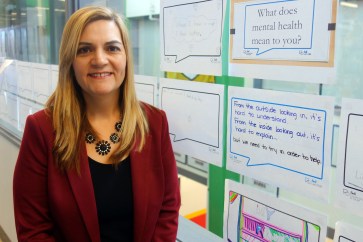
KCS_Where-Was-This-30-Years-AgoLast week, staff and students were asked to fill in a thought bubble about what mental health meant to them. After reading many of them, a flood of emotions and memories came to me as I have a brother who lives with a mental illness. Words like “brave” and “hero” put a smile on my face because that’s how I would describe my brother. These were not words I heard when I was a young girl dealing with this issue in my family.

People did not understand that my brother was sick. Maybe if he were in a wheelchair, people would have been more supportive. It is hard to understand something that you cannot see.

We have come so far with raising awareness and decreasing the stigma surrounding mental illness, but we still need to continue with these conversations, not just on Bell Let’s Talk Day. Here, at KCS, teachers encourage these dialogues with their students to promote good mental health. As uncomfortable as it may be for some, we embrace it.

KCS instills in our students key habits such as Act with empathy, Do what is right, and Make the world better. These children will carry kindness and empathy towards others for the rest of their lives. It makes me hopeful that this next generation of students will do their part to end the stigma towards mental illness. This makes my heart happy and it made my brother’s heart also very happy when I told him about what our students were saying!

Lucy Rizzuto
Senior Kindergarten Teacher

Practising the Hard Part of Listening

soundOne of our Habits at KCS is Listen to Understand. Hearing comes easily for most of us. Listening requires a bit more effort but we usually try our best with that. It’s the ‘understand’ part that is trickiest. Some cool things are happening here with that Habit and they’re a reminder of why it matters.

Understanding means stepping out of our old opinions, assumptions, and even otherwise-justified practices to fully understand those of others. It requires another one of our Habits, Flexible Thinking. Cognitive science Daniel T. Willingham helps explain why that makes it so tricky. In his book Why Don’t Students Like School:  A Cognitive Scientist Answers Questions About How the Mind Works and What It Means for the Classroom, Willingham explains that the brain, surprisingly, is not designed for thinking. That’s right. For all its smarts, it’s actually designed to avoid thinking. When listening, the unmotivated and undisciplined brain will work to hear what it wants to hear, or rapidly defeat what it finds contradictory and therefore too much trouble. Hmm. Does that sound like some conversations you’ve heard (or even had) before?

The KCS Habits are not just for students. Listening to our senior students recently, we introduced a modified timetable during the week of exams so grade 7 and 8 students had choice in how they spent their mornings: either in subject-specific extra help or an open-study session. Earlier this year, when our senior students asked for more independence, numerous other new practices based on student suggestions were introduced (some examples include: freedom to eat lunch with friends from the other class; grade 8s being allowed to eat lunch in the Student Lounge; Special Lunches for 7s and 8s in their corridor instead of Canada Hall; more choices for students who want to stay in to work during recess). Readers of “Stay Connected” are learning direct from the students about some of the changes they helped make happen. We listened and understood. The result has been a breath of fresh air for us all.

“Respect, manners and try your best” are school rules that we all strive to follow. Figuring out what’s best is tricky. Listen to Understand is the first big step. Students and faculty are showing they can take it from there.

Andrea Fanjoy,
Assistant Head, Academics
You can follow Andrea on Twitter @afanjoy.

Addressing the important question of “How do we keep our kids safe online?”

Stock Photo Child with Laptop

Join us for “Keeping Our Kids Safe Online” – Kingsway College School on Tuesday, February 9, 2016 at 7:00 p.m.

When organizing a panel for our February 9th KCS  Encouraging Dialogue Speakers Series, our committee kept hearing from families that they would like this year’s panel to address issues around social media and our children.

To start our search for speakers, we called KCS alumna Marianne B ‘01., whose work is with the Digital Media Zone (DMZ) at Ryerson University.  Marianne’s expertise helped guide us in the right direction, and this year’s panel is a result of her leadership.

In our initial conference call, Marianne said something that really resonated with our group.  I’m paraphrasing now, but she said, “When I was in grade 5 at KCS, at the end of the day I went home, played with my toys, ate dinner, did my homework, maybe did some extra-curricular activities or spoke on the phone, and then went to bed.  I didn’t have a phone connected to the Internet, and I didn’t have a laptop or iPad in my room.”  And this was only a little over a ten years ago.

A short pause to think about how things have changed, and will continue to change for our children, leaves one amazed.

Marianne and her parents did not have to deal with cellphones, texting, Facebook’s Likes and Dislikes, Snapchat, Twitter, Instagram or cyberbullying.   Although we might not have appreciated it at the time, I’m sure a number of today’s parents would like to see a return to just having their children play with their toys after school.  But that’s not going to happen.  For today’s parents and their children the ‘online world’ is a big part of their everyday lives.  Given this, how can we help our children navigate their digital experiences and keep them safe online?

We are confident our Encouraging Dialogue panel will help families address this important question.  We look forward to seeing you at “Keeping Our Kids Safe Online” on Tuesday, February 9, 2016 at 7:00 p.m.

Derek Logan
Head of School

What does Mental Health mean to you? Let’s talk about it!

Tomorrow, Wednesday, January 27, is Bell Let’s Talk Day.  This is a day where Canadians are encouraged to talk, text, and tweet in order to help encourage conversation around mental health, increase awareness, reduce the stigma, and raise funds to support mental health initiatives across the country (to learn more, go to http://letstalk.bell.ca/en/ ).

Here at KCS, we have made it a priority to address the importance of mental health and wellness for our students and our staff.  We strive to promote overall wellness through our programs, curriculum and extra-curricular offerings, and we’re determined to keep the conversation going every day. We encourage students to talk to their teachers, parents, or other adults in their lives when they are feeling as if something may not be quite right.  We work to assure all of our students that if they choose to talk to someone here at KCS, they know the conversation will happen without judgement or the need to feel any shame for how they are feeling.  And in doing so, we hope that this helps to reduce some of the stigma that exists around mental health.

Over the past couple of weeks, in grades 1 – 8 either your child’s health teacher or I have taken some time to talk about mental health.  The conversations and lessons have been tailored to be age- and developmentally appropriate, and aligned with the Ministry of Education Health curriculum.  As part of the lessons, and in following one of the Bell Let’s Talk initiatives of answering the question: “What Does Mental Health Mean to You?”, the students were asked to fill in a thought bubble to share their ideas around mental health.  These are now displayed in our front lobby and throughout the school.  Our youngest students framed their answers by telling what they do when they are worried about something; our grade 4s answered the question “What Makes me Happy?”; and our grade 5 to 8 students and many faculty explained what mental health means to them.

The answers are moving, insightful, and show that there is a growing understanding of what mental health and wellness means at KCS.  These answers weren’t prompted; they came from the heart of everyone who chose to share their ideas.  Read them, and be inspired to do your part to make sure this is a conversation that will continue each and every day. It is just that important.

Tamara Drummond
Director of Student Life

A Wonderful (Reading) Thing

Kids dash across the playground to update Ms. Pollett-Boyle on their progress. Since I’m the lucky one to distribute certificates when students complete a level, I’m swarmed daily with messages of “I’m done Level 5!” or “I’m now travelling in Egypt!” or the rather direct “Where’s my certificate?” The first week after Christmas holidays I heard more about levels achieved over the break than about presents under the tree.

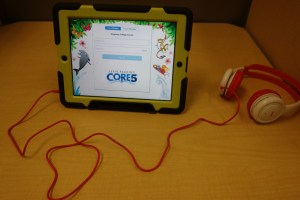
Lexia at KCSLast year we piloted a new online reading program called Lexia Core 5. It is offered as a supplement that students can use at school and at home, even on holiday if they so choose. It’s an adaptive program that helps develop core reading skills at the level and pace that’s individualized to be just right for every student. It includes re-teaching after mistakes, compelling graphics, and enticing little interludes, all designed to support, motivate, and optimize learning. The pilot was an evident success. One family was so impressed they generously offered to purchase a 3 year school-wide license. Each week, between 40 and 105 young students log on to accelerate their reading skills. — A heartfelt thank you to this family!
It’s wonderful to watch students learn. It’s not always adrenaline-fueled. The pace can be slow. On skills that are difficult, the school includes a fair amount of push and pull on the teachers’ part. So imagine the pleasure watching dozens of students driven to read (even learning the boring stuff like ‘dipthongs’ and other pesky vowel rules!).

Full disclosure, some runaway enthusiasm has led to excessive competition. That was a topic for a recent class meeting, and one more worthwhile lesson thanks to this powerful tool.

Lots of wonderful things happen at KCS and we’ve written about many of them already – the proof is in our blogs. Children swarming me with their achievement in reading? This certainly counts as one more.

Andrea Fanjoy,
Assistant Head, Academics
You can follow Andrea on Twitter @afanjoy.

An Inspired Lunch Hour with Random Acts of Learning

Every Friday at lunch recess, Mme Smith and I host Random Acts of Learning (RAOL) in the KCS Library. It’s a drop-in for any students from grade 2 and up to do, well, random acts of learning. Here’s what happened during last Friday’s lunch hour when 47 students came to RAOL:

  • Three students from grades 5 and 6 met to talk about a leadership project supporting Syrian refugees
  • One brought his Arduino kit to build a machine for his grade 7 service learning project
  • Two others worked on their littleBits ‘keytar’ (their own musical synthesizer)
  • A few others worked on the video games they’re creating themselves
  • Multiple others worked on their own independent projects, just because they want to learn more about something; this will culminate in a class presentation (Habit: Share What You Know)
  • Others are working on writing books, a few of whom are writing to submit a French book in a national contest
  • The newspaper club came to work on their upcoming edition
  • Some older students chose to study for exams
  • Many others just wanted more time to read

That was my lunch hour. How inspiring was yours?

Andrea Fanjoy,
Assistant Head, Academics
You can follow Andrea on Twitter @afanjoy.

Build Pride and Confidence in Reading and Watch Self-Esteem Soar

There’s a young student at school who I have worked with for a couple of years now. When I first met her, she was a bright-eyed, energetic child, with a wonderful imagination, who delighted in challenging me to games. When she was able to surprise me or beat me at a game, the laugh that rang out of her was pure joy.  She was an absolute delight – confident and happy.

But the next year, she was less enthusiastic, especially when it came time to read out loud. In fact, she would often have spontaneous aches, pains, or itchy bug bites that would prevent her from reading to me. I soon realised that she was no longer feeling confident about reading, and no amount of reassurance from me seemed to help for more than a few minutes.

DSC02354

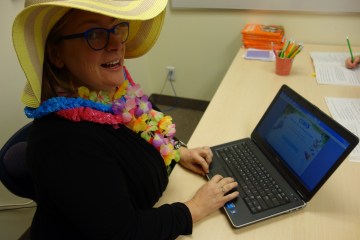
Ms. Pollett-Boyle working with Lexia. Her holiday outfit courtesy of KCS Spirit Day – Beach Day.

Mid-year, I introduced her to Lexia.

At first, she needed encouragement to use the program, and a little support to help her understand the instructions. But once she had a little taste of success, that started to change. Soon, she was regularly coming up to my desk to tell me about the 20-second humorous videos that tell the student they have met the target number of correct responses for that task.  (As we know, brain research shows that humour creates new neural pathways which help move new knowledge to long term memory.)

Passing a level in Lexia is the equivalent of a third of a grade level – or one term. Each level has scenes from a particular place, and the mini videos are connected to that location. Students travel the world as they progress. The day this student received her first visit from our Assistant Head, Academics, Mme Fanjoy, to congratulate her on moving up a level in Lexia, it was a real turning point in her motivation. It was an enormous achievement, and she knew it – and it also meant she was leaving London and going on to explore Paris!

Her new motivation to pass another level was evident. Each day she would stop me or Mme Fanjoy to tell us she had worked on Lexia the night before (a fact I already knew, because teachers can check on their students’ progress online). One day she came into class and told me she was having “Lexia dreams” at night, in which she passed 30 levels all at once.

Then, on one sunny spring day, I was out on yard duty for recess. I watched as this student ran full speed toward me, all the way from the entrance of the park, with a huge smile on her face. Of course I already knew what she was going to tell me (I had been rooting for her at home the night before, when I checked in to Lexia to see how she was doing), but nothing could have beat that look of pride and confidence that she had when she told me she had passed another level. Goodbye Paris – hello NEXT LEVEL CITY!

Teresa Pollett-Boyle
Learning Strategies Teacher, Drama teacher, Arts Coordinator

Haircut, Anyone?

We knew we were in for a treat when PK, JK and SK students joined KCS three years ago. But we didn’t expect manicures, facials and haircuts!

Anyone walking down our Senior Kindergarten hallway last week will have doubtless noticed the many signs advertising these services and more, for a price, by our SK students. No, this is not a mandated unit of study. Much better, it’s what an enterprising and imaginative young group decided to make happen.

From what I’ve seen, these young entrepreneurs are working on establishing about a dozen of our KCS Habits – habits that will set them apart wherever their future takes them. Their writing and counting are also getting emotion-driven practice. Positive emotions are booster fuel for learning.

Thanks to our faculty’s efforts with Project-Based Learning and their readiness to support student initiative, the whole KCS community benefits from dozens of student projects equally delightful. But this is the first where I can also get all fancied up for the holiday season. Thank you SKs!

This slideshow requires JavaScript.

Andrea Fanjoy,
Assistant Head, Academics
You can follow Andrea on Twitter @afanjoy.

KCS Pre-Kindergarten Students Love to Share

‘Sharing What You Know’ is one of the KCS Habits of Mind, Body and Action, so I want to share with you one thing I know about our Pre-Kindergarten program. When I’m in the PK room, my heart fills with joy. Yes, they are our youngest students in the school and yes, they make me laugh, but my heart fills with joy because they share with me what they know from the moment I walk into the room.

The other day, as soon as I entered, one child said, “Miss De Kuyper, I’m building a house!” I could tell he was proud, and I asked him who was going to live there, to which he replied, “You!” When another child put round connectors up to her eyes, I asked her what they were. She looked at my bespectacled face, smiled and said, “Glasses!” Several children brought me toys that matched the colour they were wearing that day, while some told me what they were “cooking” with playdough.

At the beginning of the school year, the PKs are coming out of toddlerhood and into the next stage of learning; something that a lot of us take for granted. This time in their little lives is huge, and it sets the stage for every year of learning after it. When children are given time to explore, they learn to identify colours or how to build a sturdy house, all while learning to share toys, space and ideas. Children absorb what they see and hear, and as the world unfolds around them, the PK program provides them the space to drive their own learning as they continuously share what they know.

Bonnie De Kuyper, RECE
PK Teacher