
Math at KCS

MathYou’ve likely already noticed that math is a hot topic in mainstream media these days. While newsrooms haven’t always been following the subject, we have.

Monitoring the profession from a global perspective, and debating strengths and limitations of our current practice, are part of the day-to-day work at KCS. This determination to do our best for every student over the years has led to a number of initiatives, such as:

  • Constantly growing collection of tools for differentiating instruction in the classroom, so all students can learn what they need at the level that’s right for them
  • Introduction of math workshops (small-group dedicated instruction) in grades 6 to 8
  • Introduction of JUMP Math in grades 2 to 5, where we think it’s the best fit
  • Introduction of the online math program Math Help Services in grades 7 and 8, where we think it’s the best fit
  • The use of Khan Academy to help support differentiated instruction
  • Widespread participation in the Brock University Caribou Math Challenge
  • The use of the University of Waterloo Math Problem of the Week in multiple grades for rigorous problem-solving
  • Introduction of computer programming with Visual Basic through our electives program, a language that requires significant use of advanced math

These are on top of our longstanding commitment to ensuring students master their basic math facts; avoiding the use of calculators except when appropriate and in the oldest grades; having ample experience with problem-solving; and enjoying generous use of concrete materials in their youngest years.

In the Family Satisfaction survey, a number of parents asked about our math program, in particular math in our older grades. I’m happy to report that our Canadian Achievement Test scores from last year are the best ever in the school’s history, with our senior students on average achieving in the 91st percentile across Canada in math concepts, and the 93rd percentile in computation and estimation. In fact, from grades 3 to 7, the grades that undertake the CAT test, the average percentiles were all at their highest ever, ranging from the 84th to the 94th percentile. We regularly hear from alumni and their parents that our students do very well in grade 9. Any feedback to the contrary is explored to determine what, if anything, can be done better.

Our math teachers have worked tirelessly over the years to help every student master what they need to know. For students who can’t get enough math, we won’t stop looking for more to give. For students who find math a relatively daunting challenge? Attentive teachers, with multiple tools, some being online, is great news for them too. And when news media have moved on to other issues, we’ll still be learning, debating and improving what we do.

Andrea Fanjoy,
Assistant Head, Academics
You can follow Andrea on Twitter @afanjoy.

The Journey to Come

“It is good to have an end to journey toward; but it is the journey that matters, in the end.”

Ernest Hemingway

Here we are, at the start of a new school year. Our teachers have been hard at work planning this year’s journey, much like parents planned the wonderful family holidays we’ve heard about since our students’ return. In the same way that our students will soon be goal-setting for the term, here are the school-wide areas of focus, the ends if you will, that our teachers are working toward:

  1. Living the Mission, with the Habits of Mind, Body and Action; Project-Based Learning; service learning; student leadership; Learning for the Love of It; and more  that support the development of lifelong learners, that I look forward to sharing as the year unfolds
  2. Student Wellness, following up on feedback from students in our Student Voice; faculty and staff-wide professional development (PD) on mental health first aid and faculty PD on Attention Deficit Hyperactivity Disorder; a review of our Social-Emotional Learning practices; and full launch of our concussion protocol
  3. Technology, with more 1:1 and 1:2 access from grades 3 and up, and increased access to iPads in grades JK to grade 2
  4. Assessment, with the development of a new report card for next school year and the exploration of other new tools to help capture and share the story of our students’ growth
  5. Writing, with the pilot of new tools in multiple grades
  6. Social Studies and French, to align with the new Ministry curriculum in these subjects

Some of our areas of focus are ongoing from previous years. Others are at the start of a multi-year focus.

Much like a good journey, you can’t plan for everything. Surprises likely lurk, as do bumps in the road that will need to be worked around. Ongoing collaboration, flexible and creative thinking, persistence and responsible risks will carry us forward. At KCS, that’s what happens on the journey, and that’s what matters in the end.

Andrea Fanjoy,
Assistant Head, Academics
You can follow Andrea on Twitter @afanjoy.

It Works! (Question and Be Curious, But How? – Part II)

Question and be CuriousI thought it would!

A few months ago I wrote about the book Make Just One Change and the methodology it shared for teaching how to come up with good questions. For all the value of questioning, it seemed to me that the profession was pretty barren on direct methods for teaching this skill. Instead, some students seem to come by questioning naturally, and others pick it up as they mature, or not. Of course, students are exposed to lots of questions at school, and they’re regularly invited to come up with questions. Despite this, my gut was telling me we could accomplish more.

Then I read about the Question Formulation Technique (QFT). Immersing students in question-asking, it also offers the benefit of learning from one’s peers, it releases students from the threat of judgment, and it includes informed reflection, so students would start developing not only the habit of asking questions, but also the habit of asking increasingly effective ones. The method struck me as straightforward and destined to work. I had to try it out, and our grade 6 teachers were willing to let me. Their students were about to start their culminating social studies assignment and they needed questions to begin. Enter the QFT.

The Question Focus (or QFocus) was ‘Canadians Making the World Better’. The process began with a ‘question frenzy’, where groups of 3-4 students, one also being the ‘recorder’, came up with questions based on the QFocus. Rules of engagement were shared before the 7-minute frenzy: ask as many questions as you can; do not stop to answer, judge or discuss; write every question as it’s stated; and any statements were to be turned into questions. The recorder typed the questions in the class Edmodo newsfeed, thereby allowing all students to eventually see the questions of the whole class when the exercise was done.

The frenzy was followed by a brief exercise in open and closed-ended questions; a discussion on the students’ current purpose in asking questions (their QFocus and their assignment); and then an exercise in choosing and justifying their top three questions from the many others they came up with earlier.

The end result? Better questions than the teacher had seen students come up with in past years. They were mature questions that even caused concern in some parents who thought they were too hard (until they learned they came from their children). The students were welcome to change their questions if they felt they needed to, but instead most chose to stick with them, and by doing so ended up writing longer and better assignments than required.

Good questions are at the heart of great learning. At KCS we’ve seen over and over again that students are capable of more than most would expect, if we only persist in finding how to unlock it. We’ll be adding QFT to our list of tools for unlocking potential in students. And this will be one area of education where I no longer have that nagging feeling that we don’t do enough.

Andrea Fanjoy,
Assistant Head, Academics
You can follow Andrea on Twitter @afanjoy.

A Brilliant Move

It’s usually a humbling experience when somebody comes along and succeeds with ease where you have already failed miserably. But sometimes you need a little humility to get to a place of deeper understanding.

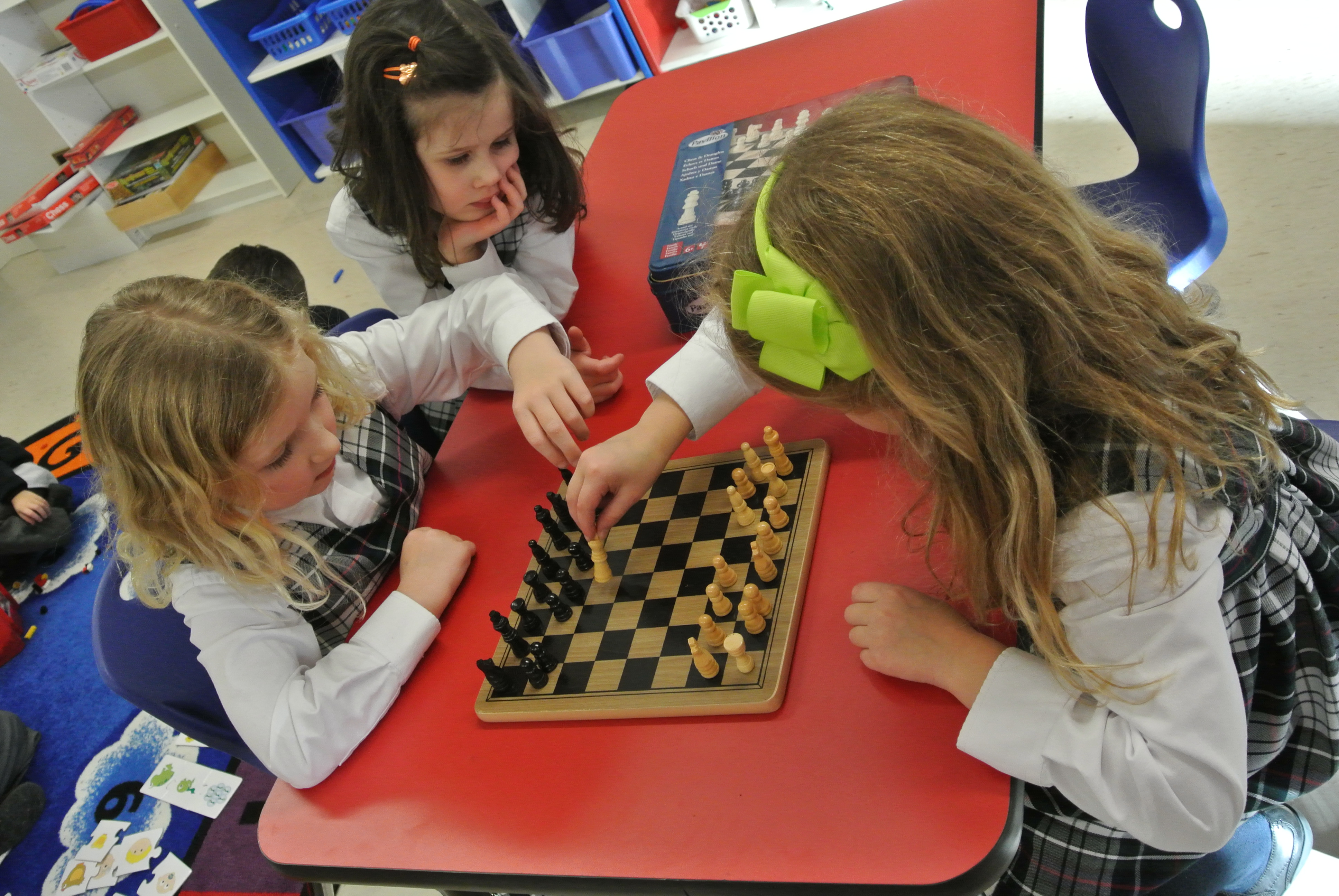
SK Chess at KCSWay back at the end of September, I tried to introduce chess to the SKs. I played up the thrilling warfare angle, created backstories to help explain the way the pieces moved, and generally did my best to sell the students on a complex and exciting game of strategy. One month later, the boards were gathering dust and the knights were being used as “guys” in LEGO castles.

But then a Grade 5 student came along. She had recently read a book called The Queen of Katwe, which chronicled the life of a poor rural Ugandan girl whose love of chess helped her pull herself out of poverty and set her on the path to becoming a world-class Grandmaster. Inspired by the story, she decided that her leadership project would be to teach chess to the little ones in Kindergarten. So she recruited a few friends, hunted down some extra boards, and started coming every Friday at lunch.

chess 3The first visit from the Grade 5s was at the start of January. And with only a few visits, these student leaders have inspired almost half the SK kids to pick up the game and give it a try. The class now cheers when they see “Chess Club” on the daily schedule, and pick-up games during free choice time have become a common sight.

For me, watching these Grade 5s succeed where I had failed has reminded me that the Official Teacher Voice of Authority just can’t compete with joyful enthusiasm from a fellow student. Peer teaching is a powerful tool, and I feel so fortunate to have ended up at a school where it emerges and grows in an organic and authentic way.

Mark Magee
SK Teacher

Question and Be Curious, But How? – Part I

One of the biggest challenges in education is in knowing how far you have to go to make sure all students learn what matters. Some skills are picked up by many quite readily. Other skills, not so much. For some things the profession has a wealth of precedent, other things not so much. Deciding how far you have to go is driven by experience, knowledge, assumptions, and the amount of time teachers have to think about it once all other important demands are dealt with.

Question and Be Curious is one of our KCS Habits, and all evidence says it’s a habit that matters. It’s no exaggeration to say that democracy, progress, and the understanding of all that happens are rooted in asking and seeking answers to questions, and doing both well. Learning to ask questions readily and well, however, is not easy for many. Sure, students learn the grammar behind asking questions, and goodness knows they get thorough immersion in being asked questions. But teaching the art of question-asking lies in an educational no-man’s-land. When and how are students taught to ask their own questions?

The widespread absence of an answer to that challenge occurred to me as I read the book Make Just One Change by Dan Rothstein and Luz Santana, based on the work of The Right Question Institute. To be fair, most teachers try in various ways to develop this skill, and many students pick it up, either readily or over time, to at least some degree. That being said, and despite pretty significant efforts, I haven’t seen a system that can directly develop this skill in all students that is more convincing than what’s shared in this book. Called the Question Formulation Technique, it immerses all students in asking questions, directly teaches students about them, and engages them in critical analysis of their questions in order to develop awareness of the suitability and relative value of questions. According to Rothstein and Santana, students who’ve gone through this exercise have found it transformational. While I haven’t yet experienced it, I’m convinced enough of its potential that I’m borrowing a class to try it out.

Does it work? Will it work for every student? If it does, what impact will this have on their learning? These are the questions I am asking. Stay tuned for Part II of Question and Be Curious for the outcome.

Andrea Fanjoy,
Assistant Head, Academics
You can follow Andrea on Twitter @afanjoy.
Consider a New Year With No-Marking Time

What would happen if students weren’t marked?

I’ve heard too often that the assumption is little learning would happen, so this post starts with a sad state of affairs. Thankfully, the true answer is both heartening, and possible.

Marks are an imperfect reality in formal education. While feedback is a valuable part of learning, marks wield power that is disproportionate to their brevity. Their power reinforces the notion that learning is something externally imposed. Marks judge, and regularly remind too many students that they simply fall short. From the attention they get, it too frequently appears that marks have usurped learning as the reason for school.

Contrary to what might be assumed, it’s not necessarily better for those earning high marks. Understandably, these students are lulled into liking favourable judgment from others and commit themselves to this model. Both the successful and struggling alike have a relationship with marks that has little to do with the resilience, curiosity, independence and internal drive needed to be successful beyond a mark-driven world. Taking risks, like the ones needed for leadership, creativity and innovation, has no place when marks are on the line.

Outside of school, it’s very evident that children and youth will readily learn without being marked. While marks are here for the foreseeable future, there’s no reason why schools can’t make room where students learn for learning’s sake. Give them time to choose what to learn and how. In these cases, let them set the standards and expectations. Let them share this learning with others without judgment, simply to create an environment of learning for the love of it. Let them take risks. Support the process and leave it in their hands, as these are the hands that need experience if the end goal is lifelong learners. I’ve seen it work. I’ve seen what students will learn when marks aren’t involved. It takes nothing but a willingness among teachers to make some time for it, then let it grow.

To teachers looking forward to a well-deserved Christmas holiday, consider starting the new year with time for unmarked learning. It’s a risk worth taking. And no marks are on the line.

Andrea Fanjoy,
Assistant Head, Academics
You can follow Andrea on Twitter @afanjoy.

Embracing Learning

As expected, lots of learning is underway at KCS.

What you might find interesting is to learn about what our teachers are learning.

Every year includes ongoing professional growth for faculty. Much of the learning is individual in nature, as all faculty are encouraged to identify areas in which they feel they want or need to grow, and then to pursue that learning. Some learning is common to groups of faculty, such as when we collaboratively address a challenge or pilot a new initiative. On top of all this activity, each year has school-wide areas of learning.

So, what faculty learning is taking place this year?

  • Many are receiving formal training in teaching Reading Mastery, a Direct Instruction program that has proven very effective since our pilot the year before last.
  • Among those who are proficient in teaching Reading Mastery, two are now working on becoming certified trainers in Direct Instruction programs.
  • We have teachers taking additional Faculty of Education courses in areas such as math and special education.
  • One teacher is working on her PhD.
  • Many of us have attended conferences and workshops on best-practices in kindergarten.
  • Six are in the midst of a ten-module Leadership Institute with CAIS (Canadian Accredited Independent Schools).
  • A number of teachers are currently receiving professional development in the area of mental health, and sharing what they learn with all faculty.  In addition, we are developing our own professional development in this area for all our staff which will begin early in 2014.
  • All teachers are learning about new applications in technology, from self-study, in-house training and by attending conferences.
  • Many teachers are learning from global professional networks on Twitter and Pinterest; an increasing number of teachers are learning to use these tools so they can develop their own network; a few teachers are learning how to leverage Twitter as a classroom tool.
  • Many teachers have signed up for external workshops specific to their subjects.
  • All are advancing their abilities to offer Project-Based Learning (PBL) opportunities in their classes, using the books PBL Starter Kit and PBL in the Elementary Grades that we all read over the summer as a common planning tool.
  • All are growing as a result of the collaborative planning and problem-solving inherent in making the most of every student’s day.

Our students have days full of learning. Our teachers do too.  Developing lifelong learners is what we do at KCS. Whether young or old(er), embracing learning is a Habit that applies to us all.

Andrea Fanjoy,
Assistant Head, Academics
You can follow Andrea on Twitter @afanjoy.

In Case You’re Wondering: Curriculum Planning By Design

LearningI recall as an elementary student admiring the coiled manual my teacher held in her hand. Believing that book held the key to my learning, I ambled through my young non-teaching years thinking good teaching was pretty straight-forward.

Boy was I wrong.

Optimal teaching is anything but straightforward. It doesn’t come from a book, but grows thanks to the endless efforts of the teachers who deliver it, and thanks to a culture that supports them.

By now, KCS parents, you’ve already met many of the outstanding teachers at KCS. You might be wondering, however, about the culture that drives what we do. It’s worth wondering about. It explains how these teachers grow from each other’s strengths and create learning experiences that surpass anything a single teacher could deliver on their own. Here are the elements of a culture that leads to a curriculum where 1 + 1 = 3:

  1. A foundation rooted in knowing each student’s needs, aspiring to our school mission, and a broad awareness of the tools and techniques that will help us meet both
  2. Regular collaboration and frank conversations
  3. A framework that meets or exceeds Ministry expectations
  4. An environment free of practice based on doing what’s comfortable, unsupported opinion, what’s in fashion, how we were taught or what we’ve always done
  5. An atmosphere saturated in the Habits of Mind, Body and Action, so teachers and students exercise and strengthen them through their work (Embrace learning, think flexibly, take responsible risks and do what is right are some of the stand-out Habits required in curriculum development.)
  6. A balance between Direct Instruction, Project-Based Learning, and other learning experiences, as deemed worthy
  7. An ever-present search for how to enrich learning, inspire a love for learning, inject critical and creative thinking, and differentiate instruction

I sure wasn’t aware of this as a young student, and don’t know that many outside of KCS faculty would be aware of it either. I do know you care a lot about what we do with your children, and thought I would share how we determine what we do, just in case you were wondering.

Andrea Fanjoy,
Assistant Head, Academics
You can follow Andrea on Twitter @afanjoy.

For Goodness Sake, Get Connected

Red Apple on ComputerThis one’s for teachers. And for everyone else who can pass it on to teachers.

We’re a pretty passion-driven lot. We work with children to meet their vast array of needs because we want to make a difference, the biggest difference we can. Ready to face daunting challenges each day (the more we learn the more challenges we’re aware of), we’re fuelled by a desire to do good.

Well, for goodness sake, get connected.

I’ve downloaded a 60-page guide on Project-Based Learning from a tweet. Videos, blogs, articles, websites, people and resources directly valuable in my day-to-day and strategic work are regularly on my feed. I’ve had Twitter chats with teachers from around the world. Tweets sent during conferences include attachments that boost the learning for all exponentially. My experience isn’t special – it lies in wait for any teacher who gets connected and builds a network. No single conference, workshop or book can replace the quantity and breadth of daily learning that comes from a professional learning network on social media.

Teachers around the world have embraced social media, particularly Twitter, like no other profession. While classroom walls and traditional timetables continue to separate us physically, more and more teachers are reaping the benefits of an infinite number of colleagues from whom to learn. Gone are the days when you have to know everything, solve everything and create everything largely yourself.  We have always tried our best. With a much bigger knowledge base and tool kit than traditional professional development can ever provide alone, our best can now be much better.

If you’re a teacher and not yet connected, take the leap. Twitter stands out for efficiency and access to the largest number of educators and content. For the visually-inclined, check out Pinterest. Enjoy selecting the colleagues of most interest and relevance. No need to tweet. No need to post. Just learn.

I wish you a great school year. With a global professional learning network by your side, you’ll be on your way toward your best one yet.

Andrea Fanjoy,
Assistant Head, Academics
You can follow Andrea on Twitter @afanjoy.

Teachers wanting to learn more about Twitter should check out www.edudemic.com and their “Ultimate Twitter Guidebook for Teachers”.

Summer Learning

SummerCubbies are cleaned. Lockers lay bare. Papers have been sifted through with favourites kept and the rest thrown out.

Summer holidays have arrived, and the weight of the academic world has been lifted for another year.

I’ve been guilty of thinking that children have it relatively easy. I can remember once pointing out to a group of teens how hard their teachers are working, leading extra-curriculars, teaching all day, marking and planning every evening. I deserved their immediate challenge. They reminded me that, in fact, students also have a lot of demands on them. They’re involved in those school extra-curriculars and more, they’re in those classes throughout the day, and they’re doing homework every evening. They have endless expectations on them for managing themselves and their work. Many regularly face misunderstanding, mistakes and reprimand in both academics and social relations. They navigate this world with the vulnerable self-esteem, self-confidence and skill set inherent in being young. Even in the best schools, the days are not easy.

Many parents and teachers bemoan the long gap between June and September. It’s true that some academic learning can take a hit. Having said that, other learning should be savoured in the summer. Because the school year doesn’t always make enough time for it, here is some of the summer learning I hope all children work hard at this holiday:

  1. Learning through play
  2. Learning through mistakes
  3. Learning within one’s strengths and passions
  4. Learning and relaxation in a healthy balance
  5. Learning what and how you want, just for the love of it

Lots of important things are learned at school. And lots of important things are learned outside of school. Like students, teachers also learn a lot over the summer. Maybe, as a result of all their learning, more of this summer learning will work its way into the school year.

Have a wonderful, learning-filled summer.

Andrea Fanjoy,
Assistant Head, Academics
You can follow Andrea on Twitter @afanjoy.

This article will be published in the July 2013 edition of SNAP Etobicoke.