The Art of Parenting in a World of Worry

WorriedEighteen years ago, expecting our first, I remember saying that I intended to have a different learning activity ready at home for every day of my child’s youngest years.

That was the first of countless parenting notions that didn’t go at all as planned.

It’s easy to laugh at some of what my husband and I thought before the reality of parenting hit. Many assumptions were thoroughly throttled when it became clear our boys were their own individuals, with their own minds (funny we didn’t assume they’d get that from us!).

What isn’t funny is the worry that comes with parenting these days. Media and much of society suggests that there’s plenty to worry about; the threat of future unemployment, mixing with the wrong crowd, bullying, drugs, excessive online gaming, online predators, ‘failure-to-launch’ from home and more lurk in the dark edges of our minds. These potential threats are alarming, to be sure. They are worthy of our watchful eye, and intervention when needed. But Alex Russell, clinical psychologist and author of Drop the Worry Ball: How to Parent in the Age of Entitlement, suggests that the more alarming and widespread problem is how many of us are responding to the threats.

Drop the Worry Ball is an account of how our generation of parents has saved our children from failure, to the unhealthy end that they’re unable to deal with failure on their own. Our well-intended efforts to ensure their lives unfold as desired have left them ill-prepared to face the obstacles, the “non-catastrophic failures”, inherent in a life fully-lived.  Be resilient is one of our KCS Habits because it’s an attribute that’s both a necessary yet under-appreciated part of success. Where children used to learn resilience, today they’re experiencing crippling anxiety or engaging in avoidance behaviours (endless gaming being one example) to alarming degrees. Many feel entitled to getting their way, and have become deft at manipulating parents to make it so. Messing up and not getting what we want is unpleasant, sometimes deeply so. That being said, they’re a powerful way, and arguably the only way, to learn how to pick oneself up, learn from mistakes, and face life undaunted. They’re a whole lot better than a life unlived.

I don’t know if my parents worried as much as I worry about my boys. I do know they let me face life with a great deal of freedom, and my fair share of non-catastrophic failures. They kept their worry in check so that I might become the adult I am today. If my husband and I can keep Russell’s message in mind, our boys will also become self-reliant adults, as my husband and I assumed they would be.

It just may not unfold as planned.

Alex Russell is speaking at KCS Monday, April 14th at 7 p.m. All are welcome and admission is free. His book Drop the Worry Ball will be available for sale at the event.

Andrea Fanjoy,
Assistant Head, Academics
You can follow Andrea on Twitter @afanjoy.

M&Ms and A Soccer Shoe

Coated chocolate candyOne evening last week, just before 8 p.m., I was driving my daughter, Alyssa, to her weekly piano lesson.  She turned to me and told me that she thought that her brother, Brandon, needed M&Ms for his grade 9 Business class the next day.  Let’s just say I was not pleased to hear this news at that time of night.  My first question to her was when did Brandon find out he needed these M&Ms?  Once she hesitated in her answer, I knew he found out last week, but forgot to tell either my wife or myself.  I told her that I wasn’t going to the store to buy them at that point in the evening and Brandon would just have to figure it out the next day.  Alyssa knew I meant what I said, as both she and her brother remember the time when Brandon was younger and he arrived at his soccer practice with one shoe.  You may have guessed this, but I didn’t drive home to get the other shoe.  If you have never done this before it is interesting to watch someone play soccer with one shoe.  I am pleased to say that since that practice, Brandon makes sure he leaves the house with all his gear before getting in the car.

Unfortunately, I will never know whether the lesson I was trying to teach Brandon with the M&Ms and being prepared for school made a difference.  When I got home from picking up Alyssa from piano, there was a package of M&Ms on the counter in the kitchen.  My wife, Heather, went out and bought them.  We hadn’t agreed on my M&M strategy in advance…

Derek Logan
Head of School

If It Feels You’ve Gone Through the Looking Glass…

“It would be so nice if something made sense for a change.”
-Lewis Carroll in Alice in Wonderland

Into the looking glassParenting has these moments. Teaching has them too.

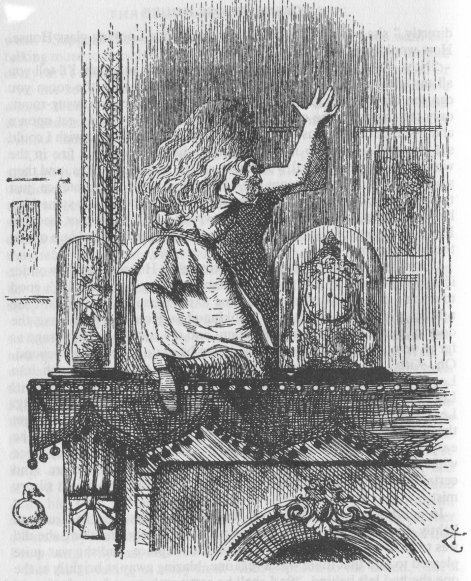
Our school musical this year was Wonderland!, a spin-off of Lewis Carroll’s classic Alice in Wonderland. As a child, I wouldn’t have noticed the dimension of the story that became evident the other night, when Alice stepped through the Looking Glass and everything turned backwards. To a child, this story is a feat of imagination, a delightful trek into a world that doesn’t exist.

As a parent and educator, it connected with something a little less fictional. It reminded me of the times where my children have come home and bemoaned things that didn’t make sense. It reminded me of times when students complain of an egregious injustice at recess, only to learn that what really happened was a little more complex and nuanced. And it reminded me of some discussions with concerned parents, who recounted what their child told them, and I had the opportunity to share some other relevant details that brought sense to a story in need.

Children aren’t cognitively and emotionally ready to fully understand their world. The perspectives and messages of others, body language, context and the implications of their own actions are often overlooked, not out of dishonesty but out of ordinary immaturity. Even adults struggle with this, and we are all vulnerable to using our imaginations, however unwittingly, to help explain a situation in a way that may please us, but is not a representation of all that really happened.

If your child comes home with a story that leaves you feeling as if you’ve gone through the Looking Glass, take heart. You needn’t go through the many adventures of Alice. Reach out to the adults who can add the facts needed to turn this backward world into one that makes sense. Doing so offers a delight that is preferable to the temporary treat of imagination. Even Alice came to realize it. “It was much pleasanter at home, when one wasn’t always growing larger or smaller.”

Andrea Fanjoy,
Assistant Head, Academics
You can follow Andrea on Twitter @afanjoy.
This article was first published in SNAP Etobicoke, April 2013.

Be Careful What You Believe

WarningThis morning as I was reading the paper I came across this story about a local high school.  When I go home tonight, I will show this to my two kids and remind them, what you read on line is not necessarily the truth.

http://www.thestar.com/news/gta/2013/02/11/schools_seemingly_racist_rules_about_africanamericans_an_online_hoax.html

Derek Logan
Head of School

The Jekyll and Hyde of the Internet

Good and BadThe Toronto Star recently published an article asking, “Is the internet bad for us?”. Good question.

Nothing excites me more than each step forward in doing our best for students. Every concern addressed, every lesson made more impactful, and every child we more effectively connect with is the reward that reenergizes us for the next day. While not always the case, technology and the Internet, in the hands of a determined and mindful teacher, frequently play a role in these steps forward. Though I stand firmly in the camp that says the technology glass is more than half full, I’ve seen enough to know that keeping The Star’s question in the back of our minds is an important part of ensuring the glass doesn’t get knocked over.

The article lists many reasons for concern: family time dominated by laptops and texting, decreased ability to converse, constant desire for affirmation, lack of time alone with one’s thoughts or playing side-by-side with others, etc. The social conflicts inherent in growing up now often play out in cyberspace, where slights, or worse, take on a much greater significance than anything the pre-Internet generation had to face. Growing up is hard, and this generation’s abundant use of the Internet amplifies the highs and lows of this critical stage. Raising children is hard, and the Internet has likewise been a mixed blessing for parenting.

The Internet is here to stay, and to bemoan what’s bad is to miss out on all that’s good. But to revel in the positive without attention to what’s not is unwise. Teaching responsible use of the Internet is now part of what schools must do. Monitoring and having reasonable limits on use at home is now part of what parents must do. With these efforts in place, we can happily answer the opening question, “It could be bad, but not in my family.”

Andrea Fanjoy,
Assistant Head, Academics
You can follow Andrea on Twitter @afanjoy.

Understanding the Teen Mind

Working in education doesn’t make parenting easier. It does, however, let me spend part of my work time learning about why children behave as they do. Increasingly, what I learn is rooted in brain research. Once one of life’s greatest mysteries, the thinking behind behavior is being revealed like a classic whodunit, thanks to magnetic-resonance images of the living, processing brain.

Questioning MindOf all the stages of development, parents and educators strive hardest to understand the teen years. An exciting yet characteristically turbulent, boundary-pushing stage where adults may often be inclined to ask, “What were you thinking?”, we’re fortunate to now have an answer. Two parts of the brain feature prominently in adolescence. The prefrontal cortex is the part of our brain most linked with mature judgment and self-control. The amygdala is the seat of our emotions. The biological details of what these two are doing during adolescence are best left to worthier publications than this column, but a satisfying metaphor shared by Ron Morrish, behavior specialist, is that of a construction site. The prefrontal cortex undergoes significant growth and change from the preteen years until the early twenties. It effectively becomes a construction site that, like any other, is unavailable for regular use. Where does the detour take an adolescent mind? The amygdala. This helps explain the oft-incomprehensible emotional swings that the adolescent, and those in their wake, must ride.

This has big implications for what we do as parents and educators. Dr. Ron Clavier, Clinical Psychologist and Neuroscientist, has laid out these implications, and related strategies, in his acclaimed book Teen Brain, Teen Mind: What Parents Need to Know to Survive the Adolescent Years. Humour, extensive experience and knowledge of the physiological underpinnings of this amazing stage have made Clavier a most-welcome voice in my world at school and home. If there is a teen or pre-teen in your life, I’m guessing he would also be a welcome voice in yours.

Dr. Clavier is speaking at Kingsway College School, 4600 Dundas St. West, at 7:00 p.m. on Wednesday, February 6th. Admission is free, and copies of his book will be available for sale. More details are available at www.kcs.on.ca/Speakers. Parents, educators, teens and all others who want to better understand the intriguing teen mind are welcome to join us.

Andrea Fanjoy,
Assistant Head, Academics
You can follow Andrea on Twitter @afanjoy.

Making a Difference, Thanks to Parents

I knew it as soon as I heard them.

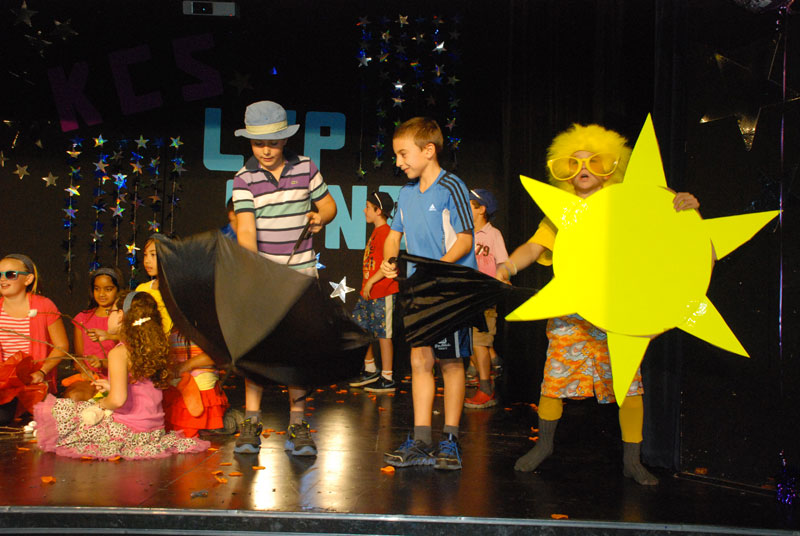
Two Moms, climbing the stairs near the Multi-Purpose Room, heaved a huge sigh.  This was the week of the annual KCS Lip Sync and these intrepid volunteers had just led a dance rehearsal with their children’s class. We crossed paths in the stairwell, we chuckled over the challenge, and off they went.

KCS Lip Sync 2012This is to thank all the parents who devote their time to helping make KCS the special place that it is. We have parents who volunteered through the summer to mentor new families. We have parents who have worked endless hours in the store. We have parents who commit their days and evenings to committee and board meetings as well as in the role of class parents. We have parents who organized an outstanding Welcome Back BBQ! We have parents preparing for our upcoming Special Lunch, parents helping in the library, parents hosting grade parties and parents who have helped supervise field trips.

And those of you who attended last week’s Lip Sync for grades 1 to 4 know that we also have a very special group of parents who are willing to do what for most is unthinkable: choreographing and teaching dance to our youngest and least focused, even dancing alone as the children’s example, in front of a Canada Hall full of spectators. What a terrific show of spirit, confidence and the joy of dance to start the school year.

Thank you to all who have already made a difference at KCS and thank you in advance for making a difference in ways to come. We’ll keep teaching your children to lead and make a difference. And we’ll point to you as examples to follow.

Andrea Fanjoy,
Assistant Head, Academics
You can follow Andrea on Twitter @afanjoy.

Thanking Others

For the past couple of weeks, I have watched my wife, Heather, prepare for a raffle for my son’s soccer team. One day she came home from a parents’ meeting and let me know that she had volunteered to do this. Heather sent various emails, wrapped baskets, answered phone calls, made a couple of visits to the mall, etc. She has received thanks from various families, the coach and team manager, and disappointingly dealt with some ungrateful families along the way. Heather would talk to me about these responses, but as she said to me, it wasn’t about her, it was for the boys.

Heather’s ex-military. She gets the idea of service to others. All she wants is a thank you when she does something like this raffle. In our “discussions” about the raffle, I mentioned how tremendous our volunteers are at KCS. How they are involved in a wide variety of activities, both in the classroom, in our school store, on the Board/committees, on school trips or organizing school wide events (such as the Welcome Back BBQ, the Christmas Cracker, the Gala, etc.). Heather knows that by volunteering without the expectation of getting something in return besides a thank you, she was setting a terrific example for Alyssa and Brandon.

The commitment of time by our volunteers for the benefit of the students of KCS allows us to do so much. I know Heather’s time preparing for the soccer raffle will benefit the boys on the team. When our families choose to give their time to KCS, the staff, faculty and students appreciate it. We remind our students to say thank you to our volunteers, and I do my best to say thank you to our volunteers in person, via a phone call or an email. Each of you, by volunteering, act as examples to your kids and reinforce our curriculum about the importance of doing things for others. If you’ve been involved in volunteering at KCS this term, thank you. Without your commitment, we would not be the school that we are today.

Derek Logan
Head of School