Design-thinking Debut

Future Design School Workshop at Kingsway College School

Inaugural KCS By Design workshop.

Have you heard of design thinking? If not, you might want to read further. It’s a process full of possibility, that’s literally changing countries. In a school that aspires to making the world better, it belongs.

Design thinking is a process that takes a group of people from ‘complex problem’ to ‘solution’ in ways that are exceptionally correlated with success. Design thinking deeply engages all stakeholders, requires them to empathise with all affected, and reins in the more typical ‘rush to conclusion’ so creative win-win thinking has time to emerge. San Francisco-based IDEO is renowned as a source of world-changing design thinking. Schools and organisations around the globe that have lofty aspirations are following their lead.

KCS is too.

KCS recently launched our new KCS By Design program. It leverages design thinking and Web 2.0 technology to connect interested senior students and staff in making KCS outstanding. It is open to all students in grades 7 and 8 and all staff who wish to join. Involvement can be as simple as joining our dedicated Wiki, where members can post what they see as challenges, problems or opportunities for KCS. Involvement can also be as significant as students and staff working together to make solutions happen.

As part of KCS By Design, members were invited to attend our inaugural workshop on design thinking, facilitated by Future Design School on November 3rd. The students and faculty in attendance chose to pursue a challenge posed by a student: How can we better enable KCS to differentiate learning? We’ve started an exciting journey to figure that out. Many other ideas for how to improve KCS were also identified, and these are now posted on our Wiki for others to run with.

While two FDS facilitators worked with our intrepid group, we learned that other FDS facilitators were in Paris leading a group of CEOs through the exact same design-thinking process. Good to hear.

We’ve always known our students were destined to make the world better. It’s nice to know that CEOs are learning to do the same.

Andrea Fanjoy,
Assistant Head, Academics
You can follow Andrea on Twitter @afanjoy.

Common Sense on Character

One of our KCS Habits of Mind, Body and Action

One of our KCS Habits of Mind, Body and Action

“It’s great to have him back, but I already run my class and raise my daughter according to his book.” — a KCS teacher

I knew it as soon as I heard Ron Morrish, speaker and author of Secrets of Effective Discipline and With All Due Respect, over 10 years ago. His message on how to develop self-discipline in children would transform my approach as both educator and mother of two young boys. Seven years ago he first spoke at KCS. This month he visited with faculty once again.

Many parents and visitors have remarked on the manners and behaviour of our students. Stand-out moments for visitors are how often they’re greeted by students and have the door held open for them. For a bustling community of 369 students, over 60 staff, and the many parents and others who join us each day, the atmosphere is happy, respectful and purposeful. While there are many good reasons for that, one is Ron Morrish and how KCS has incorporated his pointers into our day.

Ron is the first to say that much of his advice captures how many of us were raised. He says it’s the “common sense” that, unfortunately, is less common these days. So what’s included in this common sense on character? Here’s a small sample:

  1. Always model the behaviour you seek
  2. Teach the behaviour you seek; don’t assume children should know how to behave at all times
  3. Be clear and ensure follow-through on directions
  4. Make sure small things are done properly and consistently (manners, holding doors, routines)
  5. When mistakes happen, require a “do-over”; mistakes mean more practice doing things right
  6. Take proactive steps so children can be successful behaving as they’ve been taught
  7. This all takes persistent work

Parents, you’ll be glad to know that your children’s teachers spent an afternoon enjoying a refresher from Ron Morrish. And to the parents and educators seeking more self-discipline among the young in your midst, consider looking into Ron’s teachings. As it has for many of us, it could really make a difference for you too.

Andrea Fanjoy,
Assistant Head, Academics
You can follow Andrea on Twitter @afanjoy.

“Make Something that Does Something” with littleBits

littleBits at Kingsway College SchoolParents at Curriculum Night could probably sense my excitement at bringing the Maker Movement to KCS. Now that the students are back, it’s time to get making.

This will be a marathon, not a sprint, but tinkering with electronics has already started for students visiting the library’s new Imagination Station. Students can borrow the littleBits Workshop set and readily start creating things that “do something”.

What might they want to make? These videos help tell the story of what others are making with littleBits, from the young and novice, to the older, more serious, make-it-yourselfers:

littleBits is an amazing new tool helping to bring electronics to the masses. I’m excited to see how this innovation in turn will inspire our students.

Andrea Fanjoy,
Assistant Head, Academics
You can follow Andrea on Twitter @afanjoy.

Who We Become

“The quietest people have the loudest minds.”…This is exactly how I would describe myself. It’s like it was written for me. But KCS has helped me express all that creative energy swirling through my mind by teaching me about the importance of communication, the importance of patience, and most of all, the importance of being yourself.” — A grade 6 student

LearningEach May, our grade 6 students write a final five-paragraph essay describing the most important ways in which they’ve grown over the course of the year. The three paragraphs that followed the one above described in detail how the myriad of lessons, projects, opportunities and personal choices throughout the year led to this student’s self-assessment. It’s all part of how this one student came to know more about what matters in life. All of our students have their own story of growth.

That’s half of what I love about KCS. Each day we’re surrounded by students growing, whether in reading, writing, math, research, public-speaking, confidence, leadership, service, performance, creativity, empathy and every other possible way that matters.

The other half of what I love about KCS is how, as a member of staff, we also get to grow. While we collectively bring many strengths to our jobs, and we gladly share them with our students, we’re all also constantly growing, whether through curriculum reviews, workshops, returning to university, endless online courses, professional learning networks, professional reading, and frequent meetings, formal and informal, to address challenges, seize opportunities, and just become better every day.

This summer had me learning about design thinking, electronics with Littlebits and programming with Arduino. Three years ago, I never would have imagined I’d be learning those things! I’ve also been learning a lot about all the creative energy that can be expressed with these in the KCS tool kit, and I look forward to sharing more about how this will increasingly happen at KCS in upcoming blogs.

There’s actually a lot more I love about KCS, but watching students grow, and having the opportunity to grow alongside them, is what I anticipate most as the new school year is set to begin. KCS students can look forward to a great year of learning ahead. KCS staff look forward to the same.

Andrea Fanjoy,
Assistant Head, Academics
You can follow Andrea on Twitter @afanjoy

Layers for Learning

I often think of the show Wipeout, and its unconquerable obstacle course, as a metaphor for what we do. The more appropriate way to describe how KCS works, I suppose, is to talk of layers. Whichever works for you, it speaks to the big back story of what happens at KCS and it’s what needs to happen in any school striving to reach all students.

Every school has objectives, many dozens in fact. We have academic objectives in every subject and grade. At KCS, we have equally significant arts, athletics and citizenship objectives, though that doesn’t necessarily set us far apart from numerous other schools. Our Habits of Mind, Body and Action are a further set of objectives, but having them is not what matters. What matters are the layers of effort designed to achieve them – the number, the variation among each, and the ongoing commitment to keep adding layers to make sure no student leaves before our objectives are achieved.

I’m regularly reminded of this. The other week, I popped by one of our grade 5 classes. They were in the midst of an impromptu speech-giving activity, where students volunteered to pick a topic from a bag and give a 45-second speech in front of their classmates. Having already done this previously, some students assumed a semi-Rex Murphy polish, naming their moments in the spotlight “Nonsense with Noah” or “Yapping with Yarema”. Tomorrow we will experience our monthly “Wake Up With the Arts” showcase, where students volunteer to perform in the lobby. Friday mornings are typically spectacular student-led assemblies that have students from SK to grade 8 speaking to the school, including everything from reading a brick to leading school-wide contests such as “Minute to Win It”. This month was the impressive Primary Project Fair. French plays in most grades are around the corner and we just recently enjoyed the annual Café Couguar, our French café for the KCS community hosted by grade 8 students. I could go on at great length. Let this suffice as a peek into a few of the many layers that go into just public-speaking, one of many key objectives that we work endlessly to achieve with every student.

Too often, discussion on the topic of education centres on one practice over another. It supposes, erroneously, that one approach could be enough. In reality, education that makes a difference with every student needs a multitude of approaches, layers if you will, so if one layer doesn’t work for one child then the next one might, and if not that one then the next. Anything less than that will likely reach some students but be insufficient to reach all.

Wipeout isn’t my go-to program for professional development, but I’ve joined my boys at the TV often enough to see how, by design, no contestant can make it from start to finish without being “caught” somewhere along the way. That’s where the metaphor works. School has to accomplish many things with each and every student, and must ensure it does so before those students move on.  It’s no easy task, and something the profession continues to struggle with. The answer won’t be found in one approach, or two or even three. It’s in the multiple various layers of intervention, and the ongoing commitment by teachers to never end in their quest to find the layers that work for each of their students.

Andrea Fanjoy,
Assistant Head, Academics
You can follow Andrea on Twitter @afanjoy.

Redefining What’s Possible: Math Help Services

‘Redefining What’s Possible’ is a series of blogs that highlights stand-out tech tools being used at KCS.

The other day a student asked to use my office at lunch to work on math. By the end of lunch recess, I learned he used the time to do three different versions of his homework assignment, persisting until he got the full set of questions right.

MathHomework has a patchy record in this profession. It always has. One big glitch with it is when students have homework that they, unknowingly, don’t do correctly. This can happen to anyone when learning something new, and is particularly common in advanced math when the concepts to be practised are far removed from the rest of our lives. Traditional math homework has students carry on regardless (because it’s due and will be checked), with more than a few doing it incorrectly. In essence, these students practise doing it wrong. That’s right – despite best efforts, homework helps some become proficient in doing it incorrectly. Hopefully, mistakes will be picked up by both teacher and students the next day, whether in class or extra help. Hopefully, correct practice will then be fully established. The students will all ably move on to the next concept to be practised at home that evening. That is the ideal.

Unfortunately, the ideal can be elusive, and most of us know that for a fact. Multiple obstacles could be at work, and differ from student to student – the well-practised incorrect method; students not paying full attention during homework correction for any number of reasons; students not getting enough practice doing the work correctly; students not getting enough direct, immediate feedback, among others. A quantum leap in homework effectiveness would give students fast direct feedback on their homework, make reinstruction readily available whenever needed (24/7), and make it easy to redo homework, multiple times if necessary, until it’s done well.

That’s where one innovative technology is redefining what’s possible. Every student wants to learn and do well, but many traditional practices don’t readily support it for all. There are many reasons why the Math Help Services program in grades 7 and 8 is making a positive difference to student learning, but one significant reason is the difference with homework. Students find out immediately after completing a set of questions how they did. They learn right away in the privacy of their home (or my office) which questions were right and which were wrong. They have unlimited access to multimedia instruction and step-by-step examples to correct misunderstandings. And with the click of their mouse they can request and receive a new set of homework questions on the same topic. Trying a second or third time, homework marks invariably go up. The students learn the concept with however many questions they need, and are ready to go on.

There’s an additional benefit this technology provides that’s soundly rooted in brain research. Math Help Services lets the teacher create regular concept reviews with questions from all concepts previously taught. Research has clearly established the power of extended, mixed practice of learned concepts over intense, repetitive practice of just single concepts. The former leads to mastery, the latter leads to the all-too-common math affliction, “I don’t remember how to do it!” And like all other homework, the students can access as many versions of the concept review as they need to get the mark, and mastery, they seek.

Was the one student in my office an anomaly? No. The majority of our grade 7 and 8 students take advantage of doing homework assignments multiple times, as needed, forging through different question sets until they nail them.

That ideal isn’t elusive. It’s here and making sure math gets learned.

Andrea Fanjoy,
Assistant Head, Academics
You can follow Andrea on Twitter @afanjoy.

Grade 2 Students Learning to Build Our Wall of Service

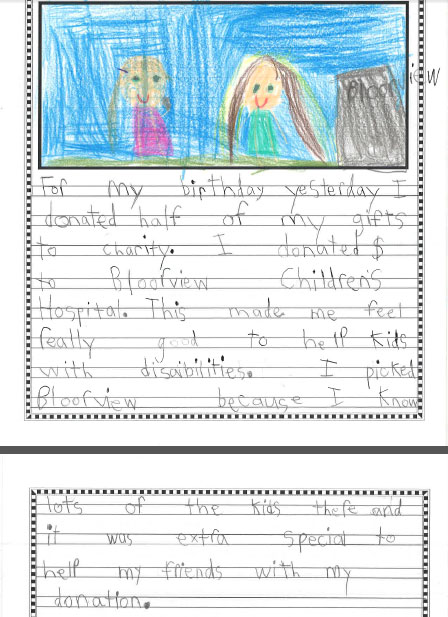
“I wanted to play the piano for a nursing home. But they never answered my call. So I went around my block giving Christmas cookies out. I did this because I wanted to spread Christmas spirit.”

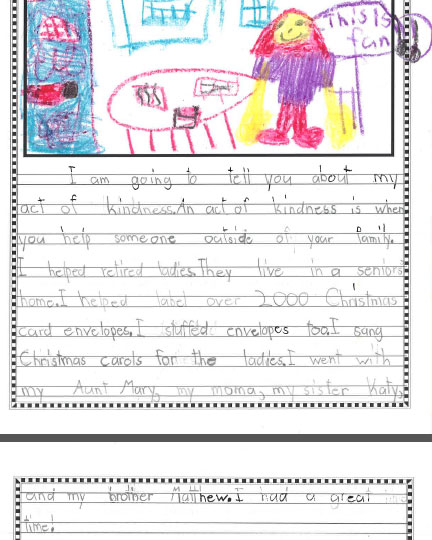
KCS Student Donation to Bloorview Children's HospitalOther grade 2 students cleaned up local parks, read to kindergarten students and collected donations of various worthy items. Some did chores to donate money. Unlike the young man who didn’t hear back from the nursing home, one student was lucky enough to spend time volunteering and singing Christmas carols at a seniors’ residence. For every grade 2 student, there is a heartwarming story of service.

In late fall, the grade 2 students at KCS are officially introduced to the expectation that they, as individuals, are expected to make a difference. Though this message is shared with all students from PK, and we have many younger students earning bricks for the Wall of Service, the grade 2 unit on service is the first time they’re all expected, on their own, to think of how to make the world a bit better and then make it happen. With much gratitude from us, parents are asked to help make their child’s plan possible. Hearty discussions, problem-solving, and persisting no doubt went into much of this activity, just like it does in any important work. At the end of the effort, the students shared in a writing assignment what they did and how they felt for all their efforts. Emphatic expressions of happiness were the widespread reply. One further explained, “It made me feel good to give instead of take.”

KCS Student Spends Time at a Seniors’ ResidenceEach grade 2 student received a ‘brick’ for their act of service, and each has now been called up at assembly to share what they did, for which they received loud applause. By telling the school about their collective efforts, the whole KCS community continues to grow in its knowledge of how each one of us can follow their lead (there’s no end to the ways we can each make the world a bit better!).

Thanks to the grade 2s and others who earned bricks recently, KCS is looking forward to a dress-down day on April 17th. More importantly, thanks to the grade 2s and all others taking the initiative to make a difference, the world really is a bit better for many. Most importantly, with this unit behind them, the world now has 40 more individuals who are ready and able to keep making a difference.

According to one write-up, one woman at a park, upon seeing two students cleaning it up, said “That’s amazing. Way to go!” We agree.

Andrea Fanjoy,
Assistant Head, Academics
You can follow Andrea on Twitter @afanjoy.

Redefining What’s Possible: TodaysMeet

‘Redefining What’s Possible’ is a series of blogs that highlights stand-out tech tools being used at KCS.

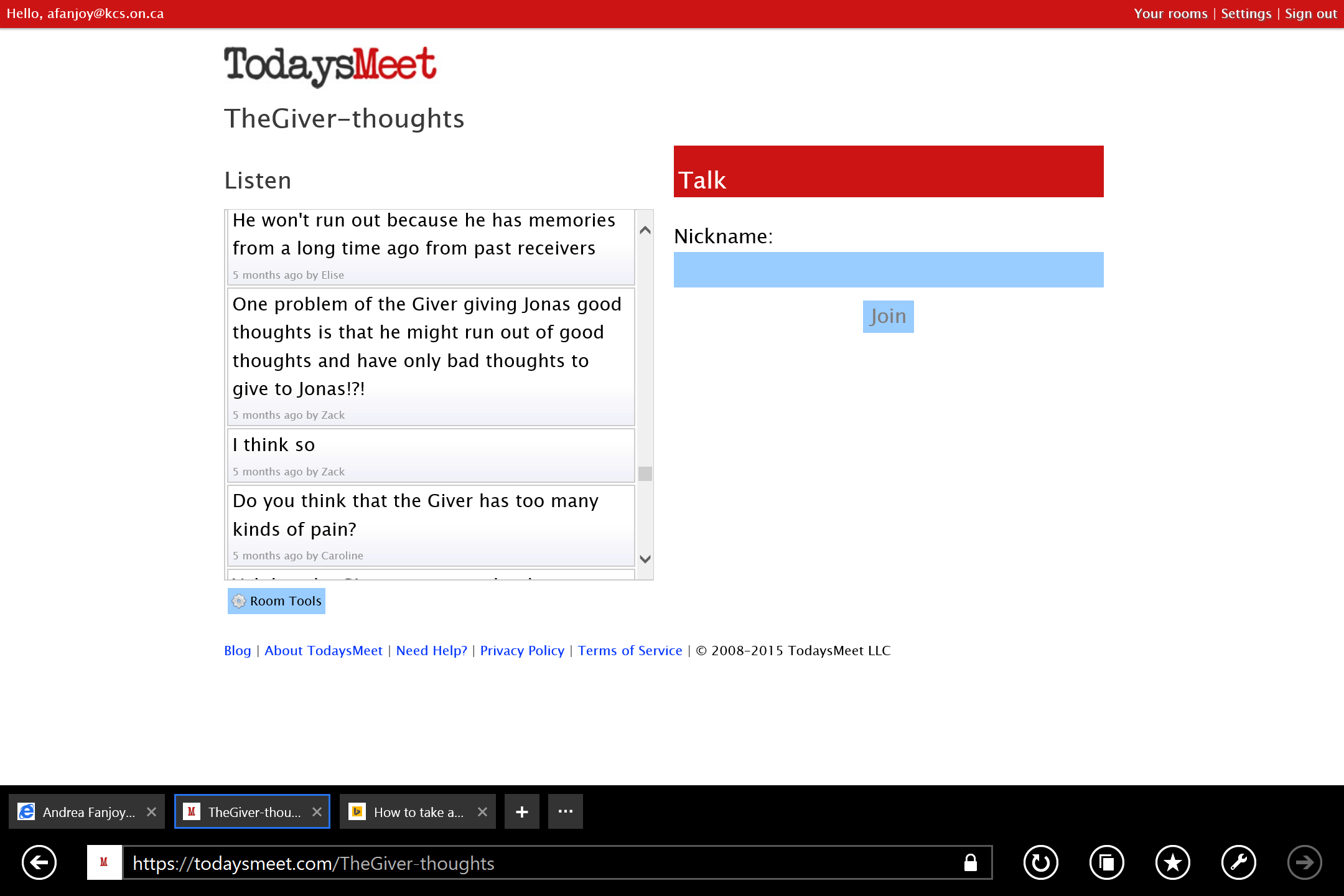
TodaysMeet - KCS student thoughts on The Giver. Most recent thoughts are displayed at the top.

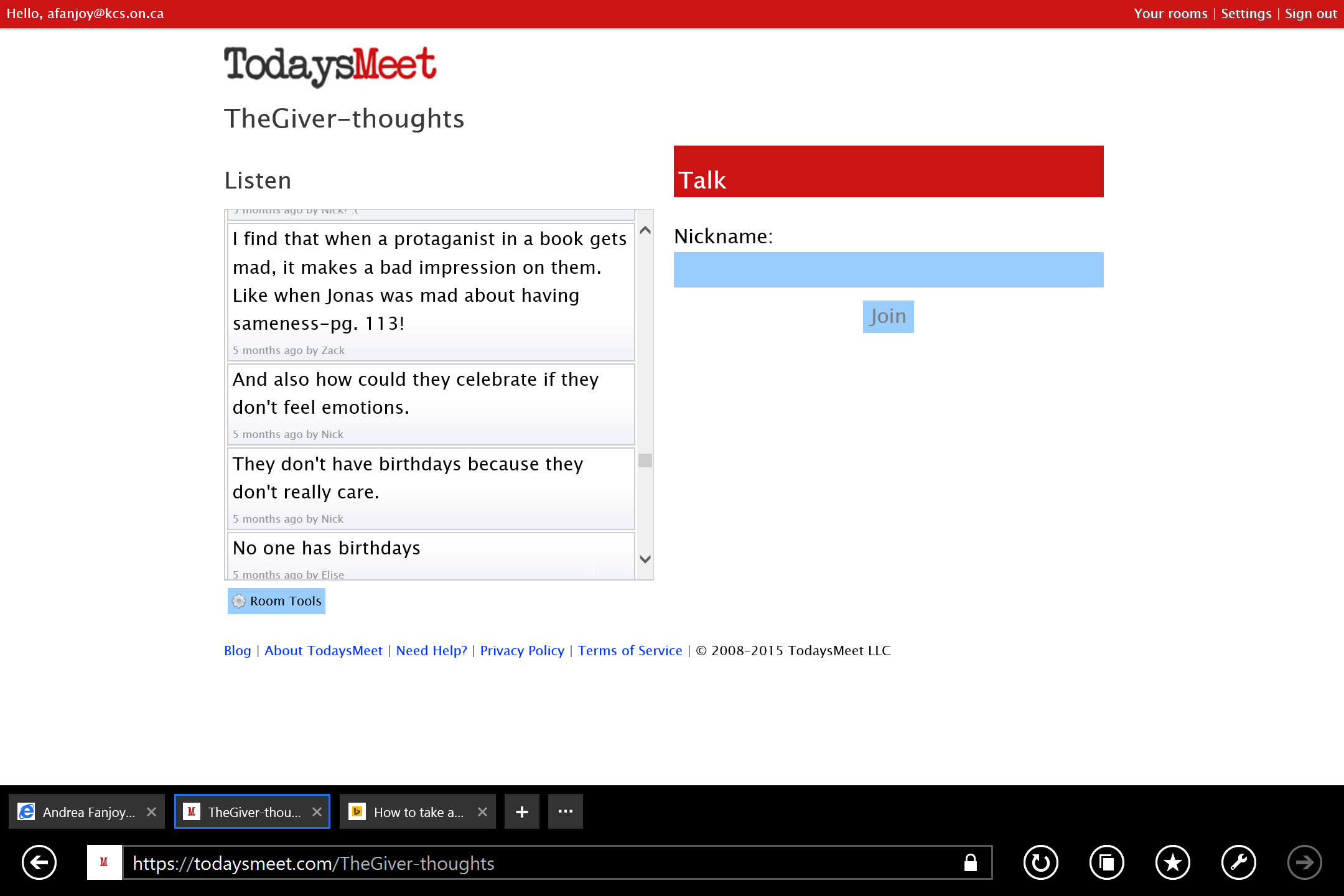
TodaysMeet – KCS student thoughts on The Giver. Most recent thoughts are displayed at the top.

TodaysMeet - KCS student thoughts on The Giver. Most recent thoughts are displayed at the top.

TodaysMeet – KCS student thoughts on The Giver. Most recent thoughts are displayed at the top.

TodaysMeet - KCS student thoughts on The Giver. Most recent thoughts are displayed at the top.

TodaysMeet – KCS student thoughts on The Giver. Most recent thoughts are displayed at the top.

Ever wondered what students are thinking during class discussion? Maybe you’ve attended large meetings or conferences, and had things on your mind you wanted to contribute, but didn’t (and so has everyone else, by the way). Imagine if there were a way for everyone to share what’s on their mind in venues like these, easily and without affecting the progress of the discussion or taking up undue time. Imagine how much more everyone could take away from these occasions.

I’ve seen what my students are thinking, and what I’ve found may tempt you to give TodaysMeet try.

Here’s how it has worked in recent classes of mine. Earlier this year my reading group read Lois Lowry’s The Giver and opted to discuss the tension between ‘sameness’ and difference, both in the book and in the real world. While discussing and reflecting on this vast topic, the students went to our dedicated TodaysMeet site and posted brief messages, capturing salient points, questions, and insights. On TodaysMeet they’ve speculated and debated. They’ve shared related websites and responded to each other’s comments. Submitted posts are readily visible to all on the page, thereby provoking further thought and fuelling the class discussion and reflection. Our whole group has access to this long page of student dialogue for the rest of the year, and at any point I can print off a transcript with all that was shared. Limited to 140 characters, posts are succinct – a worthy skill to develop in itself. Intense listening while note-taking is another worthy skill being evidently developed. On top of all this, the collaborative collection was rich fodder for the writing assignment to come.

So what were these grade 6 students thinking about during our recent discussions? Quotes from Plato, and commentary on the protests in Hong Kong, the Crusades, the origins of communism, Amish society and the challenges that come with a society full of differences were among the many posts that had the group furiously engaged.

Schools are about learning. Any tool that increases learning belongs in schools. TodaysMeet exponentially increases learning by accessing a well of untapped thought and insight and engaging learners in a way that traditional discussion too often doesn’t.

Imagine what your students, colleagues or peers are thinking. Then find out.

Andrea Fanjoy,
Assistant Head, Academics
You can follow Andrea on Twitter @afanjoy.

Redefining What’s Possible: Real Lives

‘Redefining What’s Possible’ is a series of blogs that highlights
stand-out tech tools being used at KCS.

Educational Simulations: Real Lives screenshotFor all the technology at KCS, it’s a place full of the human touch. A new tool this year takes the human touch to an unusually moving, global level.

In Ontario, the grade 8 geography curriculum includes the study of human demographics in countries around the world. Students learn about the effect that such things as literacy, birth rate, maternal health and more have on mortality and quality of life. It’s one thing to ‘learn’ these things, but imagine the power of ‘living’ them. Otherwise impossible for these young Ontarians, that’s just what our students get to do using the program Real Lives.

Real Lives simulates a life for each player, based on authentic global statistics. If one-fifth of the world’s population is Chinese, then chances are that one-fifth of a class will be randomly assigned a simulated life that begins in China. They’ll be given a name, photo and detailed profile. The students’ simulated lives will start at birth and unfold naturally, as chance and statistics dictate. With each log-in, their person will age and face decision points. Gender, socio-demographics, health, disease, and natural disasters will also be assigned to these ‘real lives’ based on where they live and all other aspects of their profile. Some students will die young, others will live a long and healthy life. Malaria, famine, and drought will take many. Along the way, real life decisions need to be made by students, such as:

  • Will you help a friend in need, even if it harms you?
  • You’ve found a wallet on the ground. What will you do with it?
  • You are of the age to marry. Will you?
  • What job will you try to get?
  • You’ve come across a mess left by another individual. Will you clean it up?
  • Some friends have decided to take up smoking. Will you?
  • You’ve been drafted into the military. What will you do?

It’s a virtual game of life, where important decisions need to be made, all of which have consequences.

What do the students think of using Real Lives in the classroom? The students were very keen to use this program and to share what was happening to their avatar in the game. It provoked lively discussions about the consequences of life decisions and the plight of people in their country. With Real Lives, our oldest students were immersed in a world vastly different from their own. They experienced first-hand the threats faced by many. By identifying with their ‘real life’, the simulated became real and global empathy started to take root. Made intensely personal, it’s a geography unit that these lucky young Ontarians will not soon forget.

That’s technology with a welcome human touch.

Andrea Fanjoy,
Assistant Head, Academics
You can follow Andrea on Twitter @afanjoy.

Reaching Readers with Reading Mastery

It’s not sexy and we know it.

Reading Mastery in Grade 1Three years ago KCS introduced Reading Mastery to our primary and junior grades. Our pilot followed a year’s worth of exploring the programs of multiple publishers and looking for hard data to show that the chosen program would meet our needs. Our teachers have always been following professional dialogue and delivering a program designed to develop engaged, competent readers. Never ones to shy away from problems, they weren’t satisfied, and so began a quest that led to the pilot of Reading Mastery.

Reading Mastery is a teacher-led, prescriptive program that ensures mastery of all aspects of foundational reading, leaving no skill-gap behind. It includes choral reading, standard cues, ongoing assessment and constant reinforcement of acquired skills so they stick. To use it requires significant training, and, despite the detailed teachers’ manuals, non-stop decision-making on the part of the teacher. In a school with enticing project-based learning and the unpredictable spice of student voice and choice, Reading Mastery is the yin to our yang.

So be it. What’s exciting for students is that they all see it working. What’s exciting for our teachers is the data showing the difference it makes. Standardized assessments done three times a year show struggling readers progressing quickly through the skill levels. According to our data:

  • By introducing Reading Mastery to SK we’ve increased the percentage of students ready to start the Grade 1 Reading Mastery program in September of Grade 1 by 106%.
  • Teaching Reading Mastery daily in grades 1 and 2, students are reaching the grade 2 reading level 2.7 times quicker than it took in 2012.
  • We’ve shortened the time it takes for most of our youngest students to build foundational reading skills by 83%, from 18 months to three.

Small-group instruction in our Super Skills and Workshop classes ensure all of our students get instruction at the right level for them, and as soon as students demonstrate appropriate mastery, they move on to the infinite learning possibilities awaiting strong readers.

We won’t stop addressing problems and we won’t stop following professional dialogue, with a discerning eye. Most importantly, we won’t stop doing whatever it takes to help our students be the best they can be.

ReadingReading Mastery isn’t terribly sexy, but making a difference is. So is reading. And at least in the minds of our determined KCS teachers, so is data.

Andrea Fanjoy,
Assistant Head, Academics
You can follow Andrea on Twitter @afanjoy.