The Call to Be a Defining Force

Goodness, these are unusual times. Anyone following world news, regardless of political leanings, knows that remarkable things are happening. For years now, it’s been said that the future will be increasingly unpredictable; that global interdependence will be increasingly entrenched and often uncomfortable; and that the challenges we’ll all have to face will be increasingly complex. It’s looking like the future is here.

That’s why we all, increasingly, need to step in.

Eight years ago, KCS made its intentions clear. Our vision and mission statement, adopted then, captured our aspirations:

To be a defining force in developing lifelong learners
By stewarding a learning environment that inspires us to reach our ultimate potential.

This statement is rooted in our longstanding determination to do our best for our students. It’s equally rooted in something else, something that many of our families may not have thought much about, and something worth pointing out.

Teachers join the profession to do their best for students. All KCS staff share that dedication to the children and families we serve. Doing our best means we also need to help realize the potential in education as a whole. There is a tremendous effort that goes into the education of every child. And while there is much that is sound and good in the profession, there has always been significant room for growth. As the world becomes increasingly complex to navigate, the room for growth expands. KCS is not a school that simply strives to offer what other schools, even great schools, offer. We’re a school prepared to push the boundaries of the profession, in ways that are balanced, impactful, and progressive. KCS is a school prepared to wrestle with challenges, be patient when the time for change isn’t right, and to act when creative, valuable ideas are ready. We are willing and able to be a defining force in developing lifelong learners.

Over the past eight years (and more, to be honest), KCS faculty have introduced many new practices that, to our knowledge, were either unique or rare in the profession. The small-group instruction in our Super Skills and Workshop classes; our Wall of Service; our Habits of Mind, Body and Action; our Young Authors of KCS program; our multiple approaches to Student Leadership and service; Wake Up with the Arts; our use of design thinking for innovative learning and student-staff collaboration; and more came to be because our faculty wanted to go further. Pushed by pioneers in the field, remixing promising practice, and following the inspiration from others to create brand new solutions, we keep pressing forward.

Students have always deserved the best education. What’s best is changing and the need for growth is imperative. And it’s not about one school. Our vision statement “To be a defining force in developing lifelong learners” makes clear that it’s not about KCS being ‘the’ defining force. Frankly, such a limited vision would underserve students. Our wish is that all educators work together to make education the best it can be for now and for this increasingly unforeseeable future. We’ll keep doing our part. And we look forward to another year of learning and inspiration from all others who heed the call.

Go Ahead, Figure It Out

“I am learning how to deal with frustration, time management, and learning to work without pressure.”

“I am learning to be really creative, and to problem solve.”

“I have learned that being independent is more responsibility than I thought it would be.”

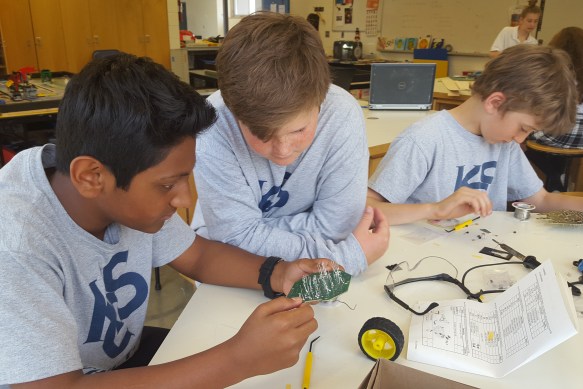
One student spent our last period launching and adjusting his prototype rocket on the school yard, to the delight of those watching from inside. Another retreated behind a tree, where the wind conditions were just right, to spray paint the sneakers that she was turning into roller skates. Writing books, assembling robots, creating works of art, and building a wind-powered, name-bearing wagon round out the array of projects underway in the new Go Ahead elective. These were the projects chosen by the students who selected this elective, and this is the responsible risk that Mrs. Drummond and I chose to take this year. While neither she nor I have experience in any of these things, we do have experience in learning from scratch. We vowed to figure it out.

About half of our students were ready to go before the elective even started. For the other half, dreaming hit reality. The student wishing to build a rocket had his heart set for three weeks on using chemicals that were too dangerous. Another student spent multiple weeks hoping to build a metal-framed, motor-powered go-kart, only to be disappointed at the cost and complication of it all. These students had taken the biggest leaps, and had the farthest to fall to reach a project they could make. Did they regret their choice of elective? Were they wasting their time? We didn’t think so, but it’s what they think that matters. So we asked.

We started the reflection by stating the obvious – school is about learning. Then we asked what they usually learn (as they should) in their regular classes. The essentials, foundational knowledge and skills, learning skills, subjects you need for the future, and new things you otherwise wouldn’t choose to learn were among their responses. Then we admitted that they likely weren’t learning many of those things in our elective. So what did they think they were learning? Hands shot up. Here’s what they shared:

  • Trying to figure out a problem on your own
  • Wide-open creativity
  • Learning to deal with choice and freedom
  • Experience with personalised learning
  • Learning to work without pressure (this is my favourite)
  • Learning to deal with frustration
  • Time management
  • Independent work
  • Doing everything yourself

They also shared that it’s exciting and interesting. Choice and freedom made the frustration worthwhile. Because the projects are entirely their own, the lessons learned, however difficult, are theirs to own as well.

20160511_121008

There is a lot else they’re learning. They’re learning to ask for help. They are learning to find what they need. Some are learning to figure out exceptionally complicated diagrams; some are learning about character development in writing fiction; one is learning woodworking and two are learning to solder resistors onto printed circuit boards. They’re all learning to turn ideas into reality, and they’re learning that this includes the sometimes tedious effort of figuring out the details and communicating them clearly and convincingly to others (especially if THIS other needs to go buy resources).

There’s a lot that students should learn at school, and certainly much of that must cover the essentials. But developing students to be lifelong learners requires more. At times, it can be frustrating. It’s also deeply exciting and interesting for all involved. You just need to go ahead and figure it out.

Sometimes you have to just believe in yourself and go for it. For example, I didn’t think this project would work out at first, but it’s going very well.”

*All quotes are from grade 6 students in the Go Ahead elective.

Andrea Fanjoy,
Assistant Head, Academics
You can follow Andrea on Twitter @afanjoy.


Learn, Adapt, Launch, Repeat – Design Thinking at KCS Part 2

Design thinking came to KCS with the launch of our new student leadership group KCS By Design (KBD). While there has been significant student leadership at KCS for years, never before have we had such a powerful means for senior students to work with staff in driving innovation.

The KBD group has chosen to focus on helping KCS better enable differentiated learning. Discussing how to make that happen, it became apparent that we needed to carve out time for students to engage in learning that is designed both by them and for them. The easiest way to find that time was in our electives program. Available for students in grades 6 to 8, this time is dedicated to “Learning for the Love of It”. Perfect.

Inspired by our KBD discussions, Mrs. Drummond and I added an elective called “Go Ahead: Lead Your Learning” to the already enticing list of learning opportunities for senior students. Our elective description went like this:

Do you wish you could control how and what you learn at school? Do you have big ideas, and wish you had the time, tools and support to pursue them? Is there something you’d love to build/create/invent/compose/investigate that you can’t do at home or school (yet)? In this elective, you can go ahead. Involved faculty will support, encourage, and look for experts/resources/tools/trips to help. Go ahead, surprise us, and yourself!

To our delight, eleven students signed up. Five students want to write a book. Three are keen on an art project, though they’re also considering writing or possibly app creation. One wants to build a high-powered rocket from scratch. Another is keen to build a motorised aircraft. The final wants to build a motorised go-kart. Adapting the design-thinking process to fit our endeavour, here is what we’re calling their ‘Game Plan’:

    1. Inspiration Phase
      1. What do you think you want to create?
      2. Find related sources of inspiration and look through many possible examples before deciding what you specifically want to make
      3. If your idea is FOR others, understand their needs and wishes. Speak with others. Record their answers via writing or video.
      4. Do a visual sketch or general plan of what you aim to create
    2. Why do you want to create it?
      1. What values/adjectives do you want associated with your final product? Have an idea you believe in and are inspired by.
      2. For what purpose (play, use, learn, decoration, gift, just because)
      3. For what audience (self, friends, siblings, family, school showcase)
      4. Know what your questions are
    3. Prototype or Storyboard
      1. How will you prototype your idea?
      2. Will your prototype answer your questions?
      3. What do you need for the prototype?
        1. Materials
        2. Expertise
        3. Location
      4. What are you learning from the prototype? Any new questions to answer? (Be curious, open-minded and prepared to start again if the evidence says you should!)
    4. Go Ahead

At each step, our students will create a video log, or ‘vlog’, on our new Sesame electronic portfolio. Before they rush ahead, they have to reflect deeply on their plan, and articulate their thinking each step of the way.

To introduce the elective to our students, we showed them the video “Do You Dare to Dream?” Among other things, it introduced students to the concept of a ‘comfort zone’, where we immerse ourselves in what’s familiar; the ‘learning zone’, for those who embrace learning of all kinds; and the ‘panic zone’, for those willing to go out on a limb to pursue the unknown. Writing books? App creation? Art, rockets, electronics and motorized vehicles? The ‘panic zone’ may be speaking to me more than our students. This couldn’t be more beyond my routine, and more exciting.

Design thinking, reaching out to our faculty and parent community for expertise, and faith in our students are all I need to allay my fears. Our students have embraced the opportunity. There will be lots of learning for us all. We’ll adapt. They’ll launch their Go Ahead projects. If all goes well, we’ll keep repeating our use of design thinking to make KCS the best it can be. Let’s see where this journey goes.

Andrea Fanjoy,
Assistant Head, Academics
You can follow Andrea on Twitter @afanjoy.

Learn, Adapt, Launch, Repeat – Design Thinking at KCS Part 1

HeadandArrowssmallEarlier this year I wrote about our debut with design thinking. For readers still unfamiliar with what that means, here’s my attempt to describe it:

Design thinking is a process that takes a group of people from ‘complex problem’ to ‘solution’ in ways that are exceptionally correlated with success. Design thinking deeply engages all stakeholders, requires them to empathise with all affected, and reins in the more typical ‘rush to conclusion’ so creative win-win thinking has time to emerge.

While the specifics can vary according to task and organisation, the method is clear and comprehensive. Thanks to Project 2051 at the Canadian Accredited Independent Schools (CAIS) Leadership Institute last summer, I became acutely aware of its power and potential. Inspired, we have adopted design thinking, adapted it to meet our needs, and launched two new innovations that are rocking our world.

The earlier blog explained how we’ve established a new form of student leadership that allows all interested senior students and staff to work together to make KCS the best it can be. Here’s the design thinking process we’re following:

  1. What is the design challenge?
    1. What problems are you aware of that need fixing?
    2. What challenges are you aware of that are worth addressing?
    3. What opportunities have occurred to you that are worth pursuing?
  2. What do you need to know?
    1. Who is affected?
    2. What are their perspectives?
    3. What research can inform you?
    4. What can you learn from others’ experiences?
  3. What ideas address your design challenge?
    1. What can you think of?
    2. Which are win-win for all?
    3. Get feedback from a larger group
  4. Act
    1. Pilot at a small scale
    2. Reflect and iterate
    3. Expand to address the challenge

We started as a small but intrepid group. Since our November launch, the group has quadrupled in size. The design challenge we’ve chosen to pursue first, identified by a grade 7 student, is the following: “How do we better enable differentiated learning at KCS?” We’ve since conducted a survey with the grade 6 to 8 students to learn more about how they best learn. Later this month, we’ll be launching this year’s Student Voice topic so we can hear from all students about differentiated learning and how to improve it. The KCS by Design members are currently preparing frequency distribution graphs and PowerPoint slides so they can share their findings through presentations to faculty, senior students, and the whole school (separately), as well as through presentation boards in the foyer for parents. Finally, Mrs. Drummond and I have launched a new elective as a prototype that makes more differentiated learning possible at KCS. That exciting venture will be Part 2 in the story of “Learn, Adapt, Launch, Repeat”.

This is what all leadership should be built upon. Engaging, listening to, learning from, prototyping with, and informing the whole school community makes smart innovation possible. I can’t wait to see where this journey goes. The inspiration that began with Project 2051 energises every step of the way.

Andrea Fanjoy,
Assistant Head, Academics
You can follow Andrea on Twitter @afanjoy.

Shrek Jr. By Numbers

  • 3 unforgettable shows
  • 36 cast members
  • 73 members in the grade 1-3 choir
  • 27 members in chorus
  • 8 members in the dance troupe
  • 28 members in Tech Crew
  • 1 Student Costume Intern
  • 4 directors
  • 60 staff and parent volunteers

plus…

  • Professional musicians and theatre crew
  • Donations and additional contributions by many others
  • Collectively thousands of hours by over 200 people

The quality of the KCS 2016 musical, Shrek Jr. was undeniable. The acting, singing, dancing, stage, costumes and music were a feast for the ears and eyes. From where I sat supervising the choir Friday night, I had an extra special opportunity to watch the delight on faces in the audience.  I was also treated with the view of chorus members mouthing every word in the musical, they had memorised each part so thoroughly. The previous night I watched from the audience and it was my face among the delighted.

As if that wasn’t enough, the sheer number of people involved, who invested countless hours and their full array of talents, left me equally impressed. It’s not unusual to have special things happen at KCS. This year’s musical takes special to an astounding level.

The curtains are now drawn and the cast party is over. Many of us continue to hum the songs from Shrek Jr., and the inspiration among young students to follow the lead of older cast members will linger. Not much else remains, however, except for one heartfelt thank you from the audience to all who brought the story, song and experience of Shrek Jr. to KCS.

Andrea Fanjoy,
Assistant Head, Academics
You can follow Andrea on Twitter @afanjoy.

Practising the Hard Part of Listening

soundOne of our Habits at KCS is Listen to Understand. Hearing comes easily for most of us. Listening requires a bit more effort but we usually try our best with that. It’s the ‘understand’ part that is trickiest. Some cool things are happening here with that Habit and they’re a reminder of why it matters.

Understanding means stepping out of our old opinions, assumptions, and even otherwise-justified practices to fully understand those of others. It requires another one of our Habits, Flexible Thinking. Cognitive science Daniel T. Willingham helps explain why that makes it so tricky. In his book Why Don’t Students Like School:  A Cognitive Scientist Answers Questions About How the Mind Works and What It Means for the Classroom, Willingham explains that the brain, surprisingly, is not designed for thinking. That’s right. For all its smarts, it’s actually designed to avoid thinking. When listening, the unmotivated and undisciplined brain will work to hear what it wants to hear, or rapidly defeat what it finds contradictory and therefore too much trouble. Hmm. Does that sound like some conversations you’ve heard (or even had) before?

The KCS Habits are not just for students. Listening to our senior students recently, we introduced a modified timetable during the week of exams so grade 7 and 8 students had choice in how they spent their mornings: either in subject-specific extra help or an open-study session. Earlier this year, when our senior students asked for more independence, numerous other new practices based on student suggestions were introduced (some examples include: freedom to eat lunch with friends from the other class; grade 8s being allowed to eat lunch in the Student Lounge; Special Lunches for 7s and 8s in their corridor instead of Canada Hall; more choices for students who want to stay in to work during recess). Readers of “Stay Connected” are learning direct from the students about some of the changes they helped make happen. We listened and understood. The result has been a breath of fresh air for us all.

“Respect, manners and try your best” are school rules that we all strive to follow. Figuring out what’s best is tricky. Listen to Understand is the first big step. Students and faculty are showing they can take it from there.

Andrea Fanjoy,
Assistant Head, Academics
You can follow Andrea on Twitter @afanjoy.

A Wonderful (Reading) Thing

Kids dash across the playground to update Ms. Pollett-Boyle on their progress. Since I’m the lucky one to distribute certificates when students complete a level, I’m swarmed daily with messages of “I’m done Level 5!” or “I’m now travelling in Egypt!” or the rather direct “Where’s my certificate?” The first week after Christmas holidays I heard more about levels achieved over the break than about presents under the tree.

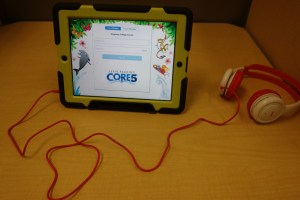
Lexia at KCSLast year we piloted a new online reading program called Lexia Core 5. It is offered as a supplement that students can use at school and at home, even on holiday if they so choose. It’s an adaptive program that helps develop core reading skills at the level and pace that’s individualized to be just right for every student. It includes re-teaching after mistakes, compelling graphics, and enticing little interludes, all designed to support, motivate, and optimize learning. The pilot was an evident success. One family was so impressed they generously offered to purchase a 3 year school-wide license. Each week, between 40 and 105 young students log on to accelerate their reading skills. — A heartfelt thank you to this family!

It’s wonderful to watch students learn. It’s not always adrenaline-fueled. The pace can be slow. On skills that are difficult, the school includes a fair amount of push and pull on the teachers’ part. So imagine the pleasure watching dozens of students driven to read (even learning the boring stuff like ‘dipthongs’ and other pesky vowel rules!).

Full disclosure, some runaway enthusiasm has led to excessive competition. That was a topic for a recent class meeting, and one more worthwhile lesson thanks to this powerful tool.

Lots of wonderful things happen at KCS and we’ve written about many of them already – the proof is in our blogs. Children swarming me with their achievement in reading? This certainly counts as one more.

Andrea Fanjoy,
Assistant Head, Academics
You can follow Andrea on Twitter @afanjoy.

An Inspired Lunch Hour with Random Acts of Learning

Every Friday at lunch recess, Mme Smith and I host Random Acts of Learning (RAOL) in the KCS Library. It’s a drop-in for any students from grade 2 and up to do, well, random acts of learning. Here’s what happened during last Friday’s lunch hour when 47 students came to RAOL:

  • Three students from grades 5 and 6 met to talk about a leadership project supporting Syrian refugees
  • One brought his Arduino kit to build a machine for his grade 7 service learning project
  • Two others worked on their littleBits ‘keytar’ (their own musical synthesizer)
  • A few others worked on the video games they’re creating themselves
  • Multiple others worked on their own independent projects, just because they want to learn more about something; this will culminate in a class presentation (Habit: Share What You Know)
  • Others are working on writing books, a few of whom are writing to submit a French book in a national contest
  • The newspaper club came to work on their upcoming edition
  • Some older students chose to study for exams
  • Many others just wanted more time to read

That was my lunch hour. How inspiring was yours?

Andrea Fanjoy,
Assistant Head, Academics
You can follow Andrea on Twitter @afanjoy.

Haircut, Anyone?

We knew we were in for a treat when PK, JK and SK students joined KCS three years ago. But we didn’t expect manicures, facials and haircuts!

Anyone walking down our Senior Kindergarten hallway last week will have doubtless noticed the many signs advertising these services and more, for a price, by our SK students. No, this is not a mandated unit of study. Much better, it’s what an enterprising and imaginative young group decided to make happen.

From what I’ve seen, these young entrepreneurs are working on establishing about a dozen of our KCS Habits – habits that will set them apart wherever their future takes them. Their writing and counting are also getting emotion-driven practice. Positive emotions are booster fuel for learning.

Thanks to our faculty’s efforts with Project-Based Learning and their readiness to support student initiative, the whole KCS community benefits from dozens of student projects equally delightful. But this is the first where I can also get all fancied up for the holiday season. Thank you SKs!

This slideshow requires JavaScript.

Andrea Fanjoy,
Assistant Head, Academics
You can follow Andrea on Twitter @afanjoy.

Busy Months of Making

Making happens when the ingredients of children, time, and ‘things-to-make-other-things-with’ are added together. Anyone who has seen what children can do with empty boxes knows this.

Thanks to our initiative to make KCS a Makerspace, and thanks to the generous support of our Annual Giving Fund, there is a lot of making at KCS these days.

Walking through the halls of KCS, there is a buzz of making in every corner. Here’s a small sample from the first few months of school:

  • The JK classes have a designated learning centre for making. The challenges change regularly, and the tools for making are varied but include generous donations from Mother Nature. The message is clear – just make!
  • The SK classes have had introductory woodworking classes in the outdoor classroom. They’ve used hammers, nails, screws and screwdrivers to make their own wooden creations.
  • The grade 3s have been busy making 3D cityscapes with recycled materials, applying their knowledge of structures, and adding generous amounts of imagination
  • Twenty students in grades 2 to 4 have enjoyed making their own videogames with Scratch under the guidance of Makerkids. Older students in the TechBlazers club are also making their own video games with Scratch and Gamestar Mechanic.
  • We have kicked off this year’s YAKCS program, and one student is well on his way to being a published author. Many others are working on it.
  • Our JKs and grade 6 students recently worked together to create their own videos under the direction of Director’s Cut.
  • One student, inspired by the littleBits in both the library and science lab, created his first invention. It’s a device that draws perfect circles, called “Draw the Circle Wide”. Many other students have combined littleBits with other odds-and-ends so their creations “do something”. The excitement at the limitless possibilities is palpable.
  • The Remembrance Day Club created deeply moving videos and dramatic performances for our ceremony on November 11th.
  • Some students in grade 6 have chosen to make exceptional videos on their culture of choice for their social studies project. As part of this project, all the grade 6s also composed music that reflected features of their chosen culture.
  • Hearing from their students about the littleBits in the library, various teachers have reached out to ask about how they can incorporate littleBits in their classroom. Two senior students are helping make that happen.
  • Several students in grades 6-8 took advantage of the invitation to create a 3D design according to certain specifications, using the online program Tinkercad.
  • Our Lego robotics team has been busy designing and programming their robot for the upcoming First Lego League Challenge.
  • Our art program has always had students making. Mme Clement’s new videos, which you can see on our social media or access via QR codes, showcase the making behind the final products you see around the school.
  • As of next week, some students will be creating robots using the Arduino microcontroller.

It has been a busy first three months on many fronts, as it should be. There has been a lot of what you should expect, including routine-setting, community-building, and instruction in all the usual subjects. There has also been a lot of what you might not expect. It accompanies an excitement that is wonderful to witness. KCS students have the time and ‘things-to-make-other-things-with’. And they’re busy making.

Andrea Fanjoy,
Assistant Head, Academics
You can follow Andrea on Twitter @afanjoy.