You Gotta Try This

DancerIn need of a work-day boost? Fed-up with the February blahs? In general need of a joyful escape but March Break is still too far away?

Our eight-year-olds know just what you need.

A group of five girls spent weeks putting it all together. They developed the plan, checked with their teachers, found a date that worked, and chose the DJ.

‘We Gotta Dance’ was a dance party for all grade twos and any available teachers. For 20 minutes, we boogied to “Gangnum Style”, “Call Me Maybe” and other good-time tunes that banish the blahs. Boys, girls, and lucky teachers, shimmied, sang, ran, laughed, rocked and rolled.

If your workplace has a vacant room, and a boss who’s willing, you gotta give this a try. This is a boost that’s as good for the body as it is for the bottom line.

Learning What We Don’t Want to Learn

Habits of Mind, Body and ActionThe first Habit on our poster is ‘Embrace Learning’. Don’t let the soothing tone of the word ‘embrace’ deceive you. We could have just as easily described it as ‘Learn whether you like it or not’.

Learning can be like that. Thankfully, most of the time, and certainly at KCS, learning does feel like a warm embrace. It’s delivered by teachers who evidently care about their students and about making learning as positive as possible. And so it should be.

I’ve been reminded recently, however, about the underbelly of ‘embrace learning’, a side that was always intentionally part of that Habit, but that may have gone unnoticed, hidden in the shadows of the ever-more pleasant type of learning that is more the norm here. I’m talking about those important lessons in life that we resist, the lessons we’d prefer not to learn, but learn we should. They may challenge our character, or reveal a sandy foundation upon which we had built mighty assumptions. These lessons may arise when exams yield lower marks than expected; sometimes they arise when we’ve done something we’re later ashamed of; sometimes they will trip up students who otherwise find learning very easy, but then are faced with a topic that is annoyingly difficult to understand. Though these examples focus on the young, we’re never too old for these lessons. And while these examples focus on others, I don’t pretend to be immune.

Humans are generally a comfort-seeking lot. Daniel Willingham, cognitive scientist and author of Why Students Don’t Like School, argues that the brain strives to be as efficient as possible, lazy even, preferring to do as it wishes and not as it is forced to do. Add a dash of limited understanding, bias, immaturity, emotion, or over-confidence, and you have someone ready for one of these most humbling lessons. If they embrace it.

Most learning should feel like a warm embrace. But growing up and being our best self will include these more challenging lessons too. While decidedly uncomfortable, the reward for their steep price is broader understanding, growing maturity, more rational thought and healthy humility. Resilience, thinking flexibly and the ability to persist, three other noteworthy habits, also grow as a result.

That’s learning worth embracing.

Andrea Fanjoy,
Assistant Head, Academics
You can follow Andrea on Twitter @afanjoy.

The Jekyll and Hyde of the Internet

Good and BadThe Toronto Star recently published an article asking, “Is the internet bad for us?”. Good question.

Nothing excites me more than each step forward in doing our best for students. Every concern addressed, every lesson made more impactful, and every child we more effectively connect with is the reward that reenergizes us for the next day. While not always the case, technology and the Internet, in the hands of a determined and mindful teacher, frequently play a role in these steps forward. Though I stand firmly in the camp that says the technology glass is more than half full, I’ve seen enough to know that keeping The Star’s question in the back of our minds is an important part of ensuring the glass doesn’t get knocked over.

The article lists many reasons for concern: family time dominated by laptops and texting, decreased ability to converse, constant desire for affirmation, lack of time alone with one’s thoughts or playing side-by-side with others, etc. The social conflicts inherent in growing up now often play out in cyberspace, where slights, or worse, take on a much greater significance than anything the pre-Internet generation had to face. Growing up is hard, and this generation’s abundant use of the Internet amplifies the highs and lows of this critical stage. Raising children is hard, and the Internet has likewise been a mixed blessing for parenting.

The Internet is here to stay, and to bemoan what’s bad is to miss out on all that’s good. But to revel in the positive without attention to what’s not is unwise. Teaching responsible use of the Internet is now part of what schools must do. Monitoring and having reasonable limits on use at home is now part of what parents must do. With these efforts in place, we can happily answer the opening question, “It could be bad, but not in my family.”

Andrea Fanjoy,
Assistant Head, Academics
You can follow Andrea on Twitter @afanjoy.

Studying Isn’t What It Used to Be

StudyingTechnology, like all things in life, has sides that are both yin and yang. Studying for exams with my son in grade 8, I’m loving the yang side of it.

We counsel our students to study for two subjects a night over the three weeks before exams. The other night, my son chose to focus on history and math. For history, he announced with uncommon enthusiasm that he was going to use the Study Wiki that he and his classmates made. A wiki is a collaboratively-built online reference site, the most well-known of which is Wikipedia. KCS teachers are embracing the making and use of wikis as a meaningful tool for students to take notes and communicate learning. The fact that these notes are shared online raises the whole exercise of note-taking to a real-world relevance that it never had before and, with that, the quality of what they produce goes up. I, and many other parents, are familiar with student “notes” that are sparsely or imperfectly done, and of little support when studying. Studying with the wiki, my son worked with thorough definitions and concept maps, and played knowledge games that cover most of the content he needs to remember. This wiki is available 24/7, thus having the added benefit of not needing to be “brought home” and “returned to school”, demands that often sabotage many a well-meaning student.

Then we moved on to math. This year KCS introduced a new online math resource that offers many benefits. For the purpose of studying, the students were sent a collection of review questions. Each question page had a link to the online video and practice questions that the student could go back to if they needed a reminder of how to approach the problem. When my son didn’t understand a question, it was no longer my responsibility to figure it out and teach him what to do – I simply reminded him to go back to the video for guidance. When my son was done, he received instant feedback on which questions he answered correctly, and which were incorrect. Seeing the ones that were incorrect, we went back to the videos to find out where he took a wrong turn.

Studying well requires many things to fall in line:

  • having what you need, when you need it;
  • having quality notes that are easy to read and use, even enticing to use;
  • getting frequent feedback on how you are doing; and
  • having material available in multiple formats.

These are but a few details that make a significant difference. Any tool that makes more of these fall in line is a tool that is most welcome.

Studying at KCS truly isn’t what it used to be. While the ancient Asian concept of yin and yang has these two as complementary and balanced, studying with technology is firmly on the yang side of this balanced equation. And thank goodness. Exams, and the challenge in facing them, otherwise haven’t changed at all.

Good luck to all in grades 6 to 8, and happy (as-can-be) studying!

Andrea Fanjoy,
Assistant Head, Academics
You can follow Andrea on Twitter @afanjoy.

Practising Leadership

Imagine Create InspireEvery Friday we have a school-wide assembly. Here’s how a recent one unfolded:

  1. Three grade 8s presented their regular ‘Save that Species’ game show/skit to promote awareness of endangered species.
  2. Three other grade 8s announced the conclusion of their successful Winter Coat Drive, thanking the KCS community for donating 101 coats to families in need.
  3. Another five grade 8s came to lead our weekly ‘Compliment Friday’, inviting students in grades 1-4 to come up and give a public compliment to anyone they felt made a difference over the holidays.
  4. Four girls in grade 6 reminded the community of their Poster-to-Canvas contest, with submissions due early February.
  5. A group of House Captains from grades 7 and 8 announced the upcoming House lunches.
  6. About thirty students from grades 1-8 came forward to present the ‘brick’ they earned for our Wall of Service. Each brick represents an initiative that makes a positive difference, and included acts such as running in marathons for charity, donating birthday money, distributing food to families in need over the holidays and many, many more.

And these represent a mere fraction of the leadership projects that are currently underway.

Practice makes perfect. The world could use more perfect leaders, or at least great ones, so KCS is working on it.

How do we do it?

First, we’ve taken the mystery out of great leadership. Every student at KCS knows the traits that lead to not only personal success but also a meaningful life that makes a positive difference. The KCS Habits of Mind, Body and Action are the undeniable, timeless attributes that make one a leader in all aspects of life.

Second, we’ve made leadership accessible to all. Leadership isn’t reserved for our oldest students, nor to students winning elections, or to students arbitrarily chosen by others. Leadership opportunities are as infinite as the imaginations of each student. If they can dream it, and we can help them make it happen, it can be pursued. We also make it clear that leadership is not always a big and bold undertaking – it can be as small and impactful as facing a daunting personal challenge, standing up to others doing something wrong or helping someone when they’re hurt.

Third, we’ve made it imperative. We don’t see leadership as optional in life – it’s as important as the academic skills that underlie any undertaking. Leadership is practiced in smaller ways among our youngest students, unless individuals choose to pursue a more substantial leadership project. By grade 6 it’s a timetabled subject and all students are given the time and guidance to imagine and deliver on an idea that makes a difference. Many choose to support groups in need, others choose to provide exciting new offerings to their schoolmates, such as contests and talent shows.

Our students have unparalleled opportunities to practice leadership. We know that the world would be a better place if all children went to a school that unleashed the leadership within, and we hope that one day this will come to be. In that way, KCS is practising leadership too. After all, it’s true what they say, practice does make perfect.

Andrea Fanjoy,
Assistant Head, Academics
You can follow Andrea on Twitter @afanjoy.

Understanding the Teen Mind

Working in education doesn’t make parenting easier. It does, however, let me spend part of my work time learning about why children behave as they do. Increasingly, what I learn is rooted in brain research. Once one of life’s greatest mysteries, the thinking behind behavior is being revealed like a classic whodunit, thanks to magnetic-resonance images of the living, processing brain.

Questioning MindOf all the stages of development, parents and educators strive hardest to understand the teen years. An exciting yet characteristically turbulent, boundary-pushing stage where adults may often be inclined to ask, “What were you thinking?”, we’re fortunate to now have an answer. Two parts of the brain feature prominently in adolescence. The prefrontal cortex is the part of our brain most linked with mature judgment and self-control. The amygdala is the seat of our emotions. The biological details of what these two are doing during adolescence are best left to worthier publications than this column, but a satisfying metaphor shared by Ron Morrish, behavior specialist, is that of a construction site. The prefrontal cortex undergoes significant growth and change from the preteen years until the early twenties. It effectively becomes a construction site that, like any other, is unavailable for regular use. Where does the detour take an adolescent mind? The amygdala. This helps explain the oft-incomprehensible emotional swings that the adolescent, and those in their wake, must ride.

This has big implications for what we do as parents and educators. Dr. Ron Clavier, Clinical Psychologist and Neuroscientist, has laid out these implications, and related strategies, in his acclaimed book Teen Brain, Teen Mind: What Parents Need to Know to Survive the Adolescent Years. Humour, extensive experience and knowledge of the physiological underpinnings of this amazing stage have made Clavier a most-welcome voice in my world at school and home. If there is a teen or pre-teen in your life, I’m guessing he would also be a welcome voice in yours.

Dr. Clavier is speaking at Kingsway College School, 4600 Dundas St. West, at 7:00 p.m. on Wednesday, February 6th. Admission is free, and copies of his book will be available for sale. More details are available at www.kcs.on.ca/Speakers. Parents, educators, teens and all others who want to better understand the intriguing teen mind are welcome to join us.

Andrea Fanjoy,
Assistant Head, Academics
You can follow Andrea on Twitter @afanjoy.

Exams Got You Down? Just PAUSS

The following blog first appeared one year ago. It’s as relevant now as it was then. We all face challenges from time to time, and how we face them makes all the difference. That’s where the KCS Habits come in.

At KCS, it’s our mission to develop lifelong learners with the habits to face and embrace life’s challenges. Many of our students and parents have an extra one of those challenges on their plate right now.

Exams.

Students in grades 6-8 write exams starting January 28th. Love them or dislike them (yes, we’ve had students say they love them!), learning to prepare for and take exams is a challenge we all have to face at some point. Starting them in grade six, with ample guidance and time learning how to prepare, is the best way to start. Though a big deal, exams at KCS are also a safe opportunity to face this challenge, ‘try your best’, and learn from mistakes.

Looking at our Habits poster in my office Friday morning, I wondered which of the habits students should focus on to be successful preparing for exams. Five stood out. When written down, it became clear they made for a nice little acronym – a beacon for calm in the storm of stress that often surrounds the ‘e’ word. The acronym is PAUSS. The habits are:

Persist – this is a marathon, not a sprint

Adapt – old patterns of studying and time management likely need to change

Use past learning – use notes and old tests; use strategies that you already know to work, and avoid those that you know don’t

Show self-control – stick to the study plan; focus on the task; remember to also rest, eat well and get exercise

Strive for accuracy – follow the study keys, test yourself, aim to understand any errors

Exams inherently stir up anxiety. PAUSS, happily, does not.

If your child is writing exams, encourage them to PAUSS. And watch with pride as your child develops habits that matter. Take heart. Dread will soon be replaced with delight, and doubt will be replaced by well-earned confidence. And the unknown challenges to come will face a tougher foe.

Testing What Matters in Life

How did you do on your last test?

If you’re not a student you probably can’t remember. Tests are for students, right?

Formal education has a long history of testing. Spelling, math, science, history – no other institution tests more than schools. Obviously.
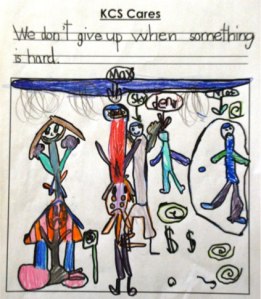
KCS CaresWhat’s not as top of mind, however, are the tests that we face minute-by-minute, wherever we are, whomever we’re with and whatever we’re doing. These are the tests of character that appear in our interactions with others, choices of how to spend our time, how we work, how we play, and how we respond to the challenges thrown our way. And if you’re following what most experts are saying, it is character, and specifically traits such as initiative, curiosity, grit, creativity, and adaptability, that will best determine our success in life.

Educators and parents alike spend a lot of time thinking about tests, whether designing, marking or preparing children to do their best with them. Tests help us monitor growth in students and effectiveness of teaching. They have value. But most of these tests don’t measure what matters most. They aren’t designed to.

So, what would a test of character look like? Simple. Watch what others do, of their own volition, and particularly when out of the gaze and direction of authority figures. Minute-by-minute.

And if you want to help prepare students to do well on these tests? Provide a school experience that not only teaches character but also includes the encouragement, time and support needed so students can practice the skills and traits that matter, and do so for their own purposes. Students of character need freedom to initiate, create, persist at solving real problems, make a difference and more, not for marks and not because they’re told to. They need a school that believes in the infinite potential of children, if we let it take shape, and a school which recognises that this means doing a number of things differently.

Educators, watch what your students do with free time. That’s testing what matters. And give them a school experience that lets them develop the traits and skills that matter most. That’s preparing them to ace the test. You won’t be disappointed.

Andrea Fanjoy,
Assistant Head, Academics
You can follow Andrea on Twitter @afanjoy.

This article was first published in SNAP Etobicoke, December 2012.

Traditions

“If history were taught in the form of stories, it would never be forgotten.”
-Rudyard Kipling

We have a saying at KCS. As soon as we try something new and all goes well, it immediately becomes known as a tradition.

Part of the beauty of traditions is that with each occasion, the story of that tradition grows. Christmas is a story with a chapter for every December. Remembrance Day is a tradition with a chapter for every service.

And last Thursday was the celebration of another special tradition – Chapter’s Night. Of course, it also comes with… ahem… chapters.

I remember the second Chapter’s Night. It took place a long time ago when we used to have winter. It was a dark and stormy night and the elements proved a formidable foe, antagonist if you will, to all who eagerly tried to attend. I was teaching French that year and had offered to have my grade 6 students perform a French play.

Luckily, my car made it through the snow. Many of my students and their parents weren’t as lucky. We delayed the performance and rounded up any present and willing classmates. Excitement and angst at the imperfection of the situation filled our veins.

In the end, like all good stories, we persevered and the students performed undaunted for the crowd. And like all good stories, I recall that it was a magnificent performance. The story ended Hollywood-style.

Last week was a wonderful new chapter in our Chapter’s Night tradition. The weather has clearly learned it will not deter us and has moved on to challenge others elsewhere. KCS parents, students and staff came out in huge numbers to mix, mingle, shop and enjoy wonderful performances. And KCS is a richer story as a result.

Thank you most sincerely to everyone who worked to keep the story growing. It’s unforgettable.

Andrea Fanjoy,
Assistant Head, Academics
You can follow Andrea on Twitter @afanjoy.

The Week of Thinking Flexibly

It became abundantly apparent to me how little we talk of it.

I was covering a grade 3 library class, and I started by saying the lesson was about my favourite habit. Hands shot up and student after student took a stab at claiming what it was sure to be. With nary a second in between, ‘show self-control’, ‘create’, ‘act with empathy’, ‘persist’, ‘think creatively’, ‘do what is right’ were offered up with conviction. Goodness, these kids know what matters in life. And to be honest, I certainly am fond of every habit they offered. They aren’t my favourites, though.

The lesson was about thinking flexibly. It’s a habit that reminds me of my most special stories. It takes me way back to the year I lived in and backpacked throughout Europe. It takes me back to the years I lived in Japan. It reminds me of the many years I spent learning French and then Japanese. It reminds me of the most special books and inspiring courses in my life. It also reminds me of why I love what I do. Not a day goes by that I’m not challenged to think flexibly, considering an opportunity or addressing a concern that just the day before may not have even entered my consciousness.

Last week, in particular, was a week of thinking flexibly. It included a wonderful collection of emails and conversations with a parent who equally enjoys thinking flexibly on the topic of education. It included the lesson in thinking flexibly for the grade threes. It included a deeply moving Remembrance Day ceremony that, once again, took me briefly away from the charmed life we enjoy and into the tragedy and sacrifice faced by soldiers both living and gone.

Then, just before the end of this short week, the grade 8 teachers, Mr. Logan and I received an email from a student who believes a change in part of our homework practice is in order.

And so, I look forward to my meeting with her, and indulging once again in my favorite habit.

What’s your favourite habit? Please also tell us why it’s special to you, either by adding a comment, sending an email or tweeting me @afanjoy. Stories have a way of sticking. And the habits are worth sticking to.

Andrea Fanjoy,
Assistant Head, Academics
You can follow Andrea on Twitter @afanjoy.