A New Definition of Cool

GraphOne reward for getting older is no longer caring about looking cool. Surrounded by tweens and teens at home and school, I’m often reminded of the lengths I went at their age to not look uncool. (Do sneakers in the snow sound familiar to anyone else?)

Gratefully, I wear warm winter boots now. I also get to witness and share the unbridled excitement that comes from, yes, data. Jumping out of our skin for numbers and charts won’t register on the typical ‘cool’ list of things to do, but it’s an unforgettable sight I’ve been grateful to witness a number of times now.

Two years ago, a significant area of focus for the school was reading. Since then, we’ve invested in a series of Direct Instruction programs, including Reading Mastery and other companion resources, that ensure all students pick up the skills needed to be thoroughly successful readers, from phonemic awareness to making inferences. All reading teachers from JK to grade 6 have received extensive training to deliver the program. Leveraging the small-group instruction time in our Super Skills and Workshop classes, we now deliver an intense, research-based, aligned effort to teach this most critical skill. Assessment happens frequently to monitor student progress. We also use a comprehensive standardized assessment to capture baseline data at the start of the year, mid-year and at the end with our youngest students, just to double-check.

That’s the data that’s got us beaming like giddy teens. Seeing the extent to which our students are growing in their reading skills is gratifying beyond words.

Teachers join the profession to make a difference. That difference is rarely quick and rarely rooted in one effort, no matter how significant that effort is. The complexity of meeting the needs of all students, to the greatest extent possible, is typically just too great.

Getting our kicks out of data may be considered uncool. So be it. But making a difference is what these teachers are about. Our excitement at doing so is irrepressible. And we’re not afraid to show it.

Andrea Fanjoy,
Assistant Head, Academics
You can follow Andrea on Twitter @afanjoy.

Unforgettable!

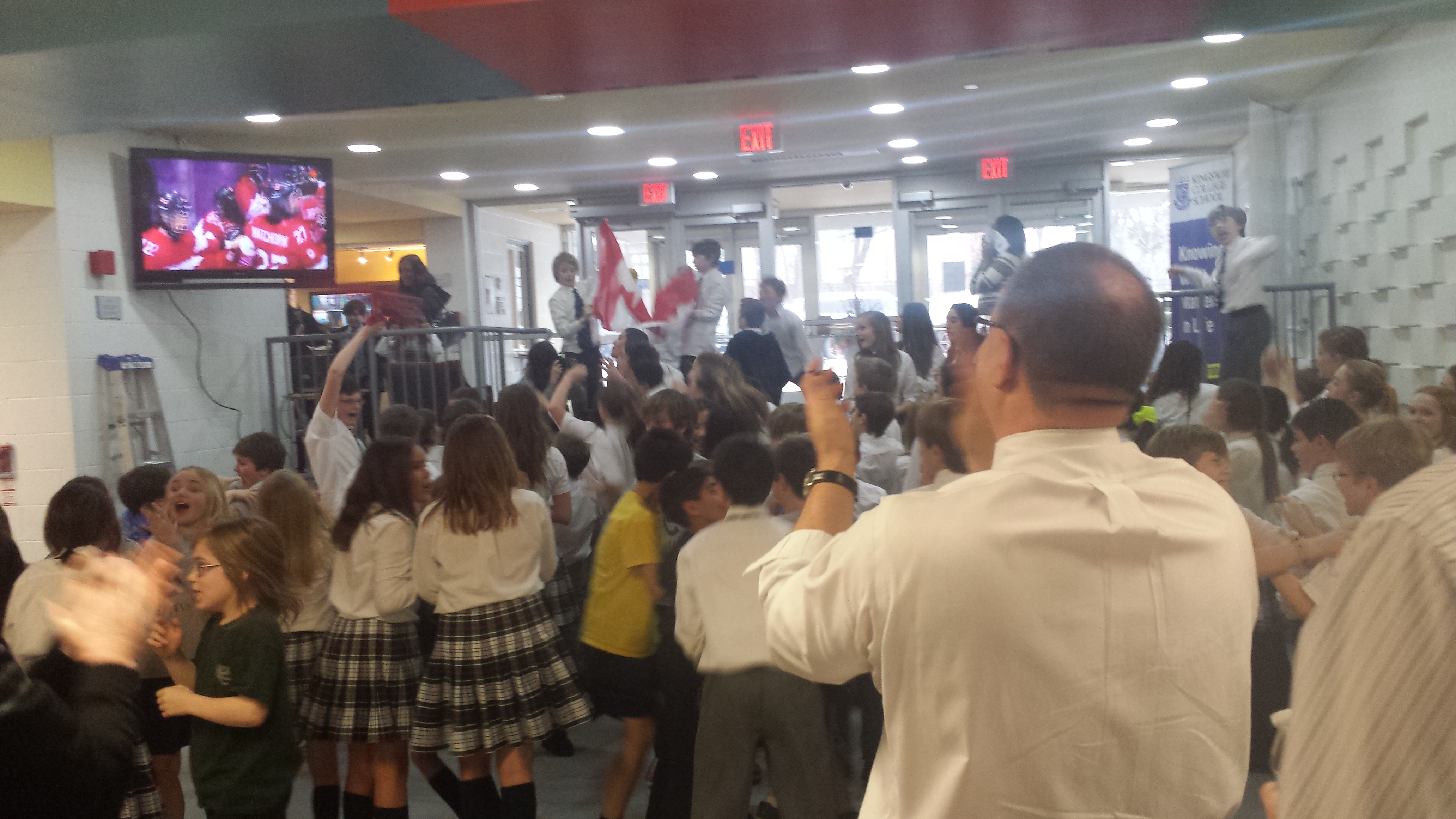
Olympics Women's Hockey Gold - Sochi 2014Today we had the Women’s Gold Medal game playing on our televisions in the lobby and in various classrooms throughout the school.  We all wanted to be in Canada Hall to witness this game today to recreate the feeling of ’72 that some of us can still remember; I was six and have a vague recollection of sitting in my school gym.  However, we are in the midst of setting up for our annual musical next week and so we watched all around the school.

As we know, things didn’t look great for the Canadians with ten minutes left.  But by now we know the memorable finish.  Standing with the students and staff in our upper lobby and experiencing the energy was awesome.

I think Paul “Bear” Bryant, the former Alabama football coach had it right when he said about sports and its ability to bring people together, “It’s kind of hard to rally around a math class.”  Let’s hope our men’s team can re-create the feeling again tomorrow in their game against the Americans.  Maybe 20 years from now our students will remember where they were on February 20th, 2014, when we won Gold.

Derek Logan
Head of School

A Groundswell of Gratitude

Our students have much to be thankful for. What’s nice is that they are thankful, and make no secret of it. Here are just of few of the ways our students express their gratitude.

Gratitude Journals
Our grade 3s are keeping gratitude journals. Messages of gratitude also cover their walls. They recently all prepared lunches for a local Out of the Cold program, and included heartfelt messages that will warm hearts as much as the lunches will fill bellies. I stopped by their class the other day to pick up the lunches and had the pleasure of hearing them share what they had just written in their journals. One was grateful for the fact his mother spent her time registering him for lacrosse. Another was grateful that his father coached his hockey team. A third was grateful for his guinea pig’s delight when he came home from school every day.

100 Reasons Why We Love KCS
100 Reasons Why We Love KCSOne of our SK teachers recently created a 100-days-of-school mural, composed of 100 hearts completed by our JK, SK and grade 1 students, as well as some teachers and administrators. In each heart we wrote a message of what we love about KCS. The messages include:

“I love using numbers and counters.”
“I like going to the library.”
“We get to play chess.”
“The teachers are very funny.”

Compliment Friday
Each end of week assembly includes Compliment Friday where students are invited to share a public thank you in front of the whole school. Last week’s assembly included compliments to teachers for their support during exams, a guest teacher for jumping in when their teacher was away, friends and classmates for generally being awesome.

Class Meetings
Class meetings at KCS start with an around-the-room sharing of compliments or expressions of thanks. Last week I had an unexpected opportunity to join a class meeting dedicated to a student facing an exceptional personal challenge. Each of the other 41 grade 6 students gave a compliment to their classmate. This student was praised for being resilient, being brave, being funny, having a positive attitude and being a great friend.

One of our KCS Habits is Make the World Better. One way to do so is to express gratitude. Our students’ obvious gratitude makes our little part of the world much better. For that, I’m grateful.

Andrea Fanjoy,
Assistant Head, Academics
You can follow Andrea on Twitter @afanjoy.

Big Steps with our Little Ones

LearningIt’s been almost six months since KCS’s first-ever PK, JK and SK classes began. You may recall that when you’re that young, six months is a very long time. Between everything our youngest students have learned and all that their teachers have accomplished, it’s time to step back, take note and celebrate.

All good teaching starts with learning. Discussions on how to align the Early Learning Program (PK-SK classes) with grades 1 to 8 began in January 2013. These discussions were promptly fuelled by external professional development throughout the spring and summer at a kindergarten conference, a reading institute and at workshops on play-based learning.

Since September, professional development hasn’t let up. More external workshops, online courses, internal guidance on emergent curriculum and technology, iPad workshops, plus visits to observe and learn from kindergarten teachers at another independent school have also taken place. Without question, the newest members of our KCS faculty are exemplary models of our KCS Habit Embrace Learning. Commitment to ongoing learning and improvement is an inherent part of KCS from PK to grade 8.

Reading Mastery is a Direct Instruction program that is now established at KCS from JK to grade 6. First introduced at KCS two years ago, the small-group, research-based instruction is proving exceptionally effective in ensuring all students master the fundamentals of reading, from phonics to making inferences. Our kindergarten students get further opportunity in reading through take-home readers, regular get-togethers with KCS Reading Buddies, the excitement of guest Mystery Readers, teacher read-alouds and multiple other opportunities to learn the power of print.

Project-based learning (PBL) is another school-wide area of focus embraced by our kindergarten classes. PBL is a method of teaching that optimizes both learning about the world and also development of the KCS Habits of Mind, Body and Action. Through a tantalizing question or challenge, curiosity is piqued, and students are ready to engage in a wide variety of learning related to the topic at hand. The Emergent Curriculum practised in our PK classes and play-based learning also practiced in kindergarten are the age-appropriate ‘cousins’ to PBL. This excellent foundation aligns with the learning that awaits in grades 1 to 8 and indeed, the rest of their lives.

Incoming young students can also look forward to much more. iPads are being leveraged to help support skill development in our kindergarten program. The program ‘Handwriting Without Tears’ is being used to teach fine-motor skills, printing and eventually cursive writing from PK to grade 3. Math is being taught according to best practice with small-group instruction, a wide variety of hands-on learning experiences and engaging games. Music and French are taught by passionate specialist teachers who have aligned their efforts with the program in grades 1 to 8. Social and physical development have dedicated time with daily outdoor play and physical education classes in our full day program. Community service included a PK-SK partnership with the George Hull Centre collecting gifts for families in need. And exciting field trips to the Humber Arboretum, Aquarium, Toronto Symphony and more allow our students to learn from the many opportunities within the GTA.

While our half-day and full-day programs both offer all of the above, our full-day program provides the time needed to make the most of a rich learning program. Deep learning comes when students take their time, engage in activities until their natural conclusion and pursue ideas until the mind, not the schedule, tells them to stop. Long uninterrupted periods of learning not only support skill development but are also when habits of persistence, curiosity and creative thinking take root.

At the six-month mark, we’re very grateful for the twelve new faculty who collectively bring more than 170 years of teaching, from not only the former St. Georges Nursery School but also other highly regarded schools. Their learning and dedication to our youngest children has made for a very special first half year. With ongoing learning and unwavering dedication going forward, our Early Learning Program can look forward to many more happy half-years to come.

Andrea Fanjoy,
Assistant Head, Academics
You can follow Andrea on Twitter @afanjoy.

A Brilliant Move

It’s usually a humbling experience when somebody comes along and succeeds with ease where you have already failed miserably. But sometimes you need a little humility to get to a place of deeper understanding.

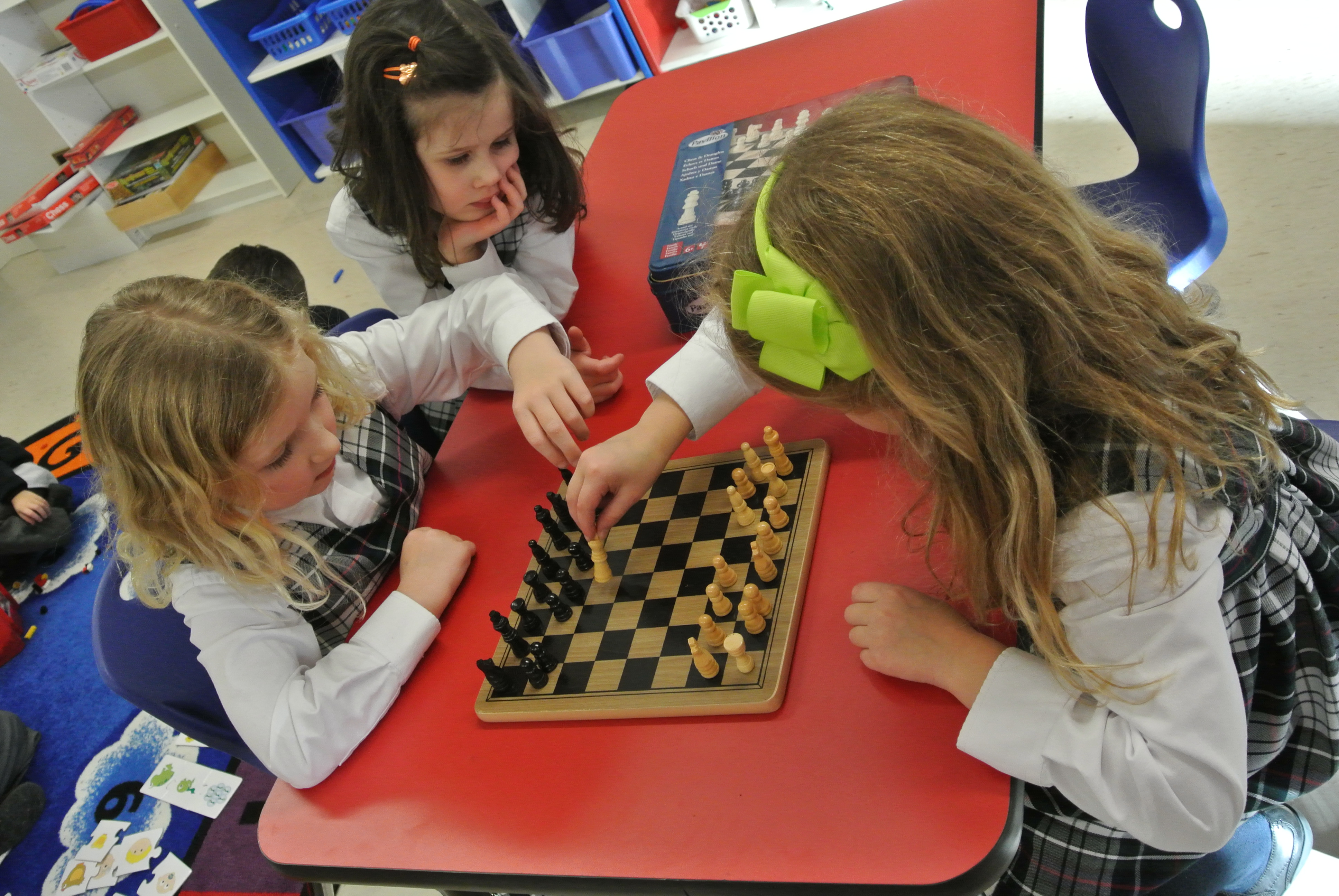
SK Chess at KCSWay back at the end of September, I tried to introduce chess to the SKs. I played up the thrilling warfare angle, created backstories to help explain the way the pieces moved, and generally did my best to sell the students on a complex and exciting game of strategy. One month later, the boards were gathering dust and the knights were being used as “guys” in LEGO castles.

But then a Grade 5 student came along. She had recently read a book called The Queen of Katwe, which chronicled the life of a poor rural Ugandan girl whose love of chess helped her pull herself out of poverty and set her on the path to becoming a world-class Grandmaster. Inspired by the story, she decided that her leadership project would be to teach chess to the little ones in Kindergarten. So she recruited a few friends, hunted down some extra boards, and started coming every Friday at lunch.

chess 3The first visit from the Grade 5s was at the start of January. And with only a few visits, these student leaders have inspired almost half the SK kids to pick up the game and give it a try. The class now cheers when they see “Chess Club” on the daily schedule, and pick-up games during free choice time have become a common sight.

For me, watching these Grade 5s succeed where I had failed has reminded me that the Official Teacher Voice of Authority just can’t compete with joyful enthusiasm from a fellow student. Peer teaching is a powerful tool, and I feel so fortunate to have ended up at a school where it emerges and grows in an organic and authentic way.

Mark Magee
SK Teacher

Me and My MOOC

MOOC(MOOC rhymes with Luke)

Attending a graduate course at Berkeley isn’t easy to make happen at the moment. Nor is it very feasible for me to visit one of the most compelling schools in the world, High Tech High in San Diego, despite my desire. Life has me fully occupied in Etobicoke right now.

No problem. I have my MOOC.

MOOC stands for Massive Open Online Courses, and they’re playing a transformational role in education. They’re offered by renowned universities around the world, delivered by their esteemed professors, and they’re free to anyone who can access the internet. There’s either no or minimal assessment (only completed if desired), which many would agree is a plus. And there’s no credit at the end. For your time, you just get to learn.

The MOOC I’m following is a joint project between the Berkeley Graduate School of Education and the celebrity educator and founder of High Tech High Schools, Larry Rosenstock. The topic: New School Creation – timely, given our exciting work around the KCS Senior Campus. But that’s just my MOOC.

Millions of lifelong learners from all walks of life and corners of the world are signing up for MOOCs that meet their needs and interests. MIT, Stanford, and Harvard are among the many that offer dozens of courses in all of their faculties, all for no cost and no troublesome admissions process. Art, architecture, chemistry, engineering, business, medicine…you name it, you can learn it. EdX, Coursera, MOOC List and Udacity are now popular go-to sites where you can browse for the university instruction of your dreams.

Formal education has evolved into a pretty complex enterprise.  MOOCs, for all their reliance on technology, bring education back to its roots. Willing learners, learning.

If going back to university, for free, at your convenience, and without concern over prerequisites and grades is a way you’d like to be a lifelong learner, rejoice, and get online. I found the perfect MOOC for me. Yours waits for you.

Andrea Fanjoy,
Assistant Head, Academics
You can follow Andrea on Twitter @afanjoy.

A Dad’s Lesson

Be KindAs is usual, when I arrived at work early Monday morning, I took the time to skim through The Globe and Mail and The Toronto Star – I put the Sports sections of both papers along with the Life & Arts section from The Globe for reading later in the evening!  Sometimes I cut a few articles out to read when I have a moment or two over the lunch period.  On Monday, I clipped this article out:

http://www.thestar.com/life/parent/2014/01/20/how_do_you_raise_kids_to_have_good_manners.html

We expect good manners at KCS, and when we don’t witness them, we take the time to teach or remind our students about their importance.**

As I was nearing the end of the article, I was reminded of a lesson my Dad taught me during the summer of my grade 5 year.  Our family was going on a three week vacation to England.  It was our first and only trip on a plane together.  And while I have many great memories of that trip, one in particular stands out.  We were in London visiting various sites before we set off to visit our relatives throughout the south of the country.  All five of us (I have a younger brother and sister), were sitting on the Tube.  It stopped at one of stations and an “older” lady got on.  Looking back, the lady may have been 35 or she may have been 75 (when you are a kid, everyone looks old!), but to my Dad that didn’t matter.  He looked over at me, and said something like, “How long will it be until you stand up and give that lady your seat?”  Only seconds it turns out!

It’s funny, my Dad taught me a lot of things in life (as did my Mom!), but for some reason the lesson above was triggered when reading the Toronto Star article on Monday and every time I’m on public transit around the world.

Derek Logan
Head of School

** For instance, if I was this author’s editor, I would have reminded him that you should not use WTF in your article if you are trying to show good manners.

Full Steam Ahead

steam engineThe Learning Plan that captures our areas of focus this year has 17 items on it. Quite a few, yes, but they’re managed carefully, not all addressed at once, and all chosen because they matter. Some apply to all faculty, and some to just a couple. Some are ongoing every year, such as our focus on developing the Habits. Others represent a brand new initiative or a breakthrough step in a long-term project. This year’s list has no shortage of these.

Here’s a teaser of some exciting things in the works:

  1. January 21st is our first Town Hall on the new Senior Campus. Many people have been working hard on this initiative and we’re keen to start sharing updates. Our mission is to be a defining force in developing lifelong learners. Our Senior Campus will build on our track record for living this mission.
  2. Computer programming has been at KCS since the grade 7s first started creating robots a number of years ago. The addition of an extra-curricular First Lego League team and an elective last year gave interested students extra opportunity to learn programming (and their evident abilities helped them qualify for this year’s Provincial First Lego League Robotics Championship). The significance of the field, it’s opportunities for learning, and it’s increasingly accessible nature have made a compelling argument to provide more programming experience in elementary and secondary school. KCS has pursued an arrangement with RP4K, Real Programming 4 Kids, and we look forward to providing exciting new learning in this area as of this March. More details will follow.
  3. Our littlest learners are a big focus all year. Welcoming our new faculty, students and families in PK, JK and SK has been a priority in our Learning Plan this year. Among other initiatives with this special group, our JK and SK teachers, as well as our Learning Strategies teachers, are the recipients of our first fleet of iPads at KCS for use with their students, launched this month. Technology is an ongoing area of focus at KCS for the value it brings to learning. The launch of iPads brings this value to our kindergarten classes and enhances what we can do in our Learning Centre.

Many other learning projects are in the works. Those who know me know that I’m eager to share those too, but I’ll wait until I can provide more details closer to their launch.

I’m reminded daily how many good things our students manage to juggle and make happen. The least we can do for them is the same. That’s doing what’s right at KCS.

Andrea Fanjoy,
Assistant Head, Academics
You can follow Andrea on Twitter @afanjoy.

How Do You Define Success?

This past Friday, at morning assembly, our school welcomed former Canadian Olympian Deidra Dionne.  Deidra represented Canada during both the Salt Lake (2002) and Torino (2006) Winter Olympic games as a free-style (aerial) skier.  She spoke to our students about goal setting, the feeling of being an Olympian, the importance of others in our achievements, and so many other insightful and important messages.

The message that resonated with me centred on the definition of success.  During her talk, Deidra mentioned her journey to compete in the Salt Lake Olympic games.  She described how she and her coaches planned to get to her first Olympics so that she could eventually stand on the podium.  She accomplished her goal by winning a bronze medal.  By all accounts, people would consider that a success.

More importantly, she went on to describe her journey to Torino four years later.  During training in Australia, she broke her neck.  Given this, free-style skiing at the Winter Olympics in Italy would seem, to many of us, an unreachable destination.  Not for Deidra.  Once she decided she wanted to ski again, Deidra committed herself to get to Italy.  And she did make it.  After all of the jumps made by all of the skiers, Deidra finished 22nd in a field of 23.  Given all she went through to get to Torino, she and her coaches, and all those who knew what she overcame to participate in another Winter Olympics, would consider this a success.  And I think you would too.

In school, sometimes people equate success with winning awards, first place teams, and medals for some competition or another.  There is no doubt you can consider all of those type of achievements success.  This type of success is easily identifiable in assemblies and awards ceremonies.  But there are so many other ways that our students should see themselves as successful: dealing with a difficult personal situation; overcoming a physical injury; doing something for the first time; improving their study or organizational skills, etc.

Deidra defined success in much the same way we’ve been defining success at KCS for 25 years:  try your best in whatever you do.  Success will follow.

Derek Logan
Head of School

Question and Be Curious, But How? – Part I

One of the biggest challenges in education is in knowing how far you have to go to make sure all students learn what matters. Some skills are picked up by many quite readily. Other skills, not so much. For some things the profession has a wealth of precedent, other things not so much. Deciding how far you have to go is driven by experience, knowledge, assumptions, and the amount of time teachers have to think about it once all other important demands are dealt with.

Question and Be Curious is one of our KCS Habits, and all evidence says it’s a habit that matters. It’s no exaggeration to say that democracy, progress, and the understanding of all that happens are rooted in asking and seeking answers to questions, and doing both well. Learning to ask questions readily and well, however, is not easy for many. Sure, students learn the grammar behind asking questions, and goodness knows they get thorough immersion in being asked questions. But teaching the art of question-asking lies in an educational no-man’s-land. When and how are students taught to ask their own questions?

The widespread absence of an answer to that challenge occurred to me as I read the book Make Just One Change by Dan Rothstein and Luz Santana, based on the work of The Right Question Institute. To be fair, most teachers try in various ways to develop this skill, and many students pick it up, either readily or over time, to at least some degree. That being said, and despite pretty significant efforts, I haven’t seen a system that can directly develop this skill in all students that is more convincing than what’s shared in this book. Called the Question Formulation Technique, it immerses all students in asking questions, directly teaches students about them, and engages them in critical analysis of their questions in order to develop awareness of the suitability and relative value of questions. According to Rothstein and Santana, students who’ve gone through this exercise have found it transformational. While I haven’t yet experienced it, I’m convinced enough of its potential that I’m borrowing a class to try it out.

Does it work? Will it work for every student? If it does, what impact will this have on their learning? These are the questions I am asking. Stay tuned for Part II of Question and Be Curious for the outcome.

Andrea Fanjoy,
Assistant Head, Academics
You can follow Andrea on Twitter @afanjoy.