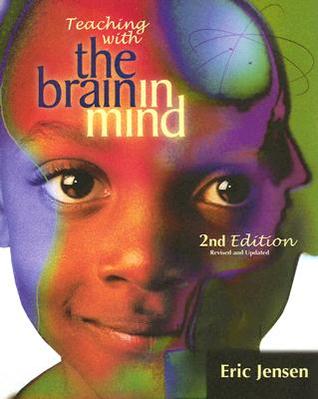
Teacher, Meet Brain.

Teaching with the Brain in MindThat’s how it felt to read Teaching with the Brain in Mind by Eric Jenkins. While the bond between the brain and learning has been known for centuries, the two have been notably coy. It is only recent research which has started sharing and subsequently sparking the intimate side of this complex relationship. And like the rush of first love, it will blow your mind.

My measure of a great book on education is the degree to which it ends up highlighted. Barely a page of Jenkins’ book escaped my yellow swipe. Starting with Neuroscience 101, Jenkins addresses many of the major areas related to learning and highlights the research and implications it has for teaching. From birth and beyond, he looks at preparing the brain for school; the connections between movement, emotions, and one’s physical environment with learning; managing the social brain; and optimizing motivation, engagement, critical thinking, memory and recall. Clearly affecting a significant chunk of the school experience, Jenkins is devoting his career to having teachers ‘teach with the brain in mind’.

Some insights include:

  1. The brain changes and can even grow new neurons throughout life. Nature and nurture both clearly play a role in defining who we are, with growing evidence revealing that nurture can override some nature, even to the degree of changing the impact of our genes.
  2. Exercise offers much more than just physical health. If you desire a denser and better brain, make regular exercise a lifelong habit.
  3. Much of what distinguishes teenage behaviour is rooted in the enormous changes taking place in their brains. Teens even temporarily regress in a number of abilities, such as their ability to recognize emotions in others.
  4. While collaborative learning gets most professional press these days, brain research supports the integration of group activities with traditional learning tasks for optimal learning.
  5. Emotions play a central role in learning and can hinder as much as enhance the brain’s ability to remember. Teachers would benefit from mindfully leveraging them.
  6. Frequent opportunities for movement, and breaks where no new learning happens, are important for long-term storage of learning.

Teachers, indulge in the intimate details of the learner-brain relationship. Meddle even. This is one couple that needs you in the middle.

Andrea Fanjoy,
Assistant Head, Academics
You can follow Andrea on Twitter @afanjoy.

This article was first published in SNAP Etobicoke, May 2013.
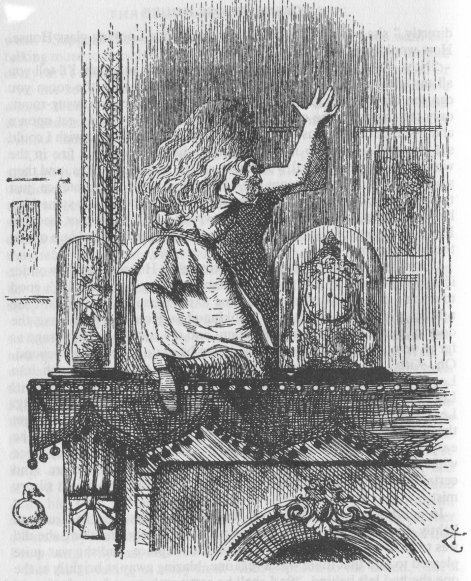
If It Feels You’ve Gone Through the Looking Glass…

“It would be so nice if something made sense for a change.”
-Lewis Carroll in Alice in Wonderland

Into the looking glassParenting has these moments. Teaching has them too.

Our school musical this year was Wonderland!, a spin-off of Lewis Carroll’s classic Alice in Wonderland. As a child, I wouldn’t have noticed the dimension of the story that became evident the other night, when Alice stepped through the Looking Glass and everything turned backwards. To a child, this story is a feat of imagination, a delightful trek into a world that doesn’t exist.

As a parent and educator, it connected with something a little less fictional. It reminded me of the times where my children have come home and bemoaned things that didn’t make sense. It reminded me of times when students complain of an egregious injustice at recess, only to learn that what really happened was a little more complex and nuanced. And it reminded me of some discussions with concerned parents, who recounted what their child told them, and I had the opportunity to share some other relevant details that brought sense to a story in need.

Children aren’t cognitively and emotionally ready to fully understand their world. The perspectives and messages of others, body language, context and the implications of their own actions are often overlooked, not out of dishonesty but out of ordinary immaturity. Even adults struggle with this, and we are all vulnerable to using our imaginations, however unwittingly, to help explain a situation in a way that may please us, but is not a representation of all that really happened.

If your child comes home with a story that leaves you feeling as if you’ve gone through the Looking Glass, take heart. You needn’t go through the many adventures of Alice. Reach out to the adults who can add the facts needed to turn this backward world into one that makes sense. Doing so offers a delight that is preferable to the temporary treat of imagination. Even Alice came to realize it. “It was much pleasanter at home, when one wasn’t always growing larger or smaller.”

Andrea Fanjoy,
Assistant Head, Academics
You can follow Andrea on Twitter @afanjoy.

This article was first published in SNAP Etobicoke, April 2013.

Some Old School is Good School

Learning & Teaching MethodsI confess. At my school, we do some things that are very old school.

I follow what’s happening in the profession very closely. I read with interest what educators around the world are doing. I note that old-school approaches are often assumed wrong, not by research but by opinion.

These are exciting times in education, and there is a lot of room for new tools and strategies. Technology has made much that was impossible possible. Project-based learning, flat classroom projects that connect students around the world, and emphasis on 21st century stills like collaboration and inquiry are welcome progress. I love reading about how educators around the world are using these new approaches, and love bringing much of what is new to our school.

I’m also compelled to be a voice that says there is value in some of what schools used to do. The evidence is in the students, and the fact that a restricted array of approaches will never be sufficient for all. Schools must include all that has recently shown promise, plus remember all that used to have value, and then apply them all according to the needs of each student. So, in addition to all the current practices at our school, what old-school ones have we found also meet student needs?   We teach reading in many ways, but one way is through what’s called Direct Instruction, which is teacher-directed, and is the highly specific teaching of phonics, decoding and comprehension. We teach printing and cursive using a resource that is also specific to the skill, and we use it for six years in a row so that writing has a chance to develop alongside keyboarding skills. We teach math facts until students are fully fluent, allow minimal use of a calculator, and teach math concepts with clear step-by-step instruction. We have exams starting in grade 6, and put a significant effort in teaching students how to prepare for this significant challenge.

Teaching all students well requires open-mindedness to an unbounded array of tools and practices. It requires deep knowledge of each student, reflective practice, knowledge of quality research and the evidence of experience. That needs to be read more often. Whether old-school or new-school, if it helps students, it belongs.

Andrea Fanjoy,
Assistant Head, Academics
You can follow Andrea on Twitter @afanjoy.

Learning What We Don’t Want to Learn

Habits of Mind, Body and ActionThe first Habit on our poster is ‘Embrace Learning’. Don’t let the soothing tone of the word ‘embrace’ deceive you. We could have just as easily described it as ‘Learn whether you like it or not’.

Learning can be like that. Thankfully, most of the time, and certainly at KCS, learning does feel like a warm embrace. It’s delivered by teachers who evidently care about their students and about making learning as positive as possible. And so it should be.

I’ve been reminded recently, however, about the underbelly of ‘embrace learning’, a side that was always intentionally part of that Habit, but that may have gone unnoticed, hidden in the shadows of the ever-more pleasant type of learning that is more the norm here. I’m talking about those important lessons in life that we resist, the lessons we’d prefer not to learn, but learn we should. They may challenge our character, or reveal a sandy foundation upon which we had built mighty assumptions. These lessons may arise when exams yield lower marks than expected; sometimes they arise when we’ve done something we’re later ashamed of; sometimes they will trip up students who otherwise find learning very easy, but then are faced with a topic that is annoyingly difficult to understand. Though these examples focus on the young, we’re never too old for these lessons. And while these examples focus on others, I don’t pretend to be immune.

Humans are generally a comfort-seeking lot. Daniel Willingham, cognitive scientist and author of Why Students Don’t Like School, argues that the brain strives to be as efficient as possible, lazy even, preferring to do as it wishes and not as it is forced to do. Add a dash of limited understanding, bias, immaturity, emotion, or over-confidence, and you have someone ready for one of these most humbling lessons. If they embrace it.

Most learning should feel like a warm embrace. But growing up and being our best self will include these more challenging lessons too. While decidedly uncomfortable, the reward for their steep price is broader understanding, growing maturity, more rational thought and healthy humility. Resilience, thinking flexibly and the ability to persist, three other noteworthy habits, also grow as a result.

That’s learning worth embracing.

Andrea Fanjoy,
Assistant Head, Academics
You can follow Andrea on Twitter @afanjoy.

The Jekyll and Hyde of the Internet

Good and BadThe Toronto Star recently published an article asking, “Is the internet bad for us?”. Good question.

Nothing excites me more than each step forward in doing our best for students. Every concern addressed, every lesson made more impactful, and every child we more effectively connect with is the reward that reenergizes us for the next day. While not always the case, technology and the Internet, in the hands of a determined and mindful teacher, frequently play a role in these steps forward. Though I stand firmly in the camp that says the technology glass is more than half full, I’ve seen enough to know that keeping The Star’s question in the back of our minds is an important part of ensuring the glass doesn’t get knocked over.

The article lists many reasons for concern: family time dominated by laptops and texting, decreased ability to converse, constant desire for affirmation, lack of time alone with one’s thoughts or playing side-by-side with others, etc. The social conflicts inherent in growing up now often play out in cyberspace, where slights, or worse, take on a much greater significance than anything the pre-Internet generation had to face. Growing up is hard, and this generation’s abundant use of the Internet amplifies the highs and lows of this critical stage. Raising children is hard, and the Internet has likewise been a mixed blessing for parenting.

The Internet is here to stay, and to bemoan what’s bad is to miss out on all that’s good. But to revel in the positive without attention to what’s not is unwise. Teaching responsible use of the Internet is now part of what schools must do. Monitoring and having reasonable limits on use at home is now part of what parents must do. With these efforts in place, we can happily answer the opening question, “It could be bad, but not in my family.”

Andrea Fanjoy,
Assistant Head, Academics
You can follow Andrea on Twitter @afanjoy.

Studying Isn’t What It Used to Be

StudyingTechnology, like all things in life, has sides that are both yin and yang. Studying for exams with my son in grade 8, I’m loving the yang side of it.

We counsel our students to study for two subjects a night over the three weeks before exams. The other night, my son chose to focus on history and math. For history, he announced with uncommon enthusiasm that he was going to use the Study Wiki that he and his classmates made. A wiki is a collaboratively-built online reference site, the most well-known of which is Wikipedia. KCS teachers are embracing the making and use of wikis as a meaningful tool for students to take notes and communicate learning. The fact that these notes are shared online raises the whole exercise of note-taking to a real-world relevance that it never had before and, with that, the quality of what they produce goes up. I, and many other parents, are familiar with student “notes” that are sparsely or imperfectly done, and of little support when studying. Studying with the wiki, my son worked with thorough definitions and concept maps, and played knowledge games that cover most of the content he needs to remember. This wiki is available 24/7, thus having the added benefit of not needing to be “brought home” and “returned to school”, demands that often sabotage many a well-meaning student.

Then we moved on to math. This year KCS introduced a new online math resource that offers many benefits. For the purpose of studying, the students were sent a collection of review questions. Each question page had a link to the online video and practice questions that the student could go back to if they needed a reminder of how to approach the problem. When my son didn’t understand a question, it was no longer my responsibility to figure it out and teach him what to do – I simply reminded him to go back to the video for guidance. When my son was done, he received instant feedback on which questions he answered correctly, and which were incorrect. Seeing the ones that were incorrect, we went back to the videos to find out where he took a wrong turn.

Studying well requires many things to fall in line:

  • having what you need, when you need it;
  • having quality notes that are easy to read and use, even enticing to use;
  • getting frequent feedback on how you are doing; and
  • having material available in multiple formats.

These are but a few details that make a significant difference. Any tool that makes more of these fall in line is a tool that is most welcome.

Studying at KCS truly isn’t what it used to be. While the ancient Asian concept of yin and yang has these two as complementary and balanced, studying with technology is firmly on the yang side of this balanced equation. And thank goodness. Exams, and the challenge in facing them, otherwise haven’t changed at all.

Good luck to all in grades 6 to 8, and happy (as-can-be) studying!

Andrea Fanjoy,
Assistant Head, Academics
You can follow Andrea on Twitter @afanjoy.

Exams Got You Down? Just PAUSS

The following blog first appeared one year ago. It’s as relevant now as it was then. We all face challenges from time to time, and how we face them makes all the difference. That’s where the KCS Habits come in.

At KCS, it’s our mission to develop lifelong learners with the habits to face and embrace life’s challenges. Many of our students and parents have an extra one of those challenges on their plate right now.

Exams.

Students in grades 6-8 write exams starting January 28th. Love them or dislike them (yes, we’ve had students say they love them!), learning to prepare for and take exams is a challenge we all have to face at some point. Starting them in grade six, with ample guidance and time learning how to prepare, is the best way to start. Though a big deal, exams at KCS are also a safe opportunity to face this challenge, ‘try your best’, and learn from mistakes.

Looking at our Habits poster in my office Friday morning, I wondered which of the habits students should focus on to be successful preparing for exams. Five stood out. When written down, it became clear they made for a nice little acronym – a beacon for calm in the storm of stress that often surrounds the ‘e’ word. The acronym is PAUSS. The habits are:

Persist – this is a marathon, not a sprint

Adapt – old patterns of studying and time management likely need to change

Use past learning – use notes and old tests; use strategies that you already know to work, and avoid those that you know don’t

Show self-control – stick to the study plan; focus on the task; remember to also rest, eat well and get exercise

Strive for accuracy – follow the study keys, test yourself, aim to understand any errors

Exams inherently stir up anxiety. PAUSS, happily, does not.

If your child is writing exams, encourage them to PAUSS. And watch with pride as your child develops habits that matter. Take heart. Dread will soon be replaced with delight, and doubt will be replaced by well-earned confidence. And the unknown challenges to come will face a tougher foe.

How Technology Increases the Personal Touch in School

The notion shared in the title may not be obvious. Because the personal touch matters, it’s worth understanding and, for the benefit of students, acting upon.

Of course, technology isn’t a person. It won’t ever replace the power of a teacher who knows and cares for his or her students. It won’t bring the creativity and professional judgment the teacher applies daily in his or her class. So how could technology possibly increase the personal touch?

First, let’s take a hard look at the familiar. The traditional “sage-on-the-stage” approach to teaching unfolds at the pace decided by the teacher. It covers content decided by the teacher, and is delivered in a manner decided by the teacher. While appropriate at times, this approach is imperfect and, for many students, impersonal. These students require a different pace, be it faster or slower. They respond better to a different level of content, whether more simplified or complex, or would understand concepts better with different choices of content.

Technology personalizes school because it brings flexibility in pace, level and content like a teacher alone cannot. Here are some examples:

  • Instead of completing the same math fact sheet, students can use websites like www.thatquiz.org to practise the math facts they need to practise, at the right pace and level of challenge for them. Similar tools exist for all basic skill development.
  • Instead of learning through the lens of textbooks, students can use technology to roam the world for relevant content. Under teacher supervision, students can create their own multi-media “texts”, in the form of wikis, that they and their classmates can study from with pride.
  • Instead of sitting through a lesson that many students may not need (because they already know it) or not follow (because they’re lost), teachers are leveraging technology to personalise instruction. Technology can deliver introductory instruction at a pace controlled by each student (you can pause, rewind, rewatch at will). Students who need different levels of instruction can get that too. Watching instructional videos the night before class makes the in-class lesson more effective and efficient, and leaves more class time for real teacher-student interaction.

The personal touch matters and having a great teacher matters. Technology can help make the most of both.

Andrea Fanjoy,
Assistant Head, Academics
You can follow Andrea on Twitter @afanjoy.

This article was first published in SNAP Etobicoke, November 2012.