What Happens on those Early Dismissal Days?

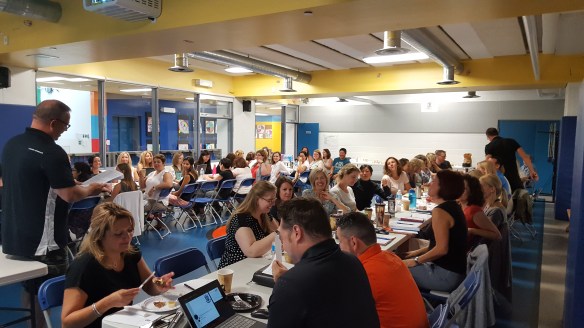
Have you ever wondered what KCS teachers are doing during those early dismissal days when school wraps up at 12:20 and students head out to start their weekend? For starters, these afternoons always begin with a great tradition- a delicious potluck lunch.  Many KCS teachers work across numerous grades throughout the building. This special lunch is a wonderful opportunity to break bread together and reconnect with colleagues from a different grade or division. A quick glance across the room reveals tables that are full of lively conversations, laughter and an unmistakable atmosphere of positive energy.  It is this energy that fuels the professional development activities that make up the balance of the afternoon.

Staff activities during Early Dismissal Days, or EDDs, exemplify the collaborative spirit of the KCS Faculty.  Early Dismissal days complement the numerous meetings that KCS teachers attend on a weekly basis.  These formal and informal meetings allow our teachers to better understand and meet the needs of our students.  Earlier this year, the KCS faculty completed professional development activities that reflected on Project Based Learning, Differentiated Instruction and Health and Wellness. These afternoons are sometimes used to formulate action plans for students who may need extra support, guidance, challenge or a friendly pat on the back.  EDDs also offer a wonderful opportunity for both teachers and administrators to invest time into discussing curriculum, school wide projects, enrichment opportunities and upcoming events. Building on these important discussions, the teachers also take time to review current best practices whose key purpose is to make KCS a better school. Topics cover the range of our Four Doors to Learning including classroom innovation, student generated ideas, the status of clubs and teams as well as improvements to assessment and reporting.  Most importantly, teachers focus on how best to apply our Habits of Mind, Body and Action.

Time is always a precious commodity during the school year.  With this in mind, the KCS team recognizes the value of taking time to pause, reflect and then planning out a solid path forward. EDDs often have a busy agenda, but enjoying your grade partner’s homemade brownies while planning for the next Science or Language Arts units is a nice way to spend an afternoon.
staff-meeting

Everything a School Should Be – Part 2

Teachers join the profession to do their best for students. Doing one’s best includes a vast array of efforts, a sample of which were shared in Part 1 of this post.

Doing one’s best also means a determined, responsible commitment to constant improvement, wherever merited and as manageable.

At KCS, we’re constantly looking at what we do, identifying where we wish to grow, and taking measured steps forward from year-to-year. Many steps are identified by individual teachers, or grade partners, or divisions of teachers. Some steps are school-wide. Some are new initiatives; while others are ongoing efforts that began in previous years and continue to be an area of focus.

Here is some of what we’re focusing on this year:

  1. Living the Mission – Always our #1 focus, our mission is to be the defining force in developing lifelong learners. Currently, this effort includes Project-Based Learning; direct efforts to teach questioning skills; the growth of KCS as a Makerspace, with our new Innovation Lab and increased “making” throughout the school; the use of design thinking for deeper thinking, learning and problem-solving; and the launch of a new program called “High Resolves” in our senior grades as part of our global education efforts.
  2. Assessment – This is a multi-year area of focus. We launched a new report card last year and some adjustments will be made this year. We also launched our new secure electronic portfolio, Sesame, and we continue our roll-out to include all students from PK to grade 3. A blog will soon follow to explain why this is an exciting addition to KCS!
  3. Movement Project – This is also an ongoing area of focus under the leadership of our Director of Student Life, Tamara Drummond. Standing desks, chairs that allow for movement, fidget toys, and new practices that invite more frequent movement in the school day are becoming increasingly widespread throughout the school.
  4. Reading Evolution – A number of years ago we introduced a reading program that helped many of our students better consolidate the fundamentals of reading. The cumulative effect of this program is now a very noticeable increase in the reading skills of all of our students. Driven by internal data, reading instruction is evolving to meet the growing readiness for greater challenge.
  5. ELP and Reggio-inspired programming – Following widespread professional development, visits to other schools, and engagement of a consultant, the PK, JK and SK faculty have enthusiastically embraced Reggio-inspired programming as a strong complement to the Ministry of Education curriculum. While direct instruction on core skills will continue, students will also be given more time to practise being deep thinkers and learners through self-directed inquiry.
  6. Professional Development – PD has always been a regular feature of employment at KCS. All teachers have a generous budget for PD and they pursue various opportunities of relevance to their role. This year we launched a new means of sharing PD that allows all staff to see what others have done, and get a glimpse into what they learned. This is an efficient and effective new way to share professional learning and encourage greater awareness of the various PD offerings available to all.
  7. Canadian Accredited Independent Schools (CAIS preparation) – This merits a blog of its own, and one will follow later in the year. CAIS oversees a comprehensive accreditation process for independent schools that aspire to excellence. KCS is CAIS-accredited, and all staff will be working this year on an internal review in preparation for our upcoming accreditation review in November of 2017.

At KCS we’re constantly learning so that we can keep improving in all ways that matter, each and every year. Creative thinking is inspired when multiple challenges synergize into innovative solutions. Progressing thoughtfully and responsibly, changes aren’t always immediate. They’re discussed, and if considered worthy they’re piloted. If successful, they spread. When imperfect, they’re tweaked. And they’re not limited by the notion that we can only focus on a few areas. Collectively, there are positive changes happening throughout the school, based on what teachers feel needs improvement, and what they can manage well. Being everything a school should be includes constantly trying to do better. Doing our best means we won’t accept anything less.

Pourquoi apprendre le français? / Why learn French?

« Why learn French? » If your child asked you this question tonight over dinner, what would your answer be? And how might your own experiences with learning the language influence that response?

The truth is there are many reasons to learn French, as our Grade 7 students recently discovered during a brainstorming session with graphic recorder, Disa Kauk. Their individual ideas contributed to the creation of two stunning visual reminders of ‘Pourquoi apprendre le français?’ and I encourage you to have a closer look at them the next time you are in the school.

In order for learning to endure in any subject area, we must see the value in what we are learning and understand our own reasons for learning it. This is especially important in the French as a Second Language classroom as most students only have a chance to practice their skills here at school. Students need to realize that French exists outside the walls of the classroom as well. With a curriculum now focused on authentic communication and real-life situations, this is truer than ever and families can play a vital role. Simply having a conversation with your child about the importance of learning French is a great starting point as it shows your child that French is valued outside of school. But you don’t have to stop there.

Parents often ask how else they can support their child’s French learning at home. Consider family movie nights in French by picking a DVD of a movie already familiar to your child in English and watching it together in French. Instead of watching the Leafs game in English, choose a station with French commentary. Point out French words on packages, in magazines, in stores and during your travels when you come across it. Visit a museum or gallery and take a tour in French. Listen to a French radio station. Take out French library books. You may even consider joining an organization like Canadian Parents for French which furthers bilingualism by promoting and creating opportunities for youth to learn and use French. Detailed information on exchange programmes, summer camps and many other unique language-learning opportunities is available on www.frenchstreet.ca. The possibilities are endless!

As a French teacher, I have seen a real difference in the classroom when students buy into their learning by taking opportunities outside of school to enjoy learning French. When they have more chances to practice their skills in the real world, they are more inclined to transfer that enthusiasm to the classroom and beyond.

Pourquoi apprendre le français? It’s never too early – or too late! – to start this conversation. When will you have yours?

img_9166

Everything a School Should Be (Part 1)

Let’s take a moment and think about everything a great school should be doing for students. There’s the curriculum – collectively many hundreds of pages of content and skills, wrapped up in subjects, that schools need to make sure all students learn. Then there’s tailoring the curriculum, because ensuring all students learn requires adjustments for each and every one. On top of that there’s enrichment programming, character education, learning skills, collaboration skills, critical and creative thinking, leadership and citizenship, appreciation of nature and the arts, and so much more. Schools need to engage minds, inspire physical health and activity, develop resilience, and nurture the artistic spirit. Direct instruction matters. Project-based learning matters. Clubs, teams, field trips, inspiring speakers, cross-grade integration activities, and spirit-raising events matter. Throughout the delivery of all of the above, a school needs to help students with the inevitable bumps – social, emotional, mental, academic, physical – that happen and directly interfere with everything else if not well addressed. And all of this, and more, needs to happen in an aligned, whole-system manner so it’s optimal both in how it’s experienced and in the difference it makes. Without a doubt, a great school must do many things exceptionally well.

Yet to follow the dialogue, one might think it’s otherwise.

We hear boasts of schools that are outstanding on singular measures, but left wondering how these feats are achieved without sacrifice in other areas of the school. We read that schools should focus improvement efforts on only a small number of areas at once, as if all other important things can wait, for years. We learn of exciting new programs that have great appeal, but represent just a tiny fraction of what’s needed for deep, longstanding impact. This is fine reading, but none are the story that students most need. None are the story we should want for our children.

At KCS, we’re transparent in our unrelenting commitment to being everything a school should be. Our Four Doors to Learning program in academics, arts, athletics and citizenship reflects years’ worth of creative, collaborative effort so that our story is the full story students need. Our faculty are constantly adding new professional learning so that this effort reflects the wisest judgment we can muster. And we’re constantly striving to improve in as many ways we can, and in all ways that matter.

KCS is committed to being everything a school should be. If there’s anything singular about where we strive to be outstanding, that’s it. We know that other schools strive for this as well, but it’s a story we don’t hear often enough. It makes for a long story, with many lengthy chapters. In a busy world and crowded social media space, it’s a story that takes time to tell and time to hear.

That’s okay. Children love long stories. So should we.

Part 2 of this post, to be published shortly, will share the story of how KCS is constantly striving to improve in its effort to be everything a school should be.

Four Doors Collage.jpg

Best Ever Teaching and Learning

“During my Driver’s Ed, I was so nervous the instructor had me drive to Tim’s. I learned how to go through the drive-through and ordered a jelly donut.”

“My grade 9 history teacher claimed he had many past lives and would tell the stories of those lives for the period we were studying. It ignited my passion for history.”

August may seem like a long time ago for many. As for me, one memory from August continues to warm my soul.

The last week of August, all faculty returned to school, joining the non-teaching staff who remained busy over the summer preparing for September. It’s a huge week of learning, meeting, and planning. This year, it was also the week that all faculty and non-teaching staff engaged in an exercise to define excellence in teaching and learning. It started with a partner activity to share our personal answers to the following:

  1. What is the best learning experience you’ve ever had at school?
  2. What is the best learning experience you’ve ever had outside of school?

Take a moment. What would your answers be? We all have them, and would do well to remember.

With these personal stories captured on post-it notes, larger groups assembled and identified the features of these experiences that made the cut. All features were then shared with all staff. Of the 39 different features, all staff then identified their top six. Collectively, here are some of the features that were most chosen by all staff:

  • “Out of our comfort zone”
  • Hands-on
  • Inspiring
  • Meaningful
  • Challenging
  • Involved responsible risks
  • Real-life experience
  • Collaborative
  • Fun, Humourous
  • Passion-driven
  • Creative
  • Empowering

There are many ways to learn, and while not all are exciting enough to be remembered as “best learning ever,” they all add up to making a difference. However, learning that is so special that it remains a powerful memory years later is learning that clearly matters. This exercise was a great kick-off to a new year meant to inspire unforgettable learning.

May the learning in your lives be full of what we aim to bring to your children.

The Numbers Have It

mathAs classrooms across Ontario echo with the sounds of excited students, the hot topic making waves in Ontario has been math scores. The news for many, unfortunately, has not been as sunny as our summer weather.

At Kingsway College School, our approach to math (and everything else) is proactive, based on proven practice, tailored to our students, and built through teamwork.  For example, in our first week of school, I observed a few of our grade 3 and 4 students completing a math placement activity with one of our specialist teachers, Mr. Graham Marshall.  Working in small groups, the students tackled a range of challenging questions.  Once evaluated, these assessment results will be used by both Mr. Marshall and his Primary and Junior colleagues to support differentiated instruction and a tailored curricular course for these students.

Math doesn’t come easily to some. And it comes very easily to others. A school’s job is to make sure all these students learn. KCS continuously strives to uncover the most effective strategies to support and if need be, accelerate students as they all navigate the ins and outs of the math curriculum.  Standardized test results make clear that we’re doing our job. Though fall will soon be here, we’re delighted that the KCS math story is the sunny one that all students deserve.

Common Sense on Character

One of our KCS Habits of Mind, Body and Action

One of our KCS Habits of Mind, Body and Action

“It’s great to have him back, but I already run my class and raise my daughter according to his book.” — a KCS teacher

I knew it as soon as I heard Ron Morrish, speaker and author of Secrets of Effective Discipline and With All Due Respect, over 10 years ago. His message on how to develop self-discipline in children would transform my approach as both educator and mother of two young boys. Seven years ago he first spoke at KCS. This month he visited with faculty once again.

Many parents and visitors have remarked on the manners and behaviour of our students. Stand-out moments for visitors are how often they’re greeted by students and have the door held open for them. For a bustling community of 369 students, over 60 staff, and the many parents and others who join us each day, the atmosphere is happy, respectful and purposeful. While there are many good reasons for that, one is Ron Morrish and how KCS has incorporated his pointers into our day.

Ron is the first to say that much of his advice captures how many of us were raised. He says it’s the “common sense” that, unfortunately, is less common these days. So what’s included in this common sense on character? Here’s a small sample:

  1. Always model the behaviour you seek
  2. Teach the behaviour you seek; don’t assume children should know how to behave at all times
  3. Be clear and ensure follow-through on directions
  4. Make sure small things are done properly and consistently (manners, holding doors, routines)
  5. When mistakes happen, require a “do-over”; mistakes mean more practice doing things right
  6. Take proactive steps so children can be successful behaving as they’ve been taught
  7. This all takes persistent work

Parents, you’ll be glad to know that your children’s teachers spent an afternoon enjoying a refresher from Ron Morrish. And to the parents and educators seeking more self-discipline among the young in your midst, consider looking into Ron’s teachings. As it has for many of us, it could really make a difference for you too.

Andrea Fanjoy,
Assistant Head, Academics
You can follow Andrea on Twitter @afanjoy.

It’s a Team Game.

At KCS, we have our very own Amazing Race in grade 7! And you’ll have to trust me that so many things about it are indeed amazing. In teams, students complete projects that span many subject areas. Because that’s how life is. We don’t learn things in silos. Everything connects! Learning includes information about: travel advisories and blogs, music, games, global challenges, comparison of statistics, environmental stewardship, maps, and more. Our students prove that when given the opportunity to learn and the adults get out of the way, great learning can happen. In grade 7, the culmination of this learning leads to the Amazing Race Challenge. Groups of students solve clues to get from one area of the school to another. Each challenge requires them to use their skills and knowledge, perseverance and group effort. It is a wonderful snapshot of their growth in learning in so many areas. Successful groups encourage each other, are empathetic, show leadership, and play to each member’s strengths. It’s a team game.

What happens behind the scenes is a team game too. Teachers excitedly work out logistics, research new technology, bring forward innovative ideas, and brainstorm solutions.  Who is more excited on the day of the Amazing Race Challenge: students or teachers? It’s hard to tell. Although I’ve been at KCS for 15 years, I’m still very humbled by how willing our team is to: jump in, propose ideas, organize, supervise, take photos, offer prep time or materials, try new technology tools, and so MANY more little and big things.  They put the students first in all that they do. I’m honoured to be part of the team. It is a team game.

Ms. Gaudet
Grade 7 Teacher and Citizenship Coordinator

The ‘H’ Word

“I’ve never overseen homework in my house. My kids know to settle down and get it done.” — A KCS parent

I’ve long envied that mother, as I know first-hand that homework doesn’t always work like that. In fact, based on everything I’ve heard and read over many years, it’s clear that the homework experience can range from the sublime to the ridiculous. While a common element in schools throughout the world, there’s little that’s common about how it plays out at home.

If there were a one-size-fits-all solution to homework, rest assured, we would have embraced it. In its absence, KCS offers what we believe is the next best thing – a balanced approach that respects individual students and families; that has value, while also respecting the value of free time, particularly in childhood; and that directly asks students and parents to let us know when homework gets out of hand. Every October, KCS teachers ask parents how homework is going. Every May, we ask parents in our annual Family Satisfaction Survey if they agree with our guidelines of approximately ten minutes per grade (e.g. grade 3 x 10 minutes = 30 minutes) and with minimal need for adult support. We also ask if parents are satisfied with their child’s ability to complete homework within these guidelines.

What do they tell us? Year after year, and for every grade, the majority of parents are satisfied with our guidelines. Overall, 81% of parents in last year’s survey stated they support our guidelines. Among those who don’t, 8% said the guidelines represent too much homework and 13% said they represent too little homework. Regarding the homework experience, 75% of parents are satisfied with their child’s ability to complete homework within the guidelines and with minimal adult assistance. Homework can be a difficult habit to establish for many children. While it’s clear a number of students are still working on becoming efficient and independent, it’s encouraging to see that the majority of our students are managing homework well.

A telling trend emerges when looking at the results from year-to-year. In fact, what’s ‘telling’ is the lack of a trend. Since we started asking about homework a number of years ago, there is considerable variability within grades year over year. Where one year the parents with children in a given grade may be close to 100% in support of our guidelines, the next year’s results may reveal that only 70% of parents support the guidelines for that grade. The following year, it may be high again. Consistent consensus on homework is nowhere to be found.

What’s a school to do? First, schools need to do their own homework on how to best design, assign and support it. A few years ago, KCS undertook this challenge and you can find the results in the report “Homework at KCS”. Second, schools need to reach out to parents. Parents know best how homework is going in their household. The same homework assigned to a class may take one child five minutes and another 50. The same assignment may be readily done by some children without parents’ help, while other students may be entirely unable to begin without an adult by their side. Finally, schools need to be prepared to make individual adjustments to homework where needed. Multiple hours of homework each night is as unhealthy as it is unwise. While we can’t promise it will always be sublime, it should never be ridiculous.

Hopefully, homework isn’t a bad word in your home. Because we know it has the potential, we’re doing our best to make it the best it can be. For that, we need your help. In this one way, we step away from our guidelines. For us to do our homework, we need you by our side.

Andrea Fanjoy,
Assistant Head, Academics
You can follow Andrea on Twitter @afanjoy.

Nervous for Nothing

Starting a new job is not easy. In fact, it is often nerve-racking. Like those “minor-niner” days in high school, you’re beginning a new chapter in your life, one that you’ve been preparing for, but still feel completely unfamiliar with. A number of thoughts run through your head: “Will I make new friends?” “I hope I don’t get lost!” “Am I going to embarrass myself?”

I have always been a nervous person. In school, when I had to do a presentation, I would shake so much that eventually the notes in my hands would become useless. I can assure you that these feelings didn’t subside as I grew older. All this being said, I’m sure you can imagine the state I was in leading up to my first day at KCS.

I will tell you now that all those nerves were unnecessary.

I was told how great KCS was before I started. This is not surprising as they wanted me to join their community. Imagine my surprise when all those amazing things I had heard turned out to be true and not just a clever ploy to get me to say yes.

Every staff member has been so welcoming and supportive, and they’ve done this in a way that doesn’t emphasize the fact that I’m new. If I didn’t know any better I would think I had been here for a couple years, not a couple weeks. The students, although many of them are not familiar with my face, have been nothing but polite and respectful. I think we all know how impressive this is. We were all students once, and likely ready to test the new/substitute teachers.

I can honestly say looking back at all the jobs that I’ve had that  I have never felt more comfortable, more welcomed, more appreciated, and more excited to wake up in the morning than I have at KCS. This school is special, and I am so excited to be a part of the community!

Diana Bowes
Teacher, Early Learning Program