JKs Look for Spring in High Park

We can all agree that this past winter was brutal and seemingly endless.  Generally speaking, spring has never been more anticipated and welcomed than this year.  Where does winter end and spring begin?

We had timely discussions in our JK classrooms, prior to the official date, so we would recognize spring when it arrived.  We read kid-friendly books with promises of better things to come. We printed spring words using our best HWT (Handwriting Without Tears) letters.  We drew hopeful pictures of spring in the brightest colours we could find.  We took a few pictures in the playground with our iPads of even the slightest hint that spring was around the corner: receding snow banks, patches of ice from the previous day’s melt, and stubborn hedge buds reluctant to unfurl.  Spring just wasn’t coming to us fast enough!

We decided to go on a field trip looking for spring.  High Park was close and pretty expansive with its alluring variety of habitats: the wetland, the woodland, and the endangered black oak savannah. Surely we would find spring there! Following a lovely warm spell of sunny weather, snow had fallen on the weekend prior to our trip: one last blast of that relentless polar vortex.  Our unfortunate traffic delay on the Humber Bridge, due to road work, hinted that we were definitely getting closer to spring!

Our two JK classes, along with teachers and parent supervisors, were greeted by two knowledgeable and captivating guides, Katrina and Mallory, who invited us into the intriguing High Park Nature Centre for the first part of our tour.  Our students impressed them with their first-hand knowledge of spring during our lively discussion, book reading, and introduction to the resident critters: turtle, lizard, and snake. Our students carefully created seed balls by rolling together mud and seeds for our outdoor planting activity: our contribution for the upcoming Earth Day and for the restoration of the rare black oak savannah.

Once outdoors again, in winter jackets and snow pants, our students hurled their seed balls into an open grassland. They were encouraged to undertake a sensory exploration while engaged in a nature hike into the woodland.  We captured signs of spring with the iPads: tufts of green grass emerging from the leaf piles, footprints in the mud, and buds on branches. We heard the songs of many birds calling for mates and announcing their readiness to start building nests.  Our keen guiders kept reaching into their educational pouches, bringing out soft replicas of the elusive birds, and coaxing their proper songs with gentle tummy squeezes. We captured images of the trees through bark rubbings, and we hugged a few trees.

It was over too quickly! Both the children and adults agreed that it was an amazing field trip.  The bus ride home seemed a little quieter, but no one fell asleep! There were so many images dancing in our heads, luring us to come back again.

Yes, we found spring, but we still want MORE!

On a personal note, I have experienced High Park as a wonderful place for families to spend quality time together.  There is nothing more humbling than hand-feeding tiny tame chickadees at the south end of the park. It is not unusual for a butterfly to land on you as you stroll through the beautiful gardens. The chipmunks along the pathways love to gather snacks thrown for them.  There are great playgrounds, opportunity for many sports, a small zoo, a pioneer museum, and many special events. What a great place for all family members to slow down, take a mental break, get one with nature, and engage in fun physical activities! I highly recommend High Park as a place to visit frequently.

Sharon Freeman, RECE
JK Teacher
Big Steps with our Little Ones

LearningIt’s been almost six months since KCS’s first-ever PK, JK and SK classes began. You may recall that when you’re that young, six months is a very long time. Between everything our youngest students have learned and all that their teachers have accomplished, it’s time to step back, take note and celebrate.

All good teaching starts with learning. Discussions on how to align the Early Learning Program (PK-SK classes) with grades 1 to 8 began in January 2013. These discussions were promptly fuelled by external professional development throughout the spring and summer at a kindergarten conference, a reading institute and at workshops on play-based learning.

Since September, professional development hasn’t let up. More external workshops, online courses, internal guidance on emergent curriculum and technology, iPad workshops, plus visits to observe and learn from kindergarten teachers at another independent school have also taken place. Without question, the newest members of our KCS faculty are exemplary models of our KCS Habit Embrace Learning. Commitment to ongoing learning and improvement is an inherent part of KCS from PK to grade 8.

Reading Mastery is a Direct Instruction program that is now established at KCS from JK to grade 6. First introduced at KCS two years ago, the small-group, research-based instruction is proving exceptionally effective in ensuring all students master the fundamentals of reading, from phonics to making inferences. Our kindergarten students get further opportunity in reading through take-home readers, regular get-togethers with KCS Reading Buddies, the excitement of guest Mystery Readers, teacher read-alouds and multiple other opportunities to learn the power of print.

Project-based learning (PBL) is another school-wide area of focus embraced by our kindergarten classes. PBL is a method of teaching that optimizes both learning about the world and also development of the KCS Habits of Mind, Body and Action. Through a tantalizing question or challenge, curiosity is piqued, and students are ready to engage in a wide variety of learning related to the topic at hand. The Emergent Curriculum practised in our PK classes and play-based learning also practiced in kindergarten are the age-appropriate ‘cousins’ to PBL. This excellent foundation aligns with the learning that awaits in grades 1 to 8 and indeed, the rest of their lives.

Incoming young students can also look forward to much more. iPads are being leveraged to help support skill development in our kindergarten program. The program ‘Handwriting Without Tears’ is being used to teach fine-motor skills, printing and eventually cursive writing from PK to grade 3. Math is being taught according to best practice with small-group instruction, a wide variety of hands-on learning experiences and engaging games. Music and French are taught by passionate specialist teachers who have aligned their efforts with the program in grades 1 to 8. Social and physical development have dedicated time with daily outdoor play and physical education classes in our full day program. Community service included a PK-SK partnership with the George Hull Centre collecting gifts for families in need. And exciting field trips to the Humber Arboretum, Aquarium, Toronto Symphony and more allow our students to learn from the many opportunities within the GTA.

While our half-day and full-day programs both offer all of the above, our full-day program provides the time needed to make the most of a rich learning program. Deep learning comes when students take their time, engage in activities until their natural conclusion and pursue ideas until the mind, not the schedule, tells them to stop. Long uninterrupted periods of learning not only support skill development but are also when habits of persistence, curiosity and creative thinking take root.

At the six-month mark, we’re very grateful for the twelve new faculty who collectively bring more than 170 years of teaching, from not only the former St. Georges Nursery School but also other highly regarded schools. Their learning and dedication to our youngest children has made for a very special first half year. With ongoing learning and unwavering dedication going forward, our Early Learning Program can look forward to many more happy half-years to come.

Andrea Fanjoy,
Assistant Head, Academics
You can follow Andrea on Twitter @afanjoy.

A Brilliant Move

It’s usually a humbling experience when somebody comes along and succeeds with ease where you have already failed miserably. But sometimes you need a little humility to get to a place of deeper understanding.

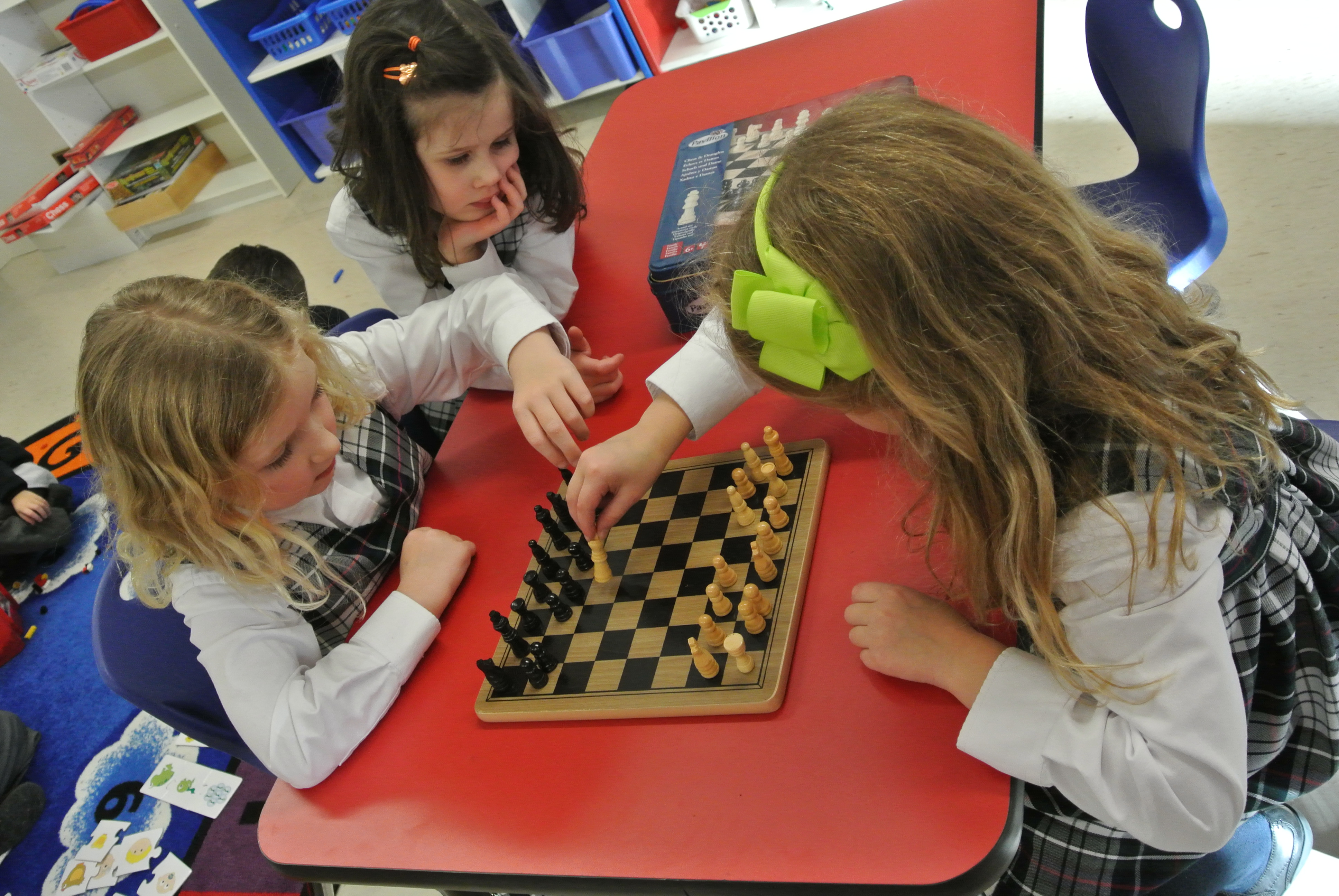
SK Chess at KCSWay back at the end of September, I tried to introduce chess to the SKs. I played up the thrilling warfare angle, created backstories to help explain the way the pieces moved, and generally did my best to sell the students on a complex and exciting game of strategy. One month later, the boards were gathering dust and the knights were being used as “guys” in LEGO castles.

But then a Grade 5 student came along. She had recently read a book called The Queen of Katwe, which chronicled the life of a poor rural Ugandan girl whose love of chess helped her pull herself out of poverty and set her on the path to becoming a world-class Grandmaster. Inspired by the story, she decided that her leadership project would be to teach chess to the little ones in Kindergarten. So she recruited a few friends, hunted down some extra boards, and started coming every Friday at lunch.

chess 3The first visit from the Grade 5s was at the start of January. And with only a few visits, these student leaders have inspired almost half the SK kids to pick up the game and give it a try. The class now cheers when they see “Chess Club” on the daily schedule, and pick-up games during free choice time have become a common sight.

For me, watching these Grade 5s succeed where I had failed has reminded me that the Official Teacher Voice of Authority just can’t compete with joyful enthusiasm from a fellow student. Peer teaching is a powerful tool, and I feel so fortunate to have ended up at a school where it emerges and grows in an organic and authentic way.

Mark Magee
SK Teacher