Pourquoi apprendre le français? / Why learn French?

« Why learn French? » If your child asked you this question tonight over dinner, what would your answer be? And how might your own experiences with learning the language influence that response?

The truth is there are many reasons to learn French, as our Grade 7 students recently discovered during a brainstorming session with graphic recorder, Disa Kauk. Their individual ideas contributed to the creation of two stunning visual reminders of ‘Pourquoi apprendre le français?’ and I encourage you to have a closer look at them the next time you are in the school.

In order for learning to endure in any subject area, we must see the value in what we are learning and understand our own reasons for learning it. This is especially important in the French as a Second Language classroom as most students only have a chance to practice their skills here at school. Students need to realize that French exists outside the walls of the classroom as well. With a curriculum now focused on authentic communication and real-life situations, this is truer than ever and families can play a vital role. Simply having a conversation with your child about the importance of learning French is a great starting point as it shows your child that French is valued outside of school. But you don’t have to stop there.

Parents often ask how else they can support their child’s French learning at home. Consider family movie nights in French by picking a DVD of a movie already familiar to your child in English and watching it together in French. Instead of watching the Leafs game in English, choose a station with French commentary. Point out French words on packages, in magazines, in stores and during your travels when you come across it. Visit a museum or gallery and take a tour in French. Listen to a French radio station. Take out French library books. You may even consider joining an organization like Canadian Parents for French which furthers bilingualism by promoting and creating opportunities for youth to learn and use French. Detailed information on exchange programmes, summer camps and many other unique language-learning opportunities is available on www.frenchstreet.ca. The possibilities are endless!

As a French teacher, I have seen a real difference in the classroom when students buy into their learning by taking opportunities outside of school to enjoy learning French. When they have more chances to practice their skills in the real world, they are more inclined to transfer that enthusiasm to the classroom and beyond.

Pourquoi apprendre le français? It’s never too early – or too late! – to start this conversation. When will you have yours?

img_9166

Everything a School Should Be (Part 1)

Let’s take a moment and think about everything a great school should be doing for students. There’s the curriculum – collectively many hundreds of pages of content and skills, wrapped up in subjects, that schools need to make sure all students learn. Then there’s tailoring the curriculum, because ensuring all students learn requires adjustments for each and every one. On top of that there’s enrichment programming, character education, learning skills, collaboration skills, critical and creative thinking, leadership and citizenship, appreciation of nature and the arts, and so much more. Schools need to engage minds, inspire physical health and activity, develop resilience, and nurture the artistic spirit. Direct instruction matters. Project-based learning matters. Clubs, teams, field trips, inspiring speakers, cross-grade integration activities, and spirit-raising events matter. Throughout the delivery of all of the above, a school needs to help students with the inevitable bumps – social, emotional, mental, academic, physical – that happen and directly interfere with everything else if not well addressed. And all of this, and more, needs to happen in an aligned, whole-system manner so it’s optimal both in how it’s experienced and in the difference it makes. Without a doubt, a great school must do many things exceptionally well.

Yet to follow the dialogue, one might think it’s otherwise.

We hear boasts of schools that are outstanding on singular measures, but left wondering how these feats are achieved without sacrifice in other areas of the school. We read that schools should focus improvement efforts on only a small number of areas at once, as if all other important things can wait, for years. We learn of exciting new programs that have great appeal, but represent just a tiny fraction of what’s needed for deep, longstanding impact. This is fine reading, but none are the story that students most need. None are the story we should want for our children.

At KCS, we’re transparent in our unrelenting commitment to being everything a school should be. Our Four Doors to Learning program in academics, arts, athletics and citizenship reflects years’ worth of creative, collaborative effort so that our story is the full story students need. Our faculty are constantly adding new professional learning so that this effort reflects the wisest judgment we can muster. And we’re constantly striving to improve in as many ways we can, and in all ways that matter.

KCS is committed to being everything a school should be. If there’s anything singular about where we strive to be outstanding, that’s it. We know that other schools strive for this as well, but it’s a story we don’t hear often enough. It makes for a long story, with many lengthy chapters. In a busy world and crowded social media space, it’s a story that takes time to tell and time to hear.

That’s okay. Children love long stories. So should we.

Part 2 of this post, to be published shortly, will share the story of how KCS is constantly striving to improve in its effort to be everything a school should be.

Four Doors Collage.jpg

Best Ever Teaching and Learning

“During my Driver’s Ed, I was so nervous the instructor had me drive to Tim’s. I learned how to go through the drive-through and ordered a jelly donut.”

“My grade 9 history teacher claimed he had many past lives and would tell the stories of those lives for the period we were studying. It ignited my passion for history.”

August may seem like a long time ago for many. As for me, one memory from August continues to warm my soul.

The last week of August, all faculty returned to school, joining the non-teaching staff who remained busy over the summer preparing for September. It’s a huge week of learning, meeting, and planning. This year, it was also the week that all faculty and non-teaching staff engaged in an exercise to define excellence in teaching and learning. It started with a partner activity to share our personal answers to the following:

  1. What is the best learning experience you’ve ever had at school?
  2. What is the best learning experience you’ve ever had outside of school?

Take a moment. What would your answers be? We all have them, and would do well to remember.

With these personal stories captured on post-it notes, larger groups assembled and identified the features of these experiences that made the cut. All features were then shared with all staff. Of the 39 different features, all staff then identified their top six. Collectively, here are some of the features that were most chosen by all staff:

  • “Out of our comfort zone”
  • Hands-on
  • Inspiring
  • Meaningful
  • Challenging
  • Involved responsible risks
  • Real-life experience
  • Collaborative
  • Fun, Humourous
  • Passion-driven
  • Creative
  • Empowering

There are many ways to learn, and while not all are exciting enough to be remembered as “best learning ever,” they all add up to making a difference. However, learning that is so special that it remains a powerful memory years later is learning that clearly matters. This exercise was a great kick-off to a new year meant to inspire unforgettable learning.

May the learning in your lives be full of what we aim to bring to your children.

The Numbers Have It

mathAs classrooms across Ontario echo with the sounds of excited students, the hot topic making waves in Ontario has been math scores. The news for many, unfortunately, has not been as sunny as our summer weather.

At Kingsway College School, our approach to math (and everything else) is proactive, based on proven practice, tailored to our students, and built through teamwork.  For example, in our first week of school, I observed a few of our grade 3 and 4 students completing a math placement activity with one of our specialist teachers, Mr. Graham Marshall.  Working in small groups, the students tackled a range of challenging questions.  Once evaluated, these assessment results will be used by both Mr. Marshall and his Primary and Junior colleagues to support differentiated instruction and a tailored curricular course for these students.

Math doesn’t come easily to some. And it comes very easily to others. A school’s job is to make sure all these students learn. KCS continuously strives to uncover the most effective strategies to support and if need be, accelerate students as they all navigate the ins and outs of the math curriculum.  Standardized test results make clear that we’re doing our job. Though fall will soon be here, we’re delighted that the KCS math story is the sunny one that all students deserve.

The Call to Be a Defining Force

Goodness, these are unusual times. Anyone following world news, regardless of political leanings, knows that remarkable things are happening. For years now, it’s been said that the future will be increasingly unpredictable; that global interdependence will be increasingly entrenched and often uncomfortable; and that the challenges we’ll all have to face will be increasingly complex. It’s looking like the future is here.

That’s why we all, increasingly, need to step in.

Eight years ago, KCS made its intentions clear. Our vision and mission statement, adopted then, captured our aspirations:

To be a defining force in developing lifelong learners
By stewarding a learning environment that inspires us to reach our ultimate potential.

This statement is rooted in our longstanding determination to do our best for our students. It’s equally rooted in something else, something that many of our families may not have thought much about, and something worth pointing out.

Teachers join the profession to do their best for students. All KCS staff share that dedication to the children and families we serve. Doing our best means we also need to help realize the potential in education as a whole. There is a tremendous effort that goes into the education of every child. And while there is much that is sound and good in the profession, there has always been significant room for growth. As the world becomes increasingly complex to navigate, the room for growth expands. KCS is not a school that simply strives to offer what other schools, even great schools, offer. We’re a school prepared to push the boundaries of the profession, in ways that are balanced, impactful, and progressive. KCS is a school prepared to wrestle with challenges, be patient when the time for change isn’t right, and to act when creative, valuable ideas are ready. We are willing and able to be a defining force in developing lifelong learners.

Over the past eight years (and more, to be honest), KCS faculty have introduced many new practices that, to our knowledge, were either unique or rare in the profession. The small-group instruction in our Super Skills and Workshop classes; our Wall of Service; our Habits of Mind, Body and Action; our Young Authors of KCS program; our multiple approaches to Student Leadership and service; Wake Up with the Arts; our use of design thinking for innovative learning and student-staff collaboration; and more came to be because our faculty wanted to go further. Pushed by pioneers in the field, remixing promising practice, and following the inspiration from others to create brand new solutions, we keep pressing forward.

Students have always deserved the best education. What’s best is changing and the need for growth is imperative. And it’s not about one school. Our vision statement “To be a defining force in developing lifelong learners” makes clear that it’s not about KCS being ‘the’ defining force. Frankly, such a limited vision would underserve students. Our wish is that all educators work together to make education the best it can be for now and for this increasingly unforeseeable future. We’ll keep doing our part. And we look forward to another year of learning and inspiration from all others who heed the call.

Things You Should Know if You Go: Using QFT in the Grade 7 “Amazing Race”

Question and be CuriousThe Amazing Race is an integrated project in grade 7 which combines learning in geography, math, Language Arts, French, and physical education. It has become part of a culminating assessment project at the end of our school year. Project based learning, a teaching technique that allows students to work through a big question, happens at many grade levels in our school. In this case, the intermediate teachers worked together to develop an inquiry about travel and what it teaches us. Students conduct research about a particular country, and helps to inform their work on this project in all subject areas. For example, the information that they learn in geography helps inform the scripts they write for their French plays. It culminates in a race around the school to solve challenges related to their learning. We used the Question Formulation Technique (QFT) to determine research questions.
The observations that struck me most about using the technique were:

  • Students came up with questions related to our learning this year in geography, and then some! There were more interesting conversations about what they could find out about the country than if I had assigned the questions.
  • Students really appreciate voice and choice at this age, and they felt that they could contribute their ideas without being judged; they also appreciated the ability to choose the questions that most appealed to them.
  • They were able to come up with thoughtful criteria for prioritizing the questions. I was impressed with their critical thinking at this stage.
  • They quickly learned to determine whether questions were open or closed, and tried ‘opening up’ some questions that they thought were worth exploring with more depth.
  • There was buy-in to the research that they were about to do. Since it was related to the Amazing Race, they knew that the research mattered. They were ready to jump right in and find answers to their questions.
  • Students were able to see subtopics emerge by grouping questions together.
  • There was very little ‘social loafing’. All students in the group were zoned in and came up with a long list of questions.
  • We noticed that some of the questions and subtopics related to the history themes we examined this year as well. The students noticed this before I did!

This was the first time I used QFT, but it won’t be the last. Thank you to The Right Question Institute for the guidance in a new technique that I needed to get my classes going. We’re now off and running in the Amazing Race.

Ms. Gaudet
Grade 7 Teacher and Citizenship Coordinator

A Wonderful (Reading) Thing

Kids dash across the playground to update Ms. Pollett-Boyle on their progress. Since I’m the lucky one to distribute certificates when students complete a level, I’m swarmed daily with messages of “I’m done Level 5!” or “I’m now travelling in Egypt!” or the rather direct “Where’s my certificate?” The first week after Christmas holidays I heard more about levels achieved over the break than about presents under the tree.

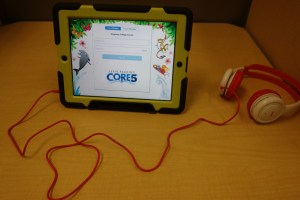
Lexia at KCSLast year we piloted a new online reading program called Lexia Core 5. It is offered as a supplement that students can use at school and at home, even on holiday if they so choose. It’s an adaptive program that helps develop core reading skills at the level and pace that’s individualized to be just right for every student. It includes re-teaching after mistakes, compelling graphics, and enticing little interludes, all designed to support, motivate, and optimize learning. The pilot was an evident success. One family was so impressed they generously offered to purchase a 3 year school-wide license. Each week, between 40 and 105 young students log on to accelerate their reading skills. — A heartfelt thank you to this family!
It’s wonderful to watch students learn. It’s not always adrenaline-fueled. The pace can be slow. On skills that are difficult, the school includes a fair amount of push and pull on the teachers’ part. So imagine the pleasure watching dozens of students driven to read (even learning the boring stuff like ‘dipthongs’ and other pesky vowel rules!).

Full disclosure, some runaway enthusiasm has led to excessive competition. That was a topic for a recent class meeting, and one more worthwhile lesson thanks to this powerful tool.

Lots of wonderful things happen at KCS and we’ve written about many of them already – the proof is in our blogs. Children swarming me with their achievement in reading? This certainly counts as one more.

Andrea Fanjoy,
Assistant Head, Academics
You can follow Andrea on Twitter @afanjoy.

Build Pride and Confidence in Reading and Watch Self-Esteem Soar

There’s a young student at school who I have worked with for a couple of years now. When I first met her, she was a bright-eyed, energetic child, with a wonderful imagination, who delighted in challenging me to games. When she was able to surprise me or beat me at a game, the laugh that rang out of her was pure joy.  She was an absolute delight – confident and happy.

But the next year, she was less enthusiastic, especially when it came time to read out loud. In fact, she would often have spontaneous aches, pains, or itchy bug bites that would prevent her from reading to me. I soon realised that she was no longer feeling confident about reading, and no amount of reassurance from me seemed to help for more than a few minutes.

DSC02354

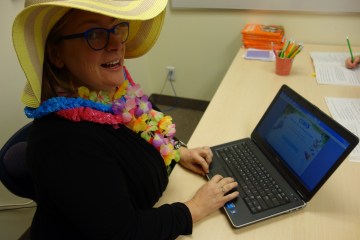
Ms. Pollett-Boyle working with Lexia. Her holiday outfit courtesy of KCS Spirit Day – Beach Day.

Mid-year, I introduced her to Lexia.

At first, she needed encouragement to use the program, and a little support to help her understand the instructions. But once she had a little taste of success, that started to change. Soon, she was regularly coming up to my desk to tell me about the 20-second humorous videos that tell the student they have met the target number of correct responses for that task.  (As we know, brain research shows that humour creates new neural pathways which help move new knowledge to long term memory.)

Passing a level in Lexia is the equivalent of a third of a grade level – or one term. Each level has scenes from a particular place, and the mini videos are connected to that location. Students travel the world as they progress. The day this student received her first visit from our Assistant Head, Academics, Mme Fanjoy, to congratulate her on moving up a level in Lexia, it was a real turning point in her motivation. It was an enormous achievement, and she knew it – and it also meant she was leaving London and going on to explore Paris!

Her new motivation to pass another level was evident. Each day she would stop me or Mme Fanjoy to tell us she had worked on Lexia the night before (a fact I already knew, because teachers can check on their students’ progress online). One day she came into class and told me she was having “Lexia dreams” at night, in which she passed 30 levels all at once.

Then, on one sunny spring day, I was out on yard duty for recess. I watched as this student ran full speed toward me, all the way from the entrance of the park, with a huge smile on her face. Of course I already knew what she was going to tell me (I had been rooting for her at home the night before, when I checked in to Lexia to see how she was doing), but nothing could have beat that look of pride and confidence that she had when she told me she had passed another level. Goodbye Paris – hello NEXT LEVEL CITY!

Teresa Pollett-Boyle
Learning Strategies Teacher, Drama teacher, Arts Coordinator

Redefining What’s Possible: Math Help Services

‘Redefining What’s Possible’ is a series of blogs that highlights stand-out tech tools being used at KCS.

The other day a student asked to use my office at lunch to work on math. By the end of lunch recess, I learned he used the time to do three different versions of his homework assignment, persisting until he got the full set of questions right.

MathHomework has a patchy record in this profession. It always has. One big glitch with it is when students have homework that they, unknowingly, don’t do correctly. This can happen to anyone when learning something new, and is particularly common in advanced math when the concepts to be practised are far removed from the rest of our lives. Traditional math homework has students carry on regardless (because it’s due and will be checked), with more than a few doing it incorrectly. In essence, these students practise doing it wrong. That’s right – despite best efforts, homework helps some become proficient in doing it incorrectly. Hopefully, mistakes will be picked up by both teacher and students the next day, whether in class or extra help. Hopefully, correct practice will then be fully established. The students will all ably move on to the next concept to be practised at home that evening. That is the ideal.

Unfortunately, the ideal can be elusive, and most of us know that for a fact. Multiple obstacles could be at work, and differ from student to student – the well-practised incorrect method; students not paying full attention during homework correction for any number of reasons; students not getting enough practice doing the work correctly; students not getting enough direct, immediate feedback, among others. A quantum leap in homework effectiveness would give students fast direct feedback on their homework, make reinstruction readily available whenever needed (24/7), and make it easy to redo homework, multiple times if necessary, until it’s done well.

That’s where one innovative technology is redefining what’s possible. Every student wants to learn and do well, but many traditional practices don’t readily support it for all. There are many reasons why the Math Help Services program in grades 7 and 8 is making a positive difference to student learning, but one significant reason is the difference with homework. Students find out immediately after completing a set of questions how they did. They learn right away in the privacy of their home (or my office) which questions were right and which were wrong. They have unlimited access to multimedia instruction and step-by-step examples to correct misunderstandings. And with the click of their mouse they can request and receive a new set of homework questions on the same topic. Trying a second or third time, homework marks invariably go up. The students learn the concept with however many questions they need, and are ready to go on.

There’s an additional benefit this technology provides that’s soundly rooted in brain research. Math Help Services lets the teacher create regular concept reviews with questions from all concepts previously taught. Research has clearly established the power of extended, mixed practice of learned concepts over intense, repetitive practice of just single concepts. The former leads to mastery, the latter leads to the all-too-common math affliction, “I don’t remember how to do it!” And like all other homework, the students can access as many versions of the concept review as they need to get the mark, and mastery, they seek.

Was the one student in my office an anomaly? No. The majority of our grade 7 and 8 students take advantage of doing homework assignments multiple times, as needed, forging through different question sets until they nail them.

That ideal isn’t elusive. It’s here and making sure math gets learned.

Andrea Fanjoy,
Assistant Head, Academics
You can follow Andrea on Twitter @afanjoy.

Redefining What’s Possible: TodaysMeet

‘Redefining What’s Possible’ is a series of blogs that highlights stand-out tech tools being used at KCS.

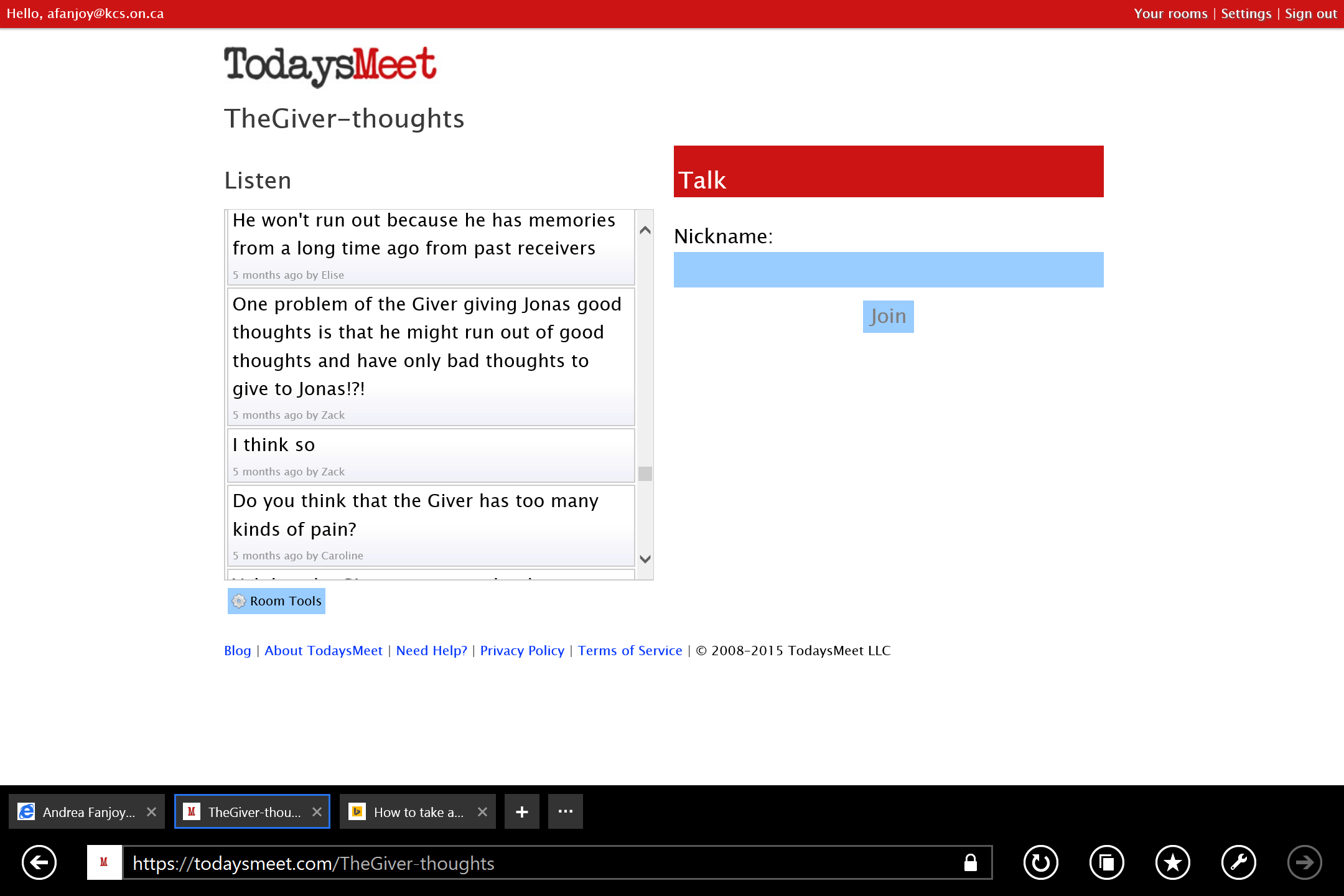
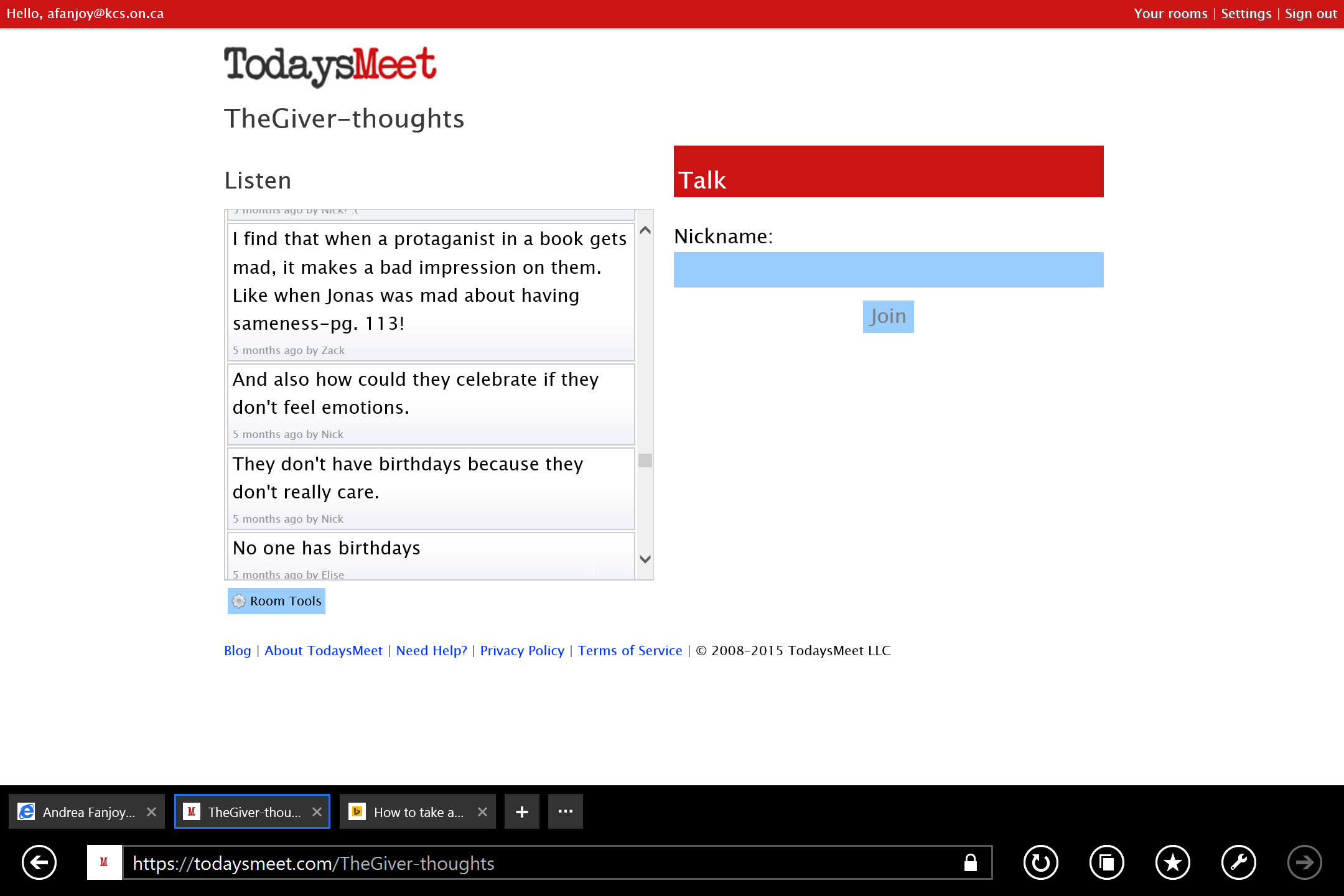
TodaysMeet - KCS student thoughts on The Giver. Most recent thoughts are displayed at the top.

TodaysMeet – KCS student thoughts on The Giver. Most recent thoughts are displayed at the top.

TodaysMeet - KCS student thoughts on The Giver. Most recent thoughts are displayed at the top.

TodaysMeet – KCS student thoughts on The Giver. Most recent thoughts are displayed at the top.

TodaysMeet - KCS student thoughts on The Giver. Most recent thoughts are displayed at the top.

TodaysMeet – KCS student thoughts on The Giver. Most recent thoughts are displayed at the top.

Ever wondered what students are thinking during class discussion? Maybe you’ve attended large meetings or conferences, and had things on your mind you wanted to contribute, but didn’t (and so has everyone else, by the way). Imagine if there were a way for everyone to share what’s on their mind in venues like these, easily and without affecting the progress of the discussion or taking up undue time. Imagine how much more everyone could take away from these occasions.

I’ve seen what my students are thinking, and what I’ve found may tempt you to give TodaysMeet try.

Here’s how it has worked in recent classes of mine. Earlier this year my reading group read Lois Lowry’s The Giver and opted to discuss the tension between ‘sameness’ and difference, both in the book and in the real world. While discussing and reflecting on this vast topic, the students went to our dedicated TodaysMeet site and posted brief messages, capturing salient points, questions, and insights. On TodaysMeet they’ve speculated and debated. They’ve shared related websites and responded to each other’s comments. Submitted posts are readily visible to all on the page, thereby provoking further thought and fuelling the class discussion and reflection. Our whole group has access to this long page of student dialogue for the rest of the year, and at any point I can print off a transcript with all that was shared. Limited to 140 characters, posts are succinct – a worthy skill to develop in itself. Intense listening while note-taking is another worthy skill being evidently developed. On top of all this, the collaborative collection was rich fodder for the writing assignment to come.

So what were these grade 6 students thinking about during our recent discussions? Quotes from Plato, and commentary on the protests in Hong Kong, the Crusades, the origins of communism, Amish society and the challenges that come with a society full of differences were among the many posts that had the group furiously engaged.

Schools are about learning. Any tool that increases learning belongs in schools. TodaysMeet exponentially increases learning by accessing a well of untapped thought and insight and engaging learners in a way that traditional discussion too often doesn’t.

Imagine what your students, colleagues or peers are thinking. Then find out.

Andrea Fanjoy,
Assistant Head, Academics
You can follow Andrea on Twitter @afanjoy.