
“I am learning how to deal with frustration, time management, and learning to work without pressure.”
“I am learning to be really creative, and to problem solve.”
“I have learned that being independent is more responsibility than I thought it would be.”
One student spent our last period launching and adjusting his prototype rocket on the school yard, to the delight of those watching from inside. Another retreated behind a tree, where the wind conditions were just right, to spray paint the sneakers that she was turning into roller skates. Writing books, assembling robots, creating works of art, and building a wind-powered, name-bearing wagon round out the array of projects underway in the new Go Ahead elective. These were the projects chosen by the students who selected this elective, and this is the responsible risk that Mrs. Drummond and I chose to take this year. While neither she nor I have experience in any of these things, we do have experience in learning from scratch. We vowed to figure it out.

About half of our students were ready to go before the elective even started. For the other half, dreaming hit reality. The student wishing to build a rocket had his heart set for three weeks on using chemicals that were too dangerous. Another student spent multiple weeks hoping to build a metal-framed, motor-powered go-kart, only to be disappointed at the cost and complication of it all. These students had taken the biggest leaps, and had the farthest to fall to reach a project they could make. Did they regret their choice of elective? Were they wasting their time? We didn’t think so, but it’s what they think that matters. So we asked.
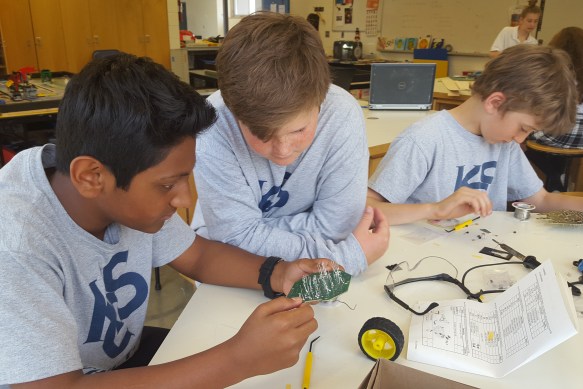
We started the reflection by stating the obvious – school is about learning. Then we asked what they usually learn (as they should) in their regular classes. The essentials, foundational knowledge and skills, learning skills, subjects you need for the future, and new things you otherwise wouldn’t choose to learn were among their responses. Then we admitted that they likely weren’t learning many of those things in our elective. So what did they think they were learning? Hands shot up. Here’s what they shared:
- Trying to figure out a problem on your own
- Wide-open creativity
- Learning to deal with choice and freedom
- Experience with personalised learning
- Learning to work without pressure (this is my favourite)
- Learning to deal with frustration
- Time management
- Independent work
- Doing everything yourself
They also shared that it’s exciting and interesting. Choice and freedom made the frustration worthwhile. Because the projects are entirely their own, the lessons learned, however difficult, are theirs to own as well.

There is a lot else they’re learning. They’re learning to ask for help. They are learning to find what they need. Some are learning to figure out exceptionally complicated diagrams; some are learning about character development in writing fiction; one is learning woodworking and two are learning to solder resistors onto printed circuit boards. They’re all learning to turn ideas into reality, and they’re learning that this includes the sometimes tedious effort of figuring out the details and communicating them clearly and convincingly to others (especially if THIS other needs to go buy resources).
There’s a lot that students should learn at school, and certainly much of that must cover the essentials. But developing students to be lifelong learners requires more. At times, it can be frustrating. It’s also deeply exciting and interesting for all involved. You just need to go ahead and figure it out.
“Sometimes you have to just believe in yourself and go for it. For example, I didn’t think this project would work out at first, but it’s going very well.”
*All quotes are from grade 6 students in the Go Ahead elective.
Andrea Fanjoy,
Assistant Head, Academics
You can follow Andrea on Twitter @afanjoy.
 The Amazing Race is an integrated project in grade 7 which combines learning in geography, math, Language Arts, French, and physical education. It has become part of a culminating assessment project at the end of our school year. Project based learning, a teaching technique that allows students to work through a big question, happens at many grade levels in our school. In this case, the intermediate teachers worked together to develop an inquiry about travel and what it teaches us. Students conduct research about a particular country, and helps to inform their work on this project in all subject areas. For example, the information that they learn in geography helps inform the scripts they write for their French plays. It culminates in a race around the school to solve challenges related to their learning. We used the
  kcsmatters.blog